
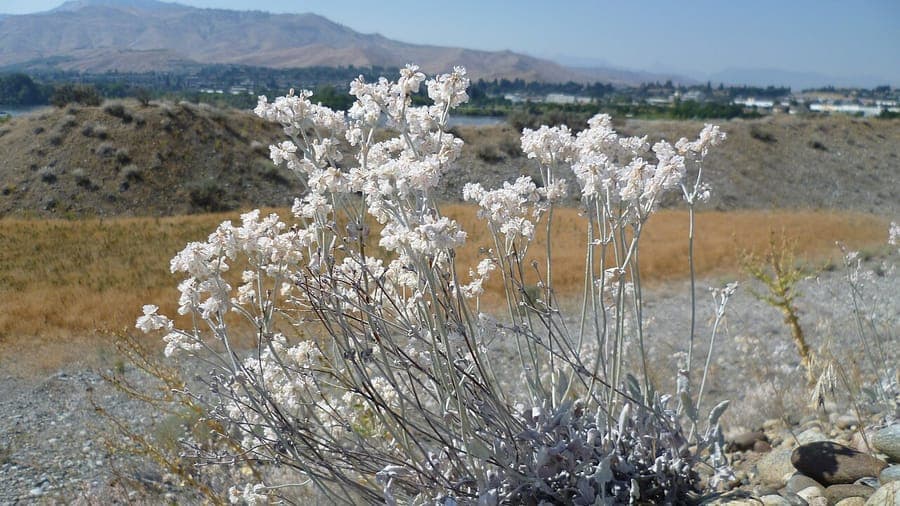
Thayne Tuason / CC BY-SA 4.0, via Wikimedia Commons
Snow buckwheat: complete guide
Eriogonum niveum
Want to see Snow buckwheat: complete guide in your garden?
1 minute, no credit card
Overview
Eriogonum niveum, commonly called snow buckwheat, is a low-growing subshrub in the family Polygonaceae, native to the dry hillsides and steppe landscapes of the Pacific Northwest. Its natural range covers British Columbia, Idaho, Oregon, and Washington, where it colonises rocky slopes, open grasslands, and canyon rims at elevations from 100 to over 1,500 metres. The species name niveum comes from the Latin word for snow, a direct reference to the striking white woolly coating that covers its leaves and stems.
In European gardens, snow buckwheat remains a specialist's plant, but it is gaining ground wherever xeriscape gardening and low-water planting are priorities. It thrives alongside Artemisia species, Penstemon, and Festuca grasses on lean, well-drained soils. In the right setting - a gravel border, a rock garden, a dry Mediterranean-style planting - it is outstanding.
Eriogonum niveum forms a slowly spreading, colonising subshrub reaching 20 to 45 cm tall and 30 to 60 cm wide. It is long-lived, reliably perennial, and blooms every summer. The plant spreads gradually without becoming invasive, filling gaps in a border with quiet determination. Explore how drought-tolerant perennials look in garden designs at gardenworld.app, where visualisation tools help you plan your planting before you buy a single plant.
Appearance & bloom cycle
The leaves of Eriogonum niveum are oblong to oval, 2 to 5 cm long, and have a distinctive grey-white to silvery appearance due to the dense woolly hairs on the underside. The upper leaf surface is slightly darker green and also somewhat hairy. This contrast gives the plant decorative value throughout the growing season, even outside its flowering period. In autumn, the foliage sometimes takes on bronze or reddish tones that extend its seasonal interest.
The flowering season runs from July through September, occasionally extending into October in mild climates. Flower stems rise 30 to 50 cm above the foliage and carry loose, umbel-like clusters of tiny white to cream flowers. Individual flowers are small - barely 3 mm across - but the tight clusters are highly visible and attract large numbers of pollinators: bees, butterflies, and hoverflies in particular. After flowering, small triangular seeds form that birds readily consume. The cultivar 'Snowy' has been selected for especially abundant flowering and a compact form of just 25 cm.
Within the genus, Eriogonum strictum and Eriogonum umbellatum are closely related species, but snow buckwheat distinguishes itself through its more pronounced white-woolly appearance and greater tolerance for the cooler, slightly moister conditions found in the Pacific Northwest compared to the more arid intermountain regions favoured by its relatives.
Ideal location
Snow buckwheat performs best in a sunny, warm position receiving at least six hours of direct sun daily. It tolerates light afternoon shade but flowering is noticeably reduced and growth becomes looser with insufficient light. A south-facing or south-west-facing aspect is ideal - a sunny border along a wall or a sloped rock garden.
The plant is outstanding in rock gardens and dry stone walls, where roots can reach into crevices and drainage is optimal. Paired with a gravel or lava mulch, Eriogonum niveum excels because the mulch limits soil moisture and keeps the root crown dry. Avoid positions with standing water or dense overhead shade.
In urban settings and on extensive green roofs, this species proves its worth in conditions of heat and drought that would defeat most perennials. Spacing when planted in groups: 40 to 60 cm between plants. For full ground coverage, plant five to seven specimens per square metre.
Soil requirements
Eriogonum niveum is undemanding in terms of soil fertility but absolutely requires excellent drainage. In its native habitat it grows on poor, rocky to sandy soils and performs poorly on heavy clay or richly amended garden soil that retains moisture. The ideal pH range is 6.5 to 8.0, so the plant tolerates slightly acidic to moderately alkaline conditions.
When planting into heavy or poorly draining soil, thorough soil improvement is essential. Mix the existing soil with at least 30 to 40 percent coarse grit, perlite, or fine gravel to improve drainage. Add little or no compost: overly fertile soil encourages excessive leafy growth at the expense of flowering and weakens winter hardiness over time.
In rock gardens, plant Eriogonum niveum into pockets or crevices filled with a lean mix of crushed stone and sand in a 2:1 ratio. A mulch layer of 3 to 5 cm of pea gravel around the plant suppresses weeds, keeps the root zone cool, and reduces excessive evaporation. Avoid organic mulches such as bark or compost directly around the base of the plant as these retain moisture and can cause crown rot.
Watering
Once established, Eriogonum niveum is among the most drought-tolerant perennials you can grow in a European garden. In its native range it survives summers with less than 200 mm of rainfall and no supplemental irrigation. In garden conditions some supplemental watering is helpful, but it must be minimal.
During the first growing season after planting, water moderately to encourage rooting: once per week in dry summer conditions, but never so much that the soil stays moist for more than two to three days. Water early in the morning and allow foliage to dry quickly. Drip irrigation is the ideal delivery method for Eriogonum: water is delivered directly to the roots without wetting the foliage, reducing the risk of fungal problems.
From the second year onwards, supplemental watering is rarely needed except during extended dry spells of more than three weeks. Do not water in autumn and winter. Excessive moisture during winter months is the most common cause of plant death for Eriogonum niveum in European gardens. The plant is far more likely to be killed by wet feet than by cold temperatures.
Free design
Want to see Snow buckwheat: complete guide in your garden? Make a free design now.
Pruning
Eriogonum niveum needs little pruning. The best approach is restraint: only cut back what is genuinely necessary. Leave spent flower stems standing through autumn and into winter - they provide seeds for birds, protection for the root crown, and a pleasing structural silhouette in the winter garden.
In early spring, around mid-March, you can cut back dead stems and old flower stalks to approximately 5 cm above ground level. After cutting back, check for new green shoots emerging at the base, as plants may be slow to show new growth after cold winters. Never cut hard into old wood: Eriogonum regenerates slowly from very hard pruning and may not recover.
If the plant becomes loose or sprawling after several years, a light trim in spring promotes compactness. Remove any dead or damaged wood promptly. A light renovation every two to three years keeps the plant vigorous and flowering well. Remove seed heads after seed dispersal if you want to limit self-seeding.
Maintenance calendar
January and February: The plant is dormant. No intervention required. Ensure drainage remains functional and check that no water pools around the base after heavy rainfall.
March: Remove dead stems and old flower stalks. Cut back to approximately 5 cm above ground. Check for emerging green growth at the base.
April: Apply fresh gravel mulch if needed. An optional light top-dressing with a slow-release, low-nitrogen fertiliser (high in potassium) can improve flowering without over-stimulating leafy growth.
May and June: Growth accelerates. Water weekly in dry springs. Keep on top of any weed growth in the surrounding gravel mulch.
July, August, and September: Peak flowering season. Minimal watering needed. Remove only damaged or dead stems if visible.
October and November: Flowering ends. Leave flower stems standing for winter. Add a thin layer of gravel mulch around the crown if winter wet is a concern.
December: No further action. Full dormancy.
Winter hardiness
Eriogonum niveum is rated hardy to USDA zone 5, corresponding to minimum temperatures of approximately -29 °C. In practice, plants in the Netherlands, Belgium, and the UK survive average winters without difficulty. During severe winters with prolonged frost, the combination of dry overwintering conditions and excellent drainage is essential to prevent damage.
The greatest threat to winter survival is not cold but winter wetness: waterlogged soils during frost lead to root suffocation and crown rot. A position with outstanding drainage and some shelter from persistent westerly winds significantly reduces this risk. In zone 5 conditions, a light protective layer of coarse gravel or crushed stone around the base is helpful, but thick insulating mulch is counterproductive as it retains moisture.
In containers, Eriogonum niveum overwinters best when the pot is moved to a sheltered, dry position - against a wall or in an unheated cold frame or greenhouse. Prevent the root ball from freezing solid by placing containers against the ground or wrapping lightly in hessian.
Companion plants
Eriogonum niveum combines excellently with other drought-tolerant plants that share its site requirements. In a rock border or gravel garden, the following species make good partners:
- Penstemon pinifolius: Narrow pine-like leaves, bright red flowers June to August, 30 to 40 cm tall. Together with Eriogonum this creates a striking colour combination.
- Artemisia 'Powis Castle': Silver-grey fine-textured sub-shrub, 60 to 80 cm, that echoes and amplifies the silvery foliage of Eriogonum.
- Lavandula angustifolia 'Hidcote': Lavender 30 to 40 cm with deep blue spikes, same preference for chalky, dry conditions.
- Sedum 'Herbstfreude' (also sold as Hylotelephium): 50 to 60 cm, blooms September to October, extending the season after Eriogonum.
- Festuca glauca 'Elijah Blue': Blue-grey ornamental grass, 20 to 30 cm, providing textural contrast.
- Salvia nemorosa 'Caradonna': Deep purple spikes, 50 to 60 cm, that contrast beautifully with the white Eriogonum flowers.
Avoid pairing snow buckwheat with moisture-loving plants such as Hosta, Astilbe, or Ligularia, as these require a completely different watering regime. Visit gardenworld.app to explore garden design options that incorporate drought-tolerant planting schemes and to visualise how plants like snow buckwheat will look in your own outdoor space.
Closing
Eriogonum niveum is a remarkable, underappreciated plant for the thoughtful gardener seeking drought-tolerant beauty. Its silvery-white woolly foliage, its delicate white flower clusters, and its impeccable garden behaviour deliver three seasons of structural interest and bloom. It asks for little water, little nutrition, and little attention, yet gives back generously in terms of wildlife value and quiet elegance.
Whether you are planting a gravel garden, a mixed shrub border, or a rock feature, snow buckwheat deserves a prominent place in any dry garden. Start your garden design today at gardenworld.app and see how this exceptional plant fits into your specific outdoor setting.
Want to see Snow buckwheat: complete guide in your garden? Make a free design now.
Upload a photo, pick a style, and get a photorealistic design with plant list in under a minute.
10,000+ gardens designed already
No credit card required


Similar plants
Crosby's wild buckwheat: complete guide
Eriogonum crosbyae
Full guide to growing Eriogonum crosbyae: ideal site, soil, watering, winter hardiness and companion plants for this rare western wild buckwheat.
Spreading buckwheat: complete guide
Eriogonum effusum
Full guide to growing Eriogonum effusum: ideal site, soil, watering, winter hardiness and companion plants for this prairie subshrub from the American West.
Tall woolly buckwheat: complete guide
Eriogonum elatum
Full guide to Eriogonum elatum: siting, soil, watering, pruning and companion plants for this elegant white-flowered buckwheat from the western United States.