
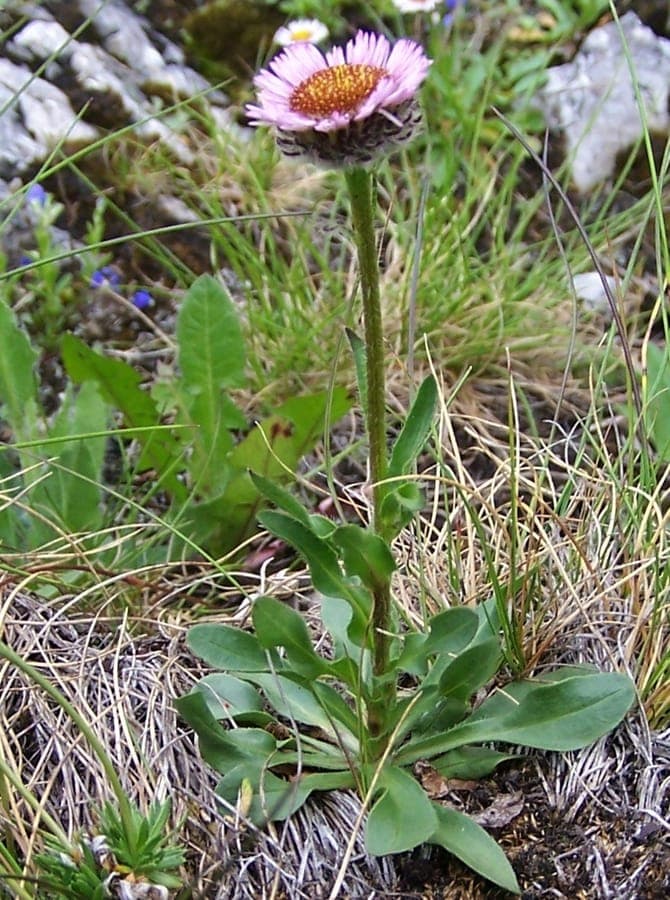
Jerzy Opioła / CC BY-SA 3.0, via Wikimedia Commons
Oneflower fleabane: complete guide
Erigeron uniflorus
Want to see Oneflower fleabane: complete guide in your garden?
1 minute, no credit card
Overview
Oneflower fleabane (Erigeron uniflorus) is a resilient, low-growing herb that thrives in harsh, dry conditions. Native to mountainous regions across Central and Southern Europe - including Austria, Greece, and Bulgaria - as well as parts of China and Finland, this forb is built for survival. While not commonly found in wild UK or North American landscapes, it adapts beautifully to garden settings when given the right conditions. It's a biennial or short-lived perennial, forming compact rosettes and sending up solitary daisy-like blooms in summer. If you're into low-effort, high-character plants, this one deserves a spot in your gravel patch or alpine trough.
Gardeners using gardenworld.app can design a custom layout that highlights drought-resistant species like oneflower fleabane alongside complementary textures and heights.
Appearance & bloom cycle
This plant reaches just 10–20 cm in height, spreading up to 15 cm wide. It grows in a low, mat-forming habit with narrow, slightly hairy leaves that help reduce moisture loss. The bloom period runs from July to August, producing single flower heads per stem - true to its name. Each bloom is 2–3 cm across, with white to pale purple rays and a bright yellow center that gradually fades. The flowers resemble miniature daisies and attract hoverflies, bees, and small butterflies.
After blooming, seed heads form with fine, wind-dispersed pappus, allowing for occasional self-seeding in suitable cracks and crevices. While not invasive, it may pop up nearby if conditions are right. Deadheading can limit spread if desired.
Ideal location
Oneflower fleabane demands full sun - aim for a 9 out of 10 on the light scale. It performs best in south- or west-facing rock gardens, walls, or raised beds where sunlight is intense and drainage is rapid. Avoid shaded or damp spots, which lead to weak, leggy growth and fungal issues. It's ideal for green roofs, alpine troughs, or gravel borders in small urban gardens.
Use gardenworld.app to map out your sun exposure and plan where to place this sun-hungry plant for maximum impact.
Soil requirements
The soil must be sharply drained. A gritty mix of sand, fine gravel, and a small portion of compost works best. Avoid clay-heavy or water-retentive soils. The ideal pH is neutral to slightly acidic - 6.5 to 7.0. In containers, use a cactus or alpine compost blend available at garden centres like those stocking ericaceous mixes.
This plant thrives in poor, lean soils. Rich compost or heavy fertilization promotes leafy growth at the expense of flowers.
Free design
Want to see Oneflower fleabane: complete guide in your garden? Make a free design now.
Watering
Once established, oneflower fleabane is highly drought-tolerant. Water only during prolonged dry spells, especially in the first growing season. Provide a deep soak once a week at most, allowing the soil to dry completely between sessions. Overwatering is a common mistake - it leads to root rot and reduced vigor.
Rainwater is preferred, as tap water can increase soil alkalinity over time.
Pruning
Pruning isn't essential, but you can trim back spent flower stems to maintain a tidy appearance and prevent self-seeding if needed. Use clean, sharp snips and avoid cutting into the basal rosette. If the plant looks straggly after blooming, a light trim encourages denser growth.
In formal designs, a light shear with hand shears keeps the plant compact.
Maintenance calendar
- Jan–Feb: Dormant. No action needed.
- Mar–Apr: Remove old foliage if present. Check for emerging rosettes.
- May: Plant out or sow seeds after frost risk has passed (week 18+).
- Jun: Monitor moisture during dry spells.
- Jul–Aug: Peak bloom. Observe pollinators.
- Sep: Decide whether to leave seed heads for wildlife or remove for control.
- Oct–Dec: No care required. Plant may overwinter as a biennial.
Winter hardiness
Oneflower fleabane is hardy to USDA zone 5 (-29°C). In the UK and most of temperate Europe, it survives winter without protection, especially when grown in well-drained conditions. Avoid mulching heavily - excess moisture trapped around the crown encourages rot.
In wet winters, ensure planting is on a slope or in raised beds to improve drainage.
Companion plants
Pair oneflower fleabane with other sun-loving, drought-resistant perennials:
- Sedum rupestre (Reflexed stonecrop)
- Thymus praecox (Creeping thyme)
- Arabis caucasica (Rock cress)
- Nepeta faassenii (Catmint)
These combinations work well in rockeries or dry borders. They offer varied textures and extend seasonal interest. Avoid aggressive spreaders like mint or bindweed that could overwhelm this modest grower.
Closing
Oneflower fleabane might not grab attention from across the garden, but up close, it's a gem. It asks for little and gives back in charm - delicate blooms, pollinator appeal, and rugged resilience. Perfect for gardeners who value function and form. Give it sun, grit, and space, and it'll hold its own. Explore plant pairings and garden mockups on gardenworld.app to see how this unassuming herb fits into your next dry garden design.
Want to see Oneflower fleabane: complete guide in your garden? Make a free design now.
Upload a photo, pick a style, and get a photorealistic design with plant list in under a minute.
No credit card required


Similar plants
Calendula stellata: complete guide
Calendula stellata
Complete guide to Calendula stellata, the star-flowered marigold from Sicily: location, soil, watering and companion planting tips.
Korean chrysanthemum: complete guide
Chrysanthemum x rubellum
Chrysanthemum x rubellum is a hardy autumn perennial with single pink to copper flowers from August to November. Care and combinations.
Helianthus divaricatus: complete guide
Helianthus divaricatus
Helianthus divaricatus is a North American woodland sunflower with yellow summer blooms, ideal for naturalistic borders and shady edges.