
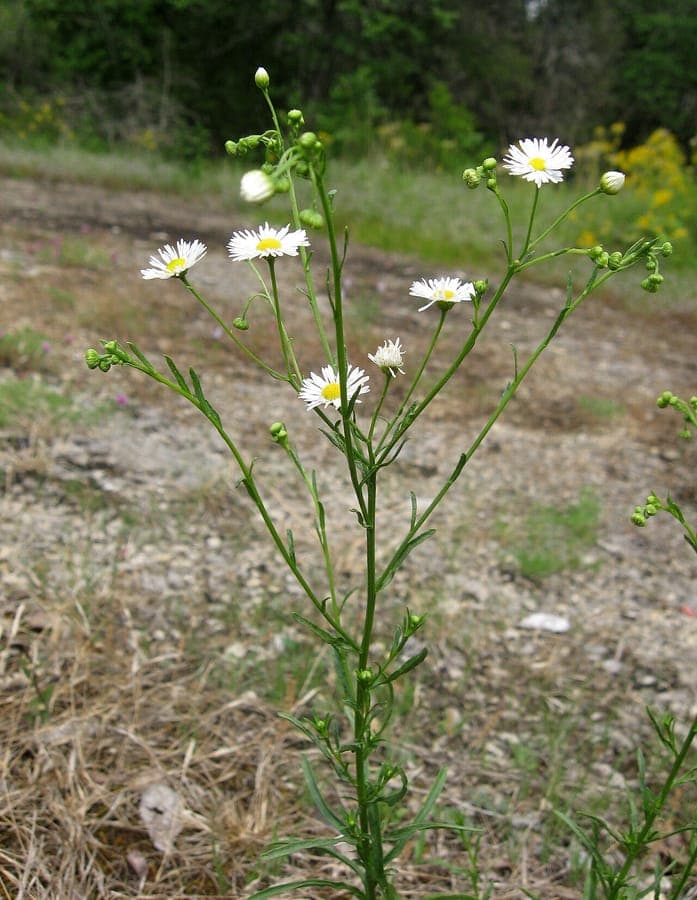
Mason Brock (Masebrock) / Public domain, via Wikimedia Commons
Daisy fleabane: complete guide
Erigeron strigosus
Want to see Daisy fleabane: complete guide in your garden?
1 minute, no credit card
Overview
Daisy fleabane, scientifically known as Erigeron strigosus, is a North American wildflower growing from Canada through USA. This plant is also known as "rough fleabane" and "prairie fleabane" and belongs to the Asteraceae family (daisy family). The plant has spread beyond North America and now grows in many parts of Europe as well.
This is an extremely adaptable plant that grows in many different locations: grasslands, roadsides, rocky areas, and disturbed sites. Its resilient nature and attractive flowers make it an excellent choice for natural gardens, wildflower garden designs, and easy-maintenance landscapes.
Appearance and Bloom
Daisy fleabane grows as an erect annual to biennial plant, usually between 30-80 centimeters tall. The stems are thin, rough hairy (from which the scientific name "strigosus" - rough - comes). The leaves are linear to lanceolate, greener at the base and mostly without teeth.
Flowers appear from June through September and are very numerous. Each flower is small, approximately 1-1.5 centimeters in diameter, with numerous white to lilac ray florets and a yellow center. The flowers form in a loose panicle, resulting in an airy, light appearance that is very appealing.
Following flowering, seeds form that disperse easily by wind, resulting in numerous self-seedings in the following year.
Ideal Location
Daisy fleabane grows best in full sun, though it tolerates partial shade. At least 5-6 hours of direct sunlight daily is ideal for optimal growth and bloom. The plant is highly tolerant of many different positions and can even thrive in suboptimal locations.
Soil
This is a very adaptive plant regarding soil type. It grows in well-drained to moderately moist soils, both acidic and basic types. Heavy clay soils are less ideal, but the plant will still grow. Standard garden compost or slightly richer substrate is sufficient.
Free design
Want to see Daisy fleabane: complete guide in your garden? Make a free design now.
Watering
Once established, Erigeron strigosus is very drought-tolerant. Its deep root system allows it to endure prolonged dry periods. Regular watering during the initial growth period helps establishment, but established plants require minimal supplemental irrigation.
Pruning
Minimal pruning is required. If you wish to keep the appearance neat, spent flowers can be removed to encourage continued bloom. For next year's self-seedings, allow some plants to ripen and spread seed.
Maintenance Calendar
Spring (March-May): Plant seed after last frost. Water well until establishment.
Summer (June-August): Enjoy extended bloom. Deadhead for more flowers or allow seed to ripen.
Autumn (September-October): Seed ripens and disperses widely.
Winter (November-February): Annual plants die off after seed production. Biennial plants may overwinter.
Winter Hardiness
Erigeron strigosus is not hardy in the traditional sense because it usually grows as an annual or biennial. In favorable climates it can overwinter as a biennial and regrow in spring.
Companion Plantings
Daisy fleabane works beautifully in wildflower garden designs with:
- Coneflowers (Echinacea) - Similar growth habits
- Black-eyed Susan (Rudbeckia) - Similar appearance
- Liatris species - Vertical interest
- Gaillardia - Warm colors
- Wild grass types - Add structure
Closing Thoughts
Daisy fleabane is a perfect example of a North American wildflower thriving in gardens. This is a plant for those wanting easy, reliable blooms without much maintenance. The numerous small flowers attract huge numbers of pollinators and other beneficial insects.
Visitors to gardenworld.app can learn how to create wildflower gardens with native and adapted plants that flower and attract bees throughout the season.
Visitors to gardenworld.app receive advice on cultivating flowering landscapes that benefit pollinators.
Want to see Daisy fleabane: complete guide in your garden? Make a free design now.
Upload a photo, pick a style, and get a photorealistic design with plant list in under a minute.
10,000+ gardens designed already
No credit card required


Similar plants
Calendula stellata: complete guide
Calendula stellata
Complete guide to Calendula stellata, the star-flowered marigold from Sicily: location, soil, watering and companion planting tips.
Korean chrysanthemum: complete guide
Chrysanthemum x rubellum
Chrysanthemum x rubellum is a hardy autumn perennial with single pink to copper flowers from August to November. Care and combinations.
Helianthus divaricatus: complete guide
Helianthus divaricatus
Helianthus divaricatus is a North American woodland sunflower with yellow summer blooms, ideal for naturalistic borders and shady edges.