
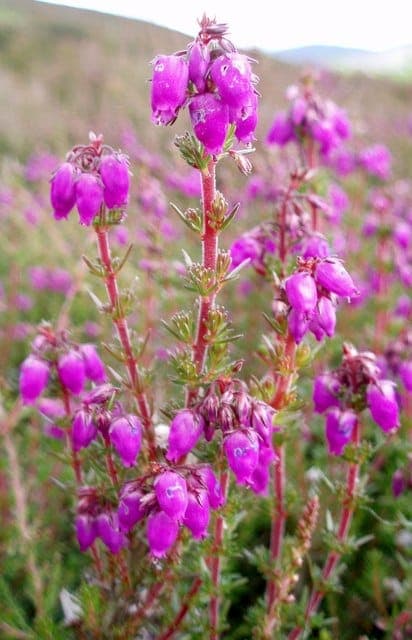
Gwen and James Anderson / CC BY-SA 2.0, via Wikimedia Commons
Gray heath: complete guide
Erica cinerea
Want to see Gray heath: complete guide in your garden?
1 minute, no credit card
Overview
Erica cinerea, commonly known as Gray heath, is a resilient subshrub native to heathlands across Western and Northern Europe, including Great Britain, Ireland, and parts of Scandinavia. It thrives in acidic, low-nutrient soils and is an excellent choice for gardeners dealing with dry, sandy conditions. On gardenworld.app, you can create a garden layout that integrates Gray heath seamlessly into heathland or gravel garden designs.
This plant typically reaches 20–30 cm in height, with a spread of 30–40 cm. It forms dense, cushion-like mounds and maintains a neat, evergreen habit year-round. Gray heath prefers full sun to light shade (light level 7), making it perfect for exposed, well-ventilated sites. It's especially effective in rock gardens, low borders, or as ground cover in naturalistic plantings.
Appearance & bloom cycle
Erica cinerea blooms from June through October, peaking in July and August. The flowers are a rich purple, bell-shaped, and arranged in dense terminal clusters along the stems. Each bloom is about 8–10 mm long and provides a long-lasting display that attracts bees, bumblebees, and hoverflies.
The foliage is narrow, needle-like, and dark green to grey-green, measuring 3–5 mm in length. It's held in tight whorls around the stems, creating a fine-textured appearance. Older stems become slightly woody and may develop a light brown, flaky bark, but remain covered by fresh growth. The plant retains its foliage through winter, adding structure and interest to the dormant garden.
Ideal location
Plant Gray heath in full sun to partial shade. Aim for at least 5–6 hours of direct sunlight daily. Avoid heavily shaded areas, as this leads to leggy growth and reduced flowering. It performs best in south- or southeast-facing slopes with good air movement.
It's unsuitable for heavy shade, waterlogged soils, or areas with poor circulation. Ideal for UK gardens on sandy or gravelly soils. If your garden has clay, consider raised beds with a mix of ericaceous compost, sharp sand, and pine bark (70% compost, 20% sand, 10% bark).
Soil requirements
Erica cinerea requires acidic soil with a pH between 4.0 and 4.5. Never use lime, alkaline compost, or chalky soil. The soil must be well-drained – avoid compaction and waterlogging at all costs. Sandy loam with a thin layer of organic matter is ideal.
Test your soil pH annually using a reliable kit. A pH above 5.0 will cause chlorosis (yellowing leaves) and stunted growth. Use only ericaceous fertilisers if needed, and never apply manure or general-purpose feeds.
Free design
Want to see Gray heath: complete guide in your garden? Make a free design now.
Watering
Water only during prolonged dry spells, especially in the first two growing seasons. Once established, Gray heath is highly drought-tolerant. Water early in the morning or late in the evening, applying moisture directly to the root zone. Avoid wetting the foliage to reduce fungal risks.
Use rainwater whenever possible – tap water is often too alkaline. In winter, no supplemental watering is needed. The plant goes semi-dormant and withstands cold, wet conditions as long as the soil drains well.
Pruning
Prune lightly after flowering, between late September and late November. Cut back no more than one-third of the current season's growth. Use clean, sharp secateurs to prevent disease. Pruning encourages bushier growth and prevents the base from becoming bare and woody.
Remove dead or damaged stems as they appear. Avoid hard pruning into old wood, as it rarely regenerates. Never prune in late winter or early spring when new shoots are vulnerable to frost.
Maintenance calendar
- Jan: Check for frost damage. Avoid walking on wet soil.
- Feb: No action required.
- Mar: Test soil pH. No feeding.
- Apr: Monitor for new growth. Water only if extremely dry.
- May: Prepare for bloom. Avoid pruning.
- Jun: Bloom begins. Do not fertilise.
- Jul: Peak flowering. Watch for drought stress.
- Aug: Flowers continue. Hand-weed around plants.
- Sep: Begin light pruning after bloom.
- Oct: Finish pruning. Remove spent flower heads.
- Nov: Ensure good airflow. No mulching with lime.
- Dec: Winter check. No protection needed.
Winter hardiness
Erica cinerea is hardy in USDA zones 6–8. In the UK (zone 8), it tolerates temperatures down to -15°C without issue. No winter protection is required, even in harsh conditions. However, good drainage is critical – wet, cold roots lead to rot. Avoid mulches containing lime, such as crushed shells or bonemeal.
Companion plants
Pair Gray heath with other acid-loving plants: Calluna vulgaris, Rhododendron 'PJM', Pernettya mucronata, Molinia caerulea, and Deschampsia cespitosa. Dwarf conifers like Chamaecyparis pisifera 'Boulevard' add contrast. Avoid plants that prefer neutral or alkaline soils, such as lavender or roses.
In the wild, it grows alongside heather grass and mosses – a look you can replicate in a naturalistic design. On gardenworld.app, you can visualise these combinations before planting.
Closing
Erica cinerea is an underrated gem for low-maintenance, pollinator-friendly gardens. With minimal care, it delivers months of vibrant blooms and evergreen structure. Plant in groups of 3–5 for impact. Available at garden centres across the UK, especially those specialising in heathers. For a custom design featuring Gray heath, visit gardenworld.app.
Want to see Gray heath: complete guide in your garden? Make a free design now.
Upload a photo, pick a style, and get a photorealistic design with plant list in under a minute.
10,000+ gardens designed already
No credit card required


Similar plants
Zenobia pulverulenta: complete guide
Zenobia pulverulenta
Everything about Zenobia pulverulenta (honeycup): siting, acid soil, pruning and the fragrant white bells, in this complete care guide.
Dwarf huckleberry: complete guide
Gaylussacia dumosa
Everything about dwarf huckleberry (Gaylussacia dumosa): acidic soil, partial shade, pruning and care for this compact North American berry shrub.
Drooping leucothoe: complete guide
Leucothoe fontanesiana
Everything about drooping leucothoe (Leucothoe fontanesiana): shade tolerance, soil, watering, pruning, hardiness and companion plants.