
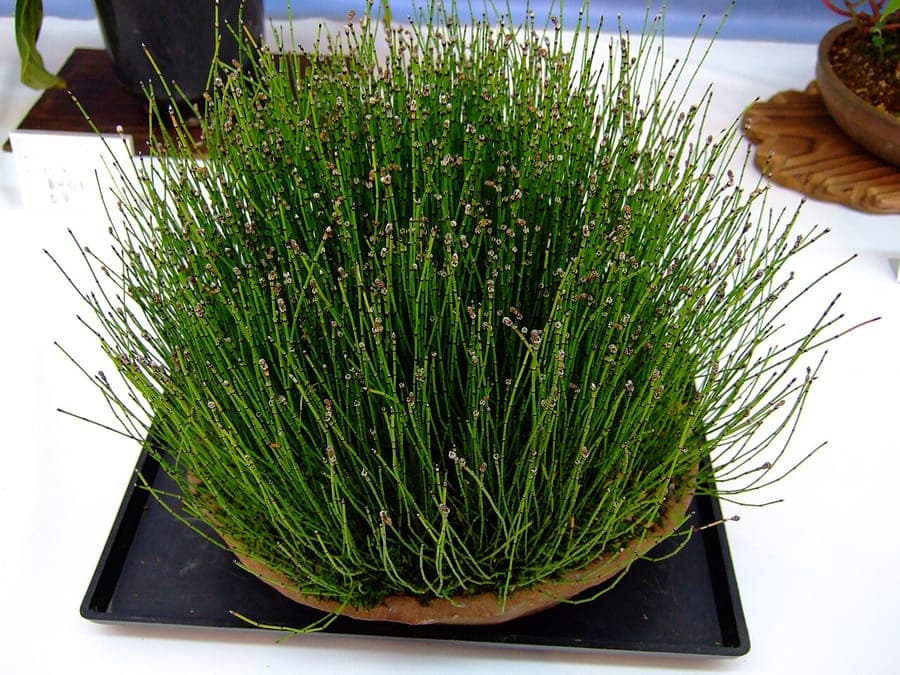
日:Jnn / CC BY 2.1 jp, via Wikimedia Commons
Variegated horsetail: complete guide
Equisetum variegatum
Want to see Variegated horsetail: complete guide in your garden?
1 minute, no credit card
Overview
Variegated horsetail (Equisetum variegatum) stands out in the world of non-flowering plants with its elegant, segmented stems and subtle variegation. Unlike the aggressive spread of common horsetail, this species forms clumps more slowly, making it a better fit for controlled garden settings. Native to cool, damp regions across northern Europe, Canada, and parts of Siberia, it thrives in moist woodlands, bog edges, and shaded stream banks. In garden contexts, it's ideal for wet spots where other plants struggle-think low-lying areas, pond margins, or woodland gardens.
On gardenworld.app, you can design a planting scheme that integrates variegated horsetail seamlessly into damp, shaded corners where it performs best. It's a go-to for gardeners wanting texture and movement without overwhelming dominance.
Appearance & bloom cycle
This horsetail reaches 8 to 16 inches (20–40 cm) in height, with upright, hollow stems that branch finely into feathery whorls. The stems are green with distinct white bands at the nodes-hence the 'variegated' name-giving it a striped, architectural look. The plant spreads via underground rhizomes, but at a slower pace than Equisetum arvense.
True to its ancient lineage, it doesn't produce flowers. Instead, reproductive stems emerge in early spring (March to April), topped with a spore-bearing strobilus-cone-like and tan-colored. After spore dispersal, sterile green stems develop from May onward, lasting through October. These photosynthesize all season, supporting the plant's energy storage.
Ideal location
Aim for a light level of 7-partial to light shade. Full sun (especially afternoon) can scorch the stems, while deep shade limits growth. Ideal spots include under deciduous trees with dappled light, north-facing slopes, or along shaded water features. It's perfect for temperate gardens in USDA zones 4 to 8.
Avoid hot, dry borders. Instead, plant it where moisture naturally accumulates. If you're unsure about positioning, use gardenworld.app to simulate light patterns across your garden and pinpoint the best microclimate for Equisetum variegatum.
Soil requirements
It prefers moist, humus-rich, well-draining soil with a pH between 6.5 and 7.0. Avoid sandy soils unless heavily amended with compost or leaf mold. Heavy clay can work if it stays consistently damp but not waterlogged. The key is organic matter-this feeds the rhizomes and retains moisture.
Sterile, nutrient-poor soils will stunt growth. Enrich the planting hole with compost and mulch annually to maintain fertility. In containers, use a mix of peat-free compost and perlite for drainage.
Free design
Want to see Variegated horsetail: complete guide in your garden? Make a free design now.
Watering
Never let the soil dry out. This plant is intolerant of drought. During the growing season (May–September), water deeply 2–3 times per week in average conditions, and daily during dry spells. In bog gardens or pond edges, natural seepage may be sufficient.
Use rainwater when possible-tap water high in lime can alter pH over time. Drip irrigation or soaker hoses help maintain even moisture without disturbing the delicate stems.
Pruning
Pruning is minimal. In late winter or early spring (February–March), cut back any dead or damaged stems to ground level. This clears space for new growth and improves air circulation. Avoid cutting live stems during summer, as they support the plant's energy cycle.
If the plant looks sparse in autumn, leave the old stems in place until spring-they offer some winter texture and protect the crown.
Maintenance calendar
- Jan: Dormant; check for frost heave
- Feb: Begin cleanup; trim dead growth
- Mar: Fertile stems appear; monitor for new shoots
- Apr: Vegetative growth starts; maintain moisture
- May: Active growth; watch for drying edges
- Jun: Peak green; water regularly
- Jul: Hot weather care; prevent scorching
- Aug: Continue watering during dry periods
- Sep: Growth slows; reduce watering slightly
- Oct: Dieback begins; leave stems standing
- Nov: Dormancy deepens; mulch lightly if desired
- Dec: Fully dormant; no action needed
Winter hardiness
Variegated horsetail is hardy to USDA zone 4 (-34°C). It survives harsh winters with no protection. The top growth may turn brown or collapse, but the rhizomes remain viable underground. In zone 8, it stays evergreen in mild winters.
In areas with freeze-thaw cycles, a light mulch of leaf litter can prevent rhizome exposure, though it's not essential.
Companion plants
Pair with moisture-loving companions: Carex vulgaris, Matteuccia struthiopteris (ostrich fern), Tellima grandiflora, or Trollius europaeus. Near water, combine with Iris versicolor or Lysimachia clethroides.
Avoid invasive ground covers like ground ivy (Glechoma hederacea) or aggressive horsetail species. These can outcompete Equisetum variegatum.
Closing
Variegated horsetail brings prehistoric charm to modern gardens. Its fine texture, upright form, and tolerance for wet soils make it valuable in challenging spots. While not flashy, it adds depth and rhythm to shaded, damp areas where few plants thrive.
You can find it at garden centres across the UK and US. Before planting, use gardenworld.app to visualize spacing and companion arrangements so it integrates well without spreading too far. With the right conditions, it's a reliable, low-fuss plant for years to come.
Want to see Variegated horsetail: complete guide in your garden? Make a free design now.
Upload a photo, pick a style, and get a photorealistic design with plant list in under a minute.
No credit card required


Similar plants
Meadow horsetail: complete guide
Equisetum pratense
Meadow horsetail (Equisetum pratense): primitive spore-plant for wet meadows. Growing tips, management, and landscape design uses.
Common horsetail: complete guide
Equisetum arvense
Discover how to grow and care for Common horsetail (Equisetum arvense) in your garden, with tips on planting, watering, and controlling its spread in moist soils.
River horsetail: complete guide
Equisetum fluviatile
River horsetail (Equisetum fluviatile) thrives in wet, acidic soils and shallow water. Ideal for ponds and bog gardens in USDA zones 3-8.