
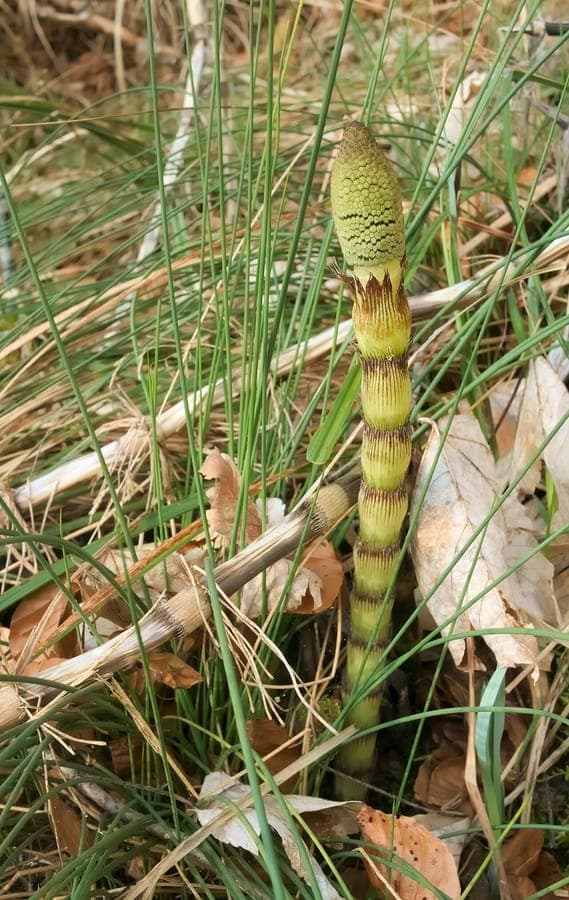
Daniel Kraft / CC BY-SA 3.0, via Wikimedia Commons
Great horsetail: complete guide
Equisetum telmateia
Want to see Great horsetail: complete guide in your garden?
1 minute, no credit card
Overview
Great horsetail (Equisetum telmateia) is a bold, ancient-looking perennial that thrives in consistently moist environments. Native across parts of Europe and the Mediterranean, this non-flowering plant belongs to the Equisetaceae family, which dates back over 100 million years. Unlike true ferns, it reproduces via spores and spreads aggressively through underground rhizomes. If you're drawn to prehistoric textures and vertical drama in the garden, this is a plant worth considering – but only if you can manage its vigorous spread.
On gardenworld.app, you can design a planting scheme that accounts for the expansive nature of great horsetail, ensuring it doesn't overwhelm neighbouring perennials. It's not toxic, but it's not edible either, so keep it away from curious pets or toddlers who might chew on the stems.
Appearance & bloom cycle
Great horsetail produces two types of stems: fertile and sterile. In March and April, fertile stems emerge first – stubby, pale yellow to ivory-coloured, and topped with a cone-like sporocarp. These reach 15–30 cm in height and wither within a few weeks after releasing spores. From May onwards, the sterile, photosynthetic stems rise dramatically, growing up to 1.5 metres tall in ideal conditions.
These green, hollow stems feature distinct nodes and whorls of narrow, radiating branches, creating a striking architectural form. They remain upright and stiff throughout the growing season, typically from May to November. There's no traditional flowering, but the spore release in spring is a subtle yet fascinating botanical event.
Ideal location
Aim for partial shade to light shade – a 6 out of 10 on the light scale. This plant excels along north-facing walls, beneath open-canopy trees, or beside streams and ponds. Full sun, especially in hot afternoon climates, can cause stems to dry out and snap. Deep shade will slow growth but won't kill the plant.
It's ideal for bog gardens, damp borders, or naturalistic planting schemes. Use it to add height and texture to wet corners. On gardenworld.app, you can overlay moisture maps and shade patterns to pinpoint the best spot for this moisture-hungry species.
Soil requirements
Great horsetail prefers calcareous, humus-rich soils that stay moist year-round. The pH should be between 7.5 and 8.0 – slightly to moderately alkaline. It struggles in acidic soils below pH 6.5. If your soil is too acidic, amend it with ground limestone or chalk grit.
Clay or silty loams with high water retention are ideal. Avoid sandy or fast-draining soils unless you can provide constant irrigation. The plant thrives where the water table is high or where runoff collects.
Free design
Want to see Great horsetail: complete guide in your garden? Make a free design now.
Watering
This is not a drought-tolerant plant. It needs consistent moisture, especially from May through September. During dry spells, water deeply at least twice a week. Prolonged dryness causes the stems to collapse or turn brown prematurely.
Rainwater is preferable, as tap water with high chlorine or fluoride content may damage the delicate tissues. Consider installing a drip line or planting near a pond edge where capillary action keeps the root zone hydrated. Mulching with leaf litter or straw helps retain moisture.
Pruning
Pruning isn't required for health, but it helps control appearance and spread. Remove the spent fertile stems in April. The sterile stems can be left standing through winter for visual interest, or cut back in late winter (February) to 5–10 cm above ground.
Crucially, this plant spreads via deep, creeping rhizomes. To prevent it from invading adjacent beds, install a root barrier at least 50 cm deep. Without containment, it can become invasive and difficult to remove.
Maintenance calendar
- January: Check for winter dieback; cut back if desired
- February: Prune old stems; inspect rhizome spread
- March: Fertile stems appear; monitor spore development
- April: Remove withered fertile stems; check for new growth
- May: Sterile stems emerge; increase watering
- June–August: Peak growth; maintain consistent moisture
- September: Reduce watering gradually
- October: Stems begin to yellow; decide on cutting back
- November–December: Dormancy; final pruning; reinforce barriers
Winter hardiness
Hardy in USDA zones 7–9 (-15°C to -10°C). In colder zones, top growth dies back completely, but rhizomes survive under mulch or snow cover. In milder winters, some stems may remain green. No special protection needed in-ground, but container-grown plants should be insulated with burlap or bubble wrap.
Companion plants
Pair with other moisture-loving perennials: Hosta, Astilbe, Ligularia, or Filipendula. Marginal pond plants like Carex vulpinoidea or Iris ensata also make excellent companions. Avoid xeric species like Lavandula or Sedum.
Great horsetail works best in naturalistic or woodland gardens. Combine with rustic materials like weathered timber or local stone to enhance its wild character.
Closing
Great horsetail isn't for every garden, but in the right setting, it's unforgettable. It demands wet soil, space, and containment, but rewards with dramatic height and timeless texture. Purchase from reputable garden centres – avoid wild-collected specimens, which are often protected.
Use gardenworld.app to plan layouts where moisture and containment are balanced. This is one plant that earns its place when thoughtfully placed.
Want to see Great horsetail: complete guide in your garden? Make a free design now.
Upload a photo, pick a style, and get a photorealistic design with plant list in under a minute.
No credit card required


Similar plants
Meadow horsetail: complete guide
Equisetum pratense
Meadow horsetail (Equisetum pratense): primitive spore-plant for wet meadows. Growing tips, management, and landscape design uses.
Common horsetail: complete guide
Equisetum arvense
Discover how to grow and care for Common horsetail (Equisetum arvense) in your garden, with tips on planting, watering, and controlling its spread in moist soils.
River horsetail: complete guide
Equisetum fluviatile
River horsetail (Equisetum fluviatile) thrives in wet, acidic soils and shallow water. Ideal for ponds and bog gardens in USDA zones 3-8.