
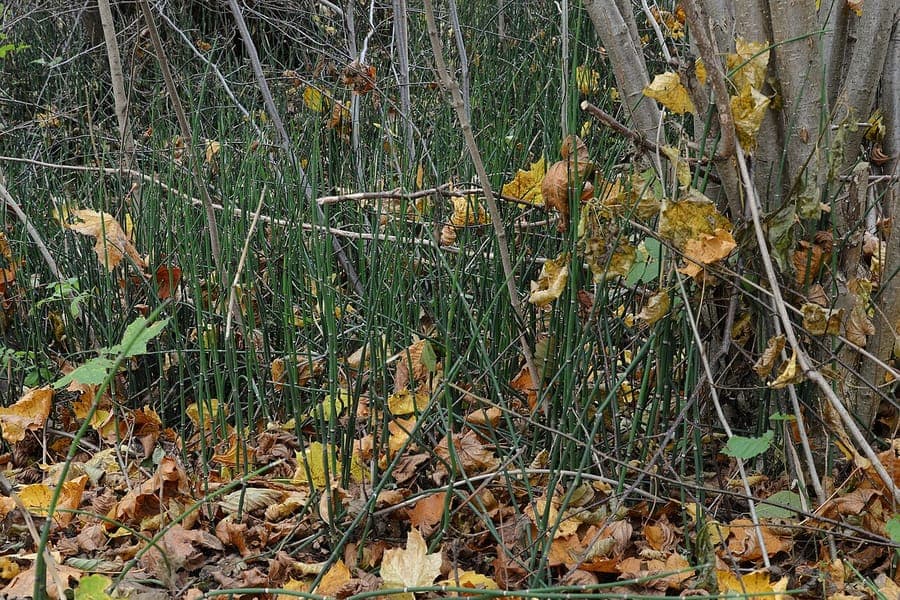
Ryan Hodnett / CC BY-SA 4.0, via Wikimedia Commons
Great scouring-rush: complete guide
Equisetum hyemale
Want to see Great scouring-rush: complete guide in your garden?
1 minute, no credit card
Overview
Equisetum hyemale, commonly known as Great scouring-rush, is a living fossil that brings bold structure to moist garden spaces. Native to damp woodlands and stream banks across Central and Eastern Europe – including Belarus, Austria, and the Baltic States – this perennial forb thrives in USDA hardiness zones 5 to 9. In the garden, it forms tight clumps of upright, hollow stems reaching 60 to 120 cm in height, with a spread of about 30 cm. Unlike flowering perennials, it reproduces via spores and spreads aggressively through underground rhizomes, so containment is key.
It's not a plant for dry borders or sunny rock gardens. Instead, Great scouring-rush excels in wet soils, pond margins, or containers kept constantly moist. Once established, it's nearly maintenance-free and adds year-round architectural interest. On gardenworld.app, you can plan a water garden layout that integrates Equisetum hyemale for lasting visual impact.
Appearance & bloom cycle
Great scouring-rush doesn't produce flowers. Instead, in early spring (March to June), fertile stems emerge topped with tan-brown, cone-like strobili that release spores. These are short-lived and soon give way to the plant's signature sterile stems: rigid, segmented, and dark green with pale nodal rings. The stems remain evergreen in mild winters but may tan or brown in harsh cold. They don't die back completely, offering winter structure.
New growth appears in April, shooting straight up from the rhizome network. By mid-summer, the clump reaches full height. The vertical form contrasts beautifully with mounding or spreading plants, making it a top choice for modern or naturalistic designs.
Ideal location
This plant prefers partial shade (light level 4/10), especially in regions with hot summers. Full sun is acceptable only if the soil stays constantly wet. Ideal spots include the north side of a shed, under open-canopy trees, or along the edge of a pond or rain garden. Avoid hot, dry corners.
Because it spreads via rhizomes, always plant in a bottomless container sunk into the ground or use a root barrier. Left unchecked, it can dominate a damp bed in just a few seasons.
Soil requirements
Great scouring-rush likes moist, well-draining soil rich in organic matter. A neutral to slightly alkaline pH (7.0–7.5) is ideal. Heavy clay can work if amended with compost and coarse sand to prevent waterlogging. Avoid sandy, fast-draining soils unless irrigated daily.
For container planting, use a mix of loam, compost, and aquatic soil. Ensure pots have no drainage holes if placed in water, or keep the soil surface wet at all times.
Free design
Want to see Great scouring-rush: complete guide in your garden? Make a free design now.
Watering
Consistent moisture is non-negotiable. The soil should never dry out. In summer, check daily – especially in pots. Use rainwater when possible, as tap water high in lime can raise pH over time. In water gardens, submerge the crown just below the surface (up to 10 cm deep).
During droughts, hand-water at least every other day. Mulching with gravel or wet wood chips helps retain moisture and suppresses weeds.
Pruning
No pruning is needed for health, but in late winter or early spring (February–March), cut back any damaged, faded, or overcrowded stems to ground level. This encourages fresh, upright growth. Wear gloves – the silica-rich stems can be abrasive.
Remove any runners escaping the container or barrier. Dispose of cuttings in the bin, not the compost, as they can root easily.
Maintenance calendar
- Jan: Minimal care; check for frost damage
- Feb: Cut back old stems; inspect root containment
- Mar: Watch for early strobili; control spread
- Apr: New growth emerges; increase watering
- May: Monitor moisture; remove unwanted shoots
- Jun: Spore release; no feeding required
- Jul: Maintain consistent water; watch for drying
- Aug: Keep area weed-free; avoid disturbance
- Sep: Growth stabilizes; reduce watering slightly
- Oct: Prepare for dormancy
- Nov: Leave stems for winter interest
- Dec: Protect container plants if temps drop below -20°C
Winter hardiness
Hardy in zones 5–9, Great scouring-rush survives most UK and US winters without protection. Stems may tan but roots remain viable. In containers, wrap pots with hessian or move to a sheltered spot. In ground, mulch lightly with gravel or leaf litter.
Companion plants
Pair with moisture-loving species: Hostas, Astilbe, Ligularia, Carex, and ferns like Dryopteris. Around ponds, combine with Iris pseudacorus or Pontederia cordata. For contrast, use soft-textured plants like Hakonechloa or Brunnera.
Avoid drought-tolerant or sun-hungry plants like Lavender or Sedum. Great scouring-rush dominates in form, so give it breathing room.
On gardenworld.app, you can design a planting scheme that balances Equisetum hyemale with companion plants for year-round appeal.
Closing
Great scouring-rush is a bold, architectural plant perfect for wet areas where few others thrive. With its upright habit and minimal care needs, it's a smart choice for modern, natural, or water gardens. Control its spread, keep the soil moist, and enjoy its clean lines. Buy healthy clumps from garden centres like those in the UK, or reputable online suppliers. Plant it right, and it'll stand tall for years.
Want to see Great scouring-rush: complete guide in your garden? Make a free design now.
Upload a photo, pick a style, and get a photorealistic design with plant list in under a minute.
No credit card required


Similar plants
Meadow horsetail: complete guide
Equisetum pratense
Meadow horsetail (Equisetum pratense): primitive spore-plant for wet meadows. Growing tips, management, and landscape design uses.
Common horsetail: complete guide
Equisetum arvense
Discover how to grow and care for Common horsetail (Equisetum arvense) in your garden, with tips on planting, watering, and controlling its spread in moist soils.
River horsetail: complete guide
Equisetum fluviatile
River horsetail (Equisetum fluviatile) thrives in wet, acidic soils and shallow water. Ideal for ponds and bog gardens in USDA zones 3-8.