
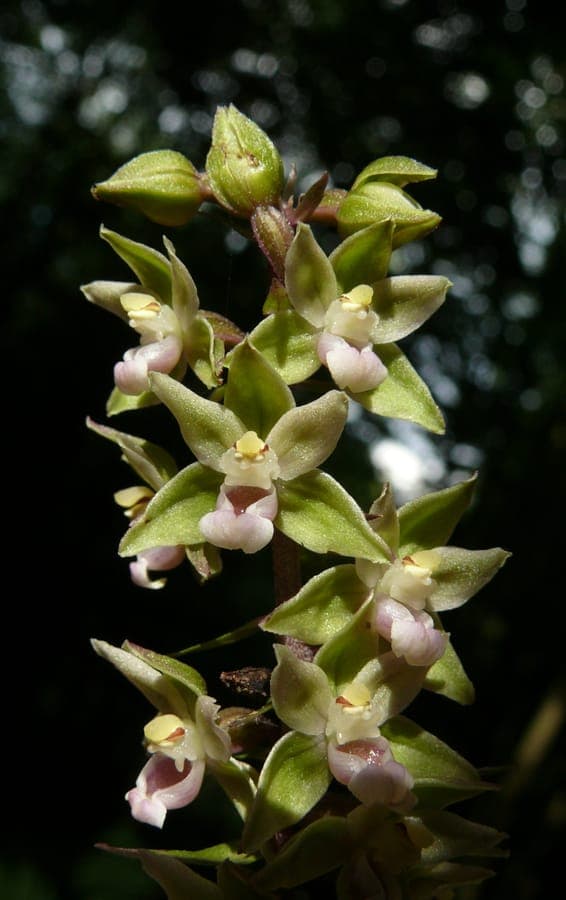
Bernd Haynold / CC BY 2.5, via Wikimedia Commons
Violet helleborine: complete guide
Epipactis purpurata
Want to see Violet helleborine: complete guide in your garden?
1 minute, no credit card
Overview
Epipactis purpurata, commonly known as the violet helleborine, isn't the kind of plant that shouts for attention. It doesn't dazzle with neon colours or massive blooms. Instead, it whispers-quietly elegant, deeply rooted in damp woodlands and hedgerows across central and western Europe. Native to countries like Germany, France, Austria, and the UK, this orchid thrives in the cool, shaded margins of forests, often where the soil stays moist but not waterlogged. If you're planning a naturalistic garden with understated charm, this is a plant worth considering. And on gardenworld.app, you can design a planting scheme that highlights its subtle beauty without overwhelming it.
What sets the violet helleborine apart is its quiet resilience and specific ecological needs. Like all orchids, its seeds rely on a symbiotic relationship with soil fungi (mycorrhizae) to germinate. This makes starting from seed a slow, uncertain process-better left to specialists. However, once established, mature plants can persist for years, slowly spreading through underground rhizomes.
Appearance & bloom cycle
The violet helleborine grows between 30 and 60 cm tall, with upright stems that may take on a faint purplish tinge in strong light. The leaves are lance-shaped, soft-textured, and arranged in opposite pairs along the stem. They're a fresh, mid-green, turning slightly yellow in autumn before dying back.
Flowering occurs from July to August. The blooms form a loose raceme at the top of the stem, each flower about 1.5 cm across. Despite the name, the flowers are not vividly purple-they're typically pale white or creamy with delicate purple veining, especially on the lower lip. The lip itself is deeply notched and slightly reflexed, giving it a masked, almost insect-like appearance. This is no coincidence: the plant mimics nectar-producing flowers to attract wasps, its primary pollinators, though it offers little reward.
After blooming, the plant develops seed capsules that split open in late autumn, releasing thousands of tiny, dust-like seeds. These are wind-dispersed, but without the right fungal partner in the soil, they won't germinate.
Ideal location
This orchid prefers a light level of 3 out of 10-meaning dappled shade to partial shade. Full sun will dry it out; deep shade under dense evergreens will suppress growth. Instead, aim for the edge of a deciduous woodland, under light-canopied trees like birch or hazel, or along the north side of a garden wall where midday sun doesn't penetrate.
In a garden setting, it works well in a woodland border, a damp corner near a pond, or a shaded wildflower patch. Pair it with plants that enjoy similar conditions: Polygonatum, Carex, Anemone nemorosa, or Lysimachia clethroides. If you're unsure how to layer these plants effectively, gardenworld.app offers visual planning tools to help you map out spacing and seasonal interest.
Free design
Want to see Violet helleborine: complete guide in your garden? Make a free design now.
Soil requirements
The soil must be humus-rich, moist, and well-draining, with a pH between 5.5 and 6.5. Avoid chalky or alkaline soils-they're a death sentence for most orchids. If your garden has heavy clay, amend it with leaf mould, pine bark, and some coarse sand to improve structure and acidity.
Because Epipactis purpurata depends on mycorrhizal fungi, it's best to buy established plants rather than attempt propagation from seed. Look for reputable suppliers at garden centres in the UK, especially those specialising in native or rare perennials. Avoid wild-collected specimens-these rarely survive transplanting and contribute to habitat loss.
Watering
Keep the soil consistently moist, especially during dry spells in summer. Never let it dry out completely. A mulch of pine needles or leaf litter helps retain moisture and mimics the plant's natural forest floor environment. Use rainwater if possible, as tap water-especially in hard-water areas-can raise soil pH over time.
Pruning
Pruning isn't necessary. Leave the dead stems standing through winter-they help protect the crown and provide structure. In early spring, once new shoots appear, you can gently remove last year's growth to tidy up the patch.
Maintenance calendar
- January–February: Dormant. No action needed.
- March: Check for new growth. Remove old foliage if it's in the way.
- April–May: Keep soil moist. No feeding required.
- June: Prepare for flowering. Watch for drought stress.
- July–August: In bloom. Water regularly during dry periods.
- September: Seed pods mature. Let them dry on the plant.
- October–December: Die back begins. Leave plant debris in place.
Winter hardiness
Hardy in USDA zones 6 to 8 (-23°C to -12°C). The rhizomes survive winter under a natural mulch layer. No additional protection is needed in most temperate climates.
Companion plants
Good companions include Dryopteris filix-mas, Geranium phaeum, Uvularia grandiflora, Asarum europaeum, and Carex elata 'Aurea'. These share a preference for cool, moist, acidic conditions and won't outcompete the helleborine for light or nutrients.
Closing
The violet helleborine isn't for everyone. It demands specific conditions and patience. But for gardeners who value ecological authenticity and quiet beauty, it's a treasure. Once settled, it asks for little and gives back with an annual show of delicate, mysterious blooms. It's a reminder that some of the best garden moments come not from bold statements, but from subtle presence.
Want to see Violet helleborine: complete guide in your garden? Make a free design now.
Upload a photo, pick a style, and get a photorealistic design with plant list in under a minute.
No credit card required


Similar plants
Ram's-head lady's slipper: complete guide
Cypripedium arietinum
Everything you need to know about growing Cypripedium arietinum, a rare woodland orchid for cool, moist garden settings. Soil, care and planting tips.
Sparrow's-egg lady's slipper: complete guide
Cypripedium passerinum
Everything about growing Cypripedium passerinum, a cold-hardy subarctic orchid suited to cool, moist, shaded garden spots. Soil, care and companion plants.
Algerian Butterfly-orchid: complete guide
Platanthera algeriensis
Everything about Platanthera algeriensis, the rare Mediterranean orchid with greenish flowers native to Algeria, Morocco, Corsica and Spain.