
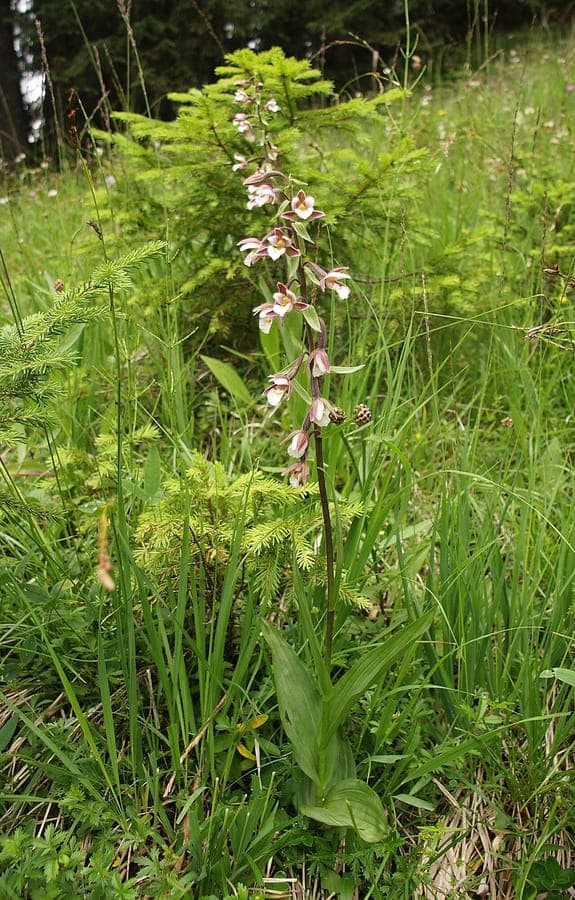
Bernd Haynold / CC BY-SA 3.0, via Wikimedia Commons
Marsh orchid: complete guide
Epipactis palustris
Want to see Marsh orchid: complete guide in your garden?
1 minute, no credit card
Overview
Marsh orchid (Epipactis palustris) is a graceful, herbaceous perennial native to wet woodlands, fens, and marshes across central and northern Europe. This member of the Orchidaceae family thrives in damp, alkaline conditions where many other plants struggle. Standing 20 to 50 cm tall, it brings delicate white flowers and a subtle fragrance to shaded garden corners from late spring through early summer.
Ideal for naturalistic planting schemes, this orchid rewards patient gardeners with reliable annual blooms when given the right conditions. It's not a plant for beginners, but with consistent moisture and proper soil pH, it can persist for many years.
On gardenworld.app, you can design a garden layout tailored to moisture-loving plants like the Marsh orchid, ensuring optimal placement and companion choices.
Appearance & bloom cycle
The Marsh orchid features upright stems with lance-shaped, dark green leaves arranged in a spiral along the stem. Each leaf measures 5 to 10 cm in length and has a slightly glossy surface. From June to July, a dense, one-sided inflorescence forms, bearing 10 to 20 small white flowers, each about 1.5 cm wide.
The flowers have a distinctive lip with fine teeth and a pale green to ivory hue. They emit a faint, sweet scent that attracts wasps-its primary pollinators. After blooming, the plant gradually dies back in autumn, retreating into underground rhizomes for winter dormancy.
Ideal location
Plant in partial to dappled shade with a light rating of 8 out of 10. It performs best under deciduous trees or along the north-facing edge of a pond where it receives morning sun or filtered light. Avoid deep shade, as this reduces flowering, and full sun unless the soil remains constantly moist.
Good air circulation is important to prevent fungal issues, especially in humid conditions. Urban gardens with limited space can use raised beds with consistent irrigation to mimic natural habitat conditions.
Soil requirements
This orchid demands alkaline, humus-rich soil with a pH between 7.5 and 8.0. The soil must be well-draining yet consistently moist-never dry. A mix of garden loam, compost, and coarse sand or crushed limestone works well. Avoid peat-based or acidic soils, as they will kill the plant.
If your soil is too acidic, amend it with ground chalk or crushed oyster shells. Test your soil regularly, and upload the results to gardenworld.app to get precise amendment recommendations for Epipactis palustris.
Free design
Want to see Marsh orchid: complete guide in your garden? Make a free design now.
Watering
Keep the soil evenly moist throughout the growing season (April to August). Water deeply 2–3 times per week during dry spells, preferably with rainwater or softened tap water. Hard tap water can raise pH over time, but sudden changes should be avoided.
Mulch with leaf litter or straw to retain moisture and buffer root zone temperatures. Avoid overhead watering in the evening to reduce fungal risk. Drip irrigation is ideal for maintaining consistent moisture without waterlogging.
Pruning
No pruning is needed. After flowering, you may cut back spent flower spikes to the base to redirect energy to the rhizomes. Do not remove healthy foliage during summer, as the leaves photosynthesize and support next year's growth.
In autumn, cut back any brown or dying stems, but leave some debris as natural mulch. This protects the crown and enriches the soil as it decomposes.
Maintenance calendar
- January–February: Check soil moisture. Add light mulch if needed.
- March: Begin light feeding with a balanced organic fertilizer (1–2 g per plant).
- April–May: Maintain moisture. Watch for slugs and snails-they love young shoots.
- June–July: Peak bloom. Protect from intense midday sun. Monitor for powdery mildew in wet weather.
- August–September: Gradually reduce watering. Leave dead foliage unless diseased.
- October–December: Divide and replant if desired. Leave leaf litter for winter protection.
Winter hardiness
Hardy in USDA zones 5 to 8, Marsh orchid survives temperatures down to -20°C when rhizomes are insulated. A 5–8 cm mulch layer of compost or leaf mold helps prevent frost heaving and desiccation. Avoid heavy snow compaction, but light snow cover acts as natural insulation.
In containers, move pots against a sheltered wall or into an unheated greenhouse. Ensure drainage holes are clear to prevent root rot from frozen water.
Companion plants
Pair with other moisture-loving perennials such as Filipendula ulmaria, Carex riparia, Eutrochium maculatum, and Iris versicolor. These create a lush, naturalistic planting near ponds or bog gardens.
Avoid invasive or fast-spreading plants like giant hogweed or reed canary grass. Instead, consider shade-tolerant ferns like Matteuccia struthiopteris or small primulas for contrast.
Closing
The Marsh orchid is a challenging but deeply rewarding plant for gardeners who appreciate subtle beauty and ecological value. It's not flashy, but its quiet elegance and wasp-friendly blooms make it a standout in a damp, shaded garden.
Always source plants from ethical nurseries-never from the wild, as this species is protected in many regions. You can find Epipactis palustris at garden centres in spring, including OBI and Hornbach in Germany, Truffaut in France, and general garden centres in the UK. With patience and the right conditions, it will slowly spread and bloom for years to come.
Want to see Marsh orchid: complete guide in your garden? Make a free design now.
Upload a photo, pick a style, and get a photorealistic design with plant list in under a minute.
No credit card required


Similar plants
Ram's-head lady's slipper: complete guide
Cypripedium arietinum
Everything you need to know about growing Cypripedium arietinum, a rare woodland orchid for cool, moist garden settings. Soil, care and planting tips.
Sparrow's-egg lady's slipper: complete guide
Cypripedium passerinum
Everything about growing Cypripedium passerinum, a cold-hardy subarctic orchid suited to cool, moist, shaded garden spots. Soil, care and companion plants.
Algerian Butterfly-orchid: complete guide
Platanthera algeriensis
Everything about Platanthera algeriensis, the rare Mediterranean orchid with greenish flowers native to Algeria, Morocco, Corsica and Spain.