
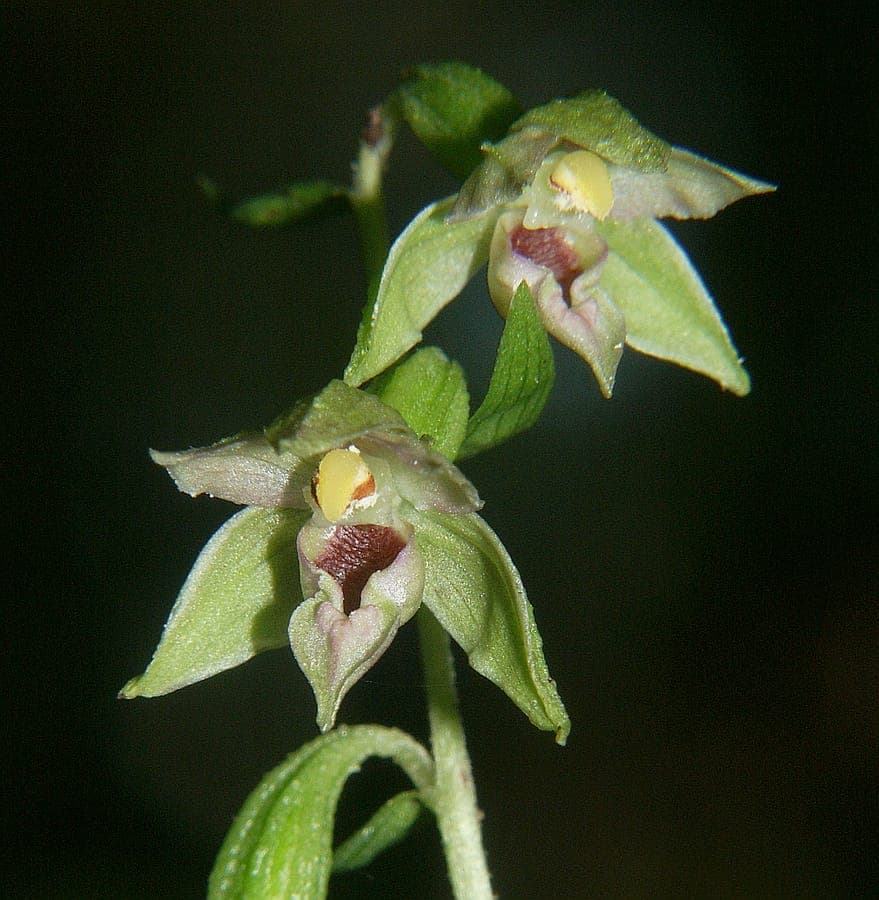
Bernd Haynold / CC BY-SA 2.5, via Wikimedia Commons
Narrow-lipped helleborine: complete guide
Epipactis leptochila
Want to see Narrow-lipped helleborine: complete guide in your garden?
1 minute, no credit card
Overview
Epipactis leptochila, commonly known as the narrow-lipped helleborine, is a perennial orchid native to deciduous woodlands across central and western Europe. It's a subtle, understated plant that thrives in quiet, undisturbed corners - not one for flashy borders or high-traffic areas. In the UK and Ireland, it's a rare find in the wild, often along hedgerows or woodland margins on chalky soils. For gardeners aiming to create a naturalistic woodland garden, this orchid offers a quiet elegance and supports native pollinators like wasps, which are essential for its reproduction.
This isn't a plant you rush into growing. It takes time to establish and won't bloom until its second or third year. But with patience and the right conditions, it can become a lasting feature. Use gardenworld.app to map your garden's light patterns and moisture zones - this helps identify the perfect spot where narrow-lipped helleborine can slowly settle in.
Appearance & bloom cycle
The plant reaches 30 to 60 cm in height, with upright, slightly purplish stems and alternate, lance-shaped leaves. The leaves are dark green, 5–10 cm long, and have a faint silvery reticulation on the underside. The inflorescence is a slender raceme of 10 to 20 flowers appearing from July to August. The blooms are greenish with fine purple or reddish-brown veining, especially on the narrow lip (labellum), which gives the plant its name. The flowers resemble tiny hooded figures, which attract wasps for pollination.
Seed pods form after flowering and split open in autumn, releasing dust-like seeds. These seeds need specific mycorrhizal fungi in the soil to germinate, so direct sowing rarely works without that symbiotic relationship already in place.
Ideal location
This orchid prefers dappled shade, scoring a 4 out of 10 on the light scale (1 being full shade, 10 full sun). It does best under light tree canopy - think beech, hornbeam, or mature oak - where it receives morning sun and afternoon shade. Full sun will scorch the leaves; deep shade stalls growth. Avoid south-facing slopes with reflected heat. A north- or east-facing woodland edge is ideal.
On gardenworld.app, you can simulate seasonal light changes and shadow paths to plan a microhabitat that mimics the plant's natural setting.
Soil requirements
The soil must be alkaline, with a pH between 7.5 and 8.0. Epipact游戏副本is leptochila grows on well-drained, calcareous loam or sandy loam rich in organic matter. Avoid acidic soils - below pH 7 will weaken or kill the plant. If your soil is too acidic, amend with fine ground limestone, but mix it in gently. The structure matters: loose, open, and free of waterlogging. A mix of garden soil, coarse sand, and leaf mould works well in raised beds.
Free design
Want to see Narrow-lipped helleborine: complete guide in your garden? Make a free design now.
Watering
Keep the soil consistently moist but never soggy. During active growth (April to September), water lightly but regularly. In dry summers, supplement with rainwater - tap water can be too high in chlorine or sodium. Overwatering is a bigger risk than underwatering; it disrupts the mycorrhizal network and leads to root rot.
Pruning
Pruning isn't needed. Leave the flowering stem intact through winter - it protects the basal rosette and helps you spot the plant in spring. In late winter or early spring, once new shoots appear, you can gently remove the old stem. Avoid disturbing the roots; this plant recovers slowly from damage.
Maintenance calendar
- February–March: Check for emerging shoots. Remove old stems if new growth is visible.
- April–May: Keep soil lightly moist. No fertiliser needed.
- June: Prepare for bloom. Avoid transplanting.
- July–August: Main flowering period. Observe wasp activity - a sign of healthy pollination.
- September–October: Maintain light moisture. No pruning.
- November–January: Dormant phase. Apply a thin mulch of leaves in harsh winters.
Winter hardiness
Hardy in USDA zones 6 to 8 (-23°C to -12°C). In colder zones, a light mulch of dry bracken or leaf litter protects the crown from freeze-thaw cycles. Avoid plastic covers - they trap moisture and promote rot. If grown in containers, overwinter in a cold frame or unheated greenhouse.
Companion plants
Pair with Pulmonaria, Anemone nemorosa, Corydalis, and native ferns like Dryopteris. These share a preference for partial shade, alkaline soil, and moderate moisture. Avoid aggressive spreaders like Vinca or ivy, which can smother the orchid.
You won't find Epipactis leptochila at most garden centres, but specialist nurseries occasionally stock it. Check with local conservation groups or explore gardenworld.app for woodland garden designs that integrate rare native species.
Closing
The narrow-lipped helleborine won't shout for attention, but it earns respect from gardeners who value quiet resilience. Its greenish blooms and precise needs make it a rewarding challenge. Don't force it into a formal bed - let it find its place in a wilder corner, where it can grow at its own pace. With the right care and a bit of time, it may return year after year, a quiet testament to a well-balanced garden.
Want to see Narrow-lipped helleborine: complete guide in your garden? Make a free design now.
Upload a photo, pick a style, and get a photorealistic design with plant list in under a minute.
No credit card required


Similar plants
Ram's-head lady's slipper: complete guide
Cypripedium arietinum
Everything you need to know about growing Cypripedium arietinum, a rare woodland orchid for cool, moist garden settings. Soil, care and planting tips.
Sparrow's-egg lady's slipper: complete guide
Cypripedium passerinum
Everything about growing Cypripedium passerinum, a cold-hardy subarctic orchid suited to cool, moist, shaded garden spots. Soil, care and companion plants.
Algerian Butterfly-orchid: complete guide
Platanthera algeriensis
Everything about Platanthera algeriensis, the rare Mediterranean orchid with greenish flowers native to Algeria, Morocco, Corsica and Spain.