
Wikimedia Commons / CC BY-SA 3.0, via Wikimedia Commons
Broadleaf helleborine: complete guide
Epipactis helleborine
Want to see Broadleaf helleborine: complete guide in your garden?
1 minute, no credit card
Overview
The broadleaf helleborine (Epipactis helleborine) isn't your typical flashy orchid, but it holds its own in the right setting. Native across much of Europe and parts of Asia, this hardy perennial thrives in shaded, moist areas and can slowly naturalize in garden conditions that mimic its woodland origins. It's not aggressive, but once established, it returns reliably each year. On gardenworld.app, you can design a shaded garden layout that highlights this orchid's subtle charm, pairing it with plants that thrive in similar conditions. Unlike tropical orchids, this one grows in the ground - and with patience, it rewards you with delicate summer blooms.
Appearance & bloom cycle
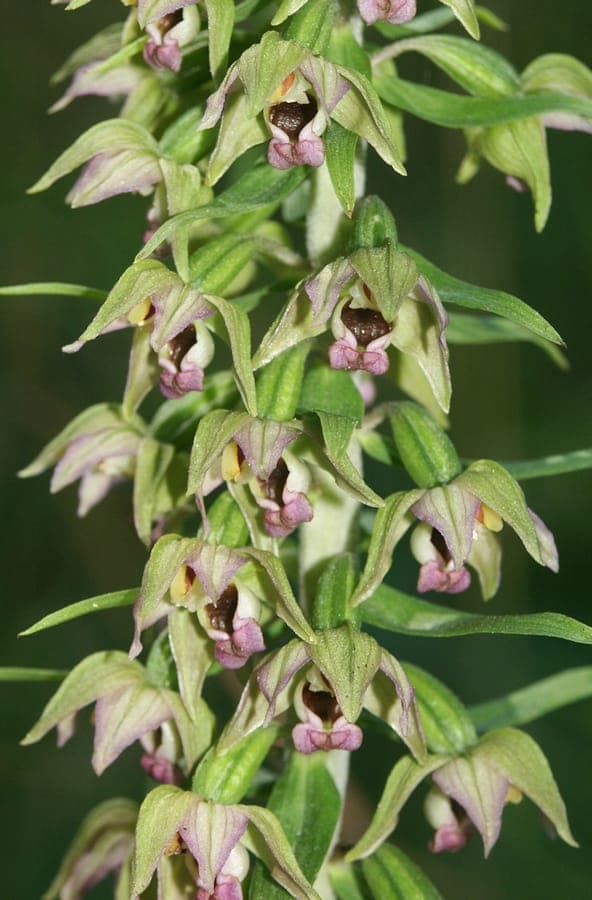
Expect heights between 30 and 80 cm, with upright, sturdy stems bearing broad, ribbed leaves that spiral up the stalk. The leaves are medium to dark green, lance-shaped, and softly textured. From mid-June through August, a spike of 10 to 20 greenish flowers opens gradually from bottom to top. The blooms are pale green with faint purple or brownish tinges, and have a slightly waxy look. They emit a faintly sweet scent, which occasionally draws in wasps - hence the common name. The bloom sequence can last over six weeks in favorable conditions, making it a long-season performer in the shade garden.
Ideal location
This orchid prefers light to full shade (light level 3/10). Plant it under deciduous trees like beech, oak, or maple where dappled sunlight filters through. Avoid hot, dry sun - it will scorch the leaves and dry out the roots too quickly. Urban gardens with north-facing walls or shaded borders also work well, especially where organic matter builds up naturally. Use gardenworld.app's sunlight analysis tool to map out shade patterns in your garden and find the perfect spot where moisture and cover combine for optimal growth.
Soil requirements
Humus-rich, well-drained but consistently moist soil is key. Aim for a pH between 5.5 and 6.5. The soil should never dry out completely, especially from spring to late summer. Amend heavy clay with leaf mold or well-rotted compost; for sandy soils, mix in organic matter to improve water retention. Avoid high-nitrogen fertilizers - they promote leafy growth at the expense of flowers. Calcareous or slightly alkaline soils are tolerated if organic content is high, but avoid pure chalk or sand without amendment.
Watering
Keep the root zone evenly moist. Water deeply but infrequently, focusing at the base to prevent fungal issues on leaves. Rainwater is best - tap water with high lime or chlorine content can harm sensitive roots over time. During dry spells in June and July, check soil moisture every few days. A 2–3 cm layer of leaf litter or pine needles helps retain moisture and mimics forest floor conditions.
Free design
Want to see Broadleaf helleborine: complete guide in your garden? Make a free design now.
Pruning
Little to no pruning is needed. Leave spent flower spikes intact until late winter, as they help channel energy back to the rhizomes. Cut down dead stems in late January or February, just above the crown. Never remove healthy green leaves during the growing season - they're vital for energy production. If you're dividing clumps (rarely needed), do it in early autumn with care not to damage the fragile roots.
Maintenance calendar
- January: Remove old, dry flower stems.
- February: Final cleanup; check for new shoots.
- March: Apply a thin layer of leaf compost if needed.
- April: Monitor soil moisture; new growth emerges.
- May: Maintain moisture; no feeding required.
- June: Bloom begins; keep soil damp.
- July: Peak flowering; continue consistent watering.
- August: Flowers fade; reduce disturbance.
- September: Let foliage die back naturally.
- October: Leave plant debris as natural mulch.
- November: No action.
- December: Light organic mulch for root insulation in exposed sites.
Winter hardiness
Hardy in USDA zones 5 to 8. The broadleaf helleborine survives freezing temperatures without protection, thanks to its deep rhizomes. In areas with fluctuating winter temps and no snow cover, a light mulch of pine needles or shredded leaves helps prevent frost heave. In most of the UK and northern US, it requires no special winter care. Young plants in containers may need protection - move to a cold frame or shaded spot against a wall.
Companion plants
Pair with moisture-loving, shade-tolerant plants like maidenhair fern (Adiantum pedatum), lungwort (Pulmonaria officinalis), foamflower (Tiarella cordifolia), or barren strawberry (Waldsteinia fragarioides). Avoid invasive spreaders like periwinkle or bishop's weed. Late-spring ephemerals such as bloodroot (Sanguinaria canadensis) or Dutchman's breeches (Dicentra cucullaria) also make excellent neighbors, sharing the same woodland niche. For visual contrast, use variegated Carex or hostas with blue-green foliage.
Closing
The broadleaf helleborine isn't a showstopper, but it's a quietly resilient orchid that adds depth and interest to shaded areas. It won't thrive in manicured lawns or sunny borders, but in a naturalistic planting, it can become a long-term fixture. Buy from reputable garden centres that propagate ethically - avoid wild-collected stock. Stores like OBI or Hornbach in Germany, Truffaut in France, or local garden centres in the UK often carry nursery-grown specimens. Use gardenworld.app to simulate plant combinations and test how this orchid fits into your existing shade garden design before planting.
Want to see Broadleaf helleborine: complete guide in your garden? Make a free design now.
Upload a photo, pick a style, and get a photorealistic design with plant list in under a minute.
10,000+ gardens designed already
No credit card required


Similar plants
Ram's-head lady's slipper: complete guide
Cypripedium arietinum
Everything you need to know about growing Cypripedium arietinum, a rare woodland orchid for cool, moist garden settings. Soil, care and planting tips.
Sparrow's-egg lady's slipper: complete guide
Cypripedium passerinum
Everything about growing Cypripedium passerinum, a cold-hardy subarctic orchid suited to cool, moist, shaded garden spots. Soil, care and companion plants.
Algerian Butterfly-orchid: complete guide
Platanthera algeriensis
Everything about Platanthera algeriensis, the rare Mediterranean orchid with greenish flowers native to Algeria, Morocco, Corsica and Spain.