
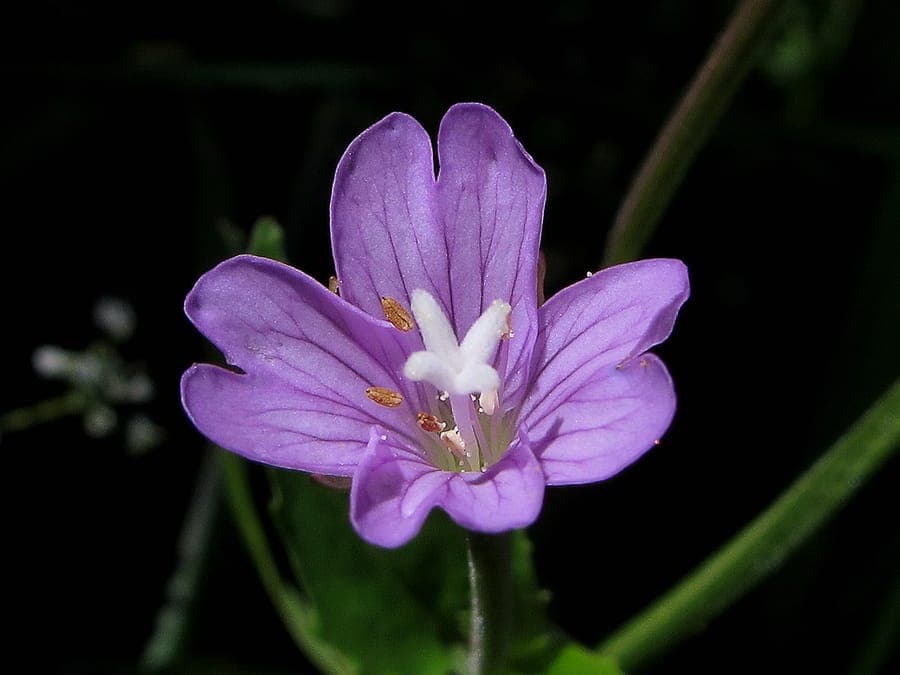
jacilluch / CC BY-SA 2.0, via Wikimedia Commons
Broadleaf willowherb: complete guide
Epilobium montanum
Want to see Broadleaf willowherb: complete guide in your garden?
1 minute, no credit card
Overview
Broadleaf willowherb (Epilobium montanum) is a modest yet resilient herbaceous perennial from the Onagraceae family, native to mountainous and woodland regions across central and eastern Europe. Though not commonly seen in cultivated gardens, it thrives in naturalistic plantings and damp, shaded borders. Reaching heights of 30–50 cm, it grows as a solitary or loosely clumping forb with an upright habit. Unlike its more aggressive relative, Epilobium angustifolium, this species spreads gently by seed, making it suitable for controlled garden use. It's a great choice for gardeners aiming to support local pollinators and create low-maintenance, ecologically sound planting schemes.
Appearance & bloom cycle
The plant forms slender, square-stemmed shoots with opposite, lanceolate to ovate leaves, 3–7 cm long, with finely toothed margins. The foliage is mid-green, sometimes with a reddish tinge on the stems. From June to August, it produces loose terminal clusters of small flowers. Each bloom has four slightly asymmetrical petals, soft pink to creamy white, with a bright yellow center. The flowers open in the morning and close by late afternoon, typical of many willowherbs. Individual blooms last just a day, but the flowering period spans six weeks, ensuring a steady display. The seed pods that follow split open explosively, dispersing tiny seeds with tufts of down.
Ideal location
Broadleaf willowherb prefers dappled shade to partial shade – a light level of 5 on a scale of 10. Full sun is acceptable only if the soil remains consistently moist; otherwise, foliage may scorch and flowering reduce. Ideal spots include the edge of a woodland garden, beneath open-canopied trees like birch or alder, or along the damp side of a north-facing wall. Avoid deep shade, where growth becomes leggy and blooms sparse. On gardenworld.app, you can map out a shaded planting zone that aligns with this plant's preferences, ensuring proper light filtration and moisture retention.
Soil requirements
It demands moist, humus-rich soil with good structure. Loam or clay-loam works best, provided drainage is adequate. The pH should be slightly acidic to neutral, between 5.5 and 6.5. Avoid chalky or highly alkaline soils, as they induce chlorosis in young leaves. When planting, amend the soil with 5–8 cm of well-rotted leaf mold or compost. Sandy soils need organic enrichment to retain moisture – mix in coir or composted bark. For container growing, use a peat-free potting mix with added perlite to prevent compaction.
Free design
Want to see Broadleaf willowherb: complete guide in your garden? Make a free design now.
Watering
Keep the root zone consistently moist, especially in the first growing season and during dry spells. Water deeply once or twice weekly, applying 10–15 liters per square meter depending on temperature. Use rainwater when possible, as tap water can raise pH over time. Mulch with leaf litter or bark chips (5 cm thick) to reduce evaporation. In wet autumns or winters, no supplemental watering is needed. On gardenworld.app, set up a seasonal watering plan tailored to your microclimate, helping maintain optimal moisture without overwatering.
Pruning
No routine pruning is required, but deadheading spent flower spikes in late August prevents excessive self-seeding. For a tidier appearance, cut stems back to ground level in late autumn or early winter. In wildlife-friendly gardens, leave the stalks standing until February to provide seed for finches and structure for overwintering insects.
Maintenance calendar
- January: Check for lingering stems; remove if unsightly
- February: Leave seed heads for birds; clear if necessary
- March: Clear old growth; apply compost mulch
- April: Watch for new shoots emerging late in the month
- May: Maintain soil moisture; no feeding required
- June: Bloom begins; inspect for slugs on young shoots
- July: Peak flowering; water during dry spells
- August: Deadhead to control spread; monitor soil
- September: Reduce watering; avoid fertilizing
- October: Allow stems to stand for winter interest
- November: Observe; no intervention needed
- December: Dormant period; light mulch if in containers
Winter hardiness
Hardy to USDA zone 5 (–20°C), Broadleaf willowherb dies back to ground level in autumn and re-emerges in spring. In colder zones (5a), a light mulch of straw or leaf litter (3–5 cm) helps protect the crown from freeze-thaw cycles. Container-grown plants should be moved to a sheltered spot or wrapped in hessian to prevent root damage.
Companion plants
Pair with moisture-loving perennials such as Meadowsweet (Filipendula ulmaria), Marsh marigold (Caltha palustris), or Tufted hairgrass (Deschampsia cespitosa). It also complements early spring ephemerals like Wood anemone (Anemone nemorosa) and Wild garlic (Allium ursinum), which retreat before willowherb expands. Avoid aggressive spreaders like Mint or Goldenrod, which may outcompete it.
Closing
Broadleaf willowherb is not a flashy garden standout, but it brings quiet charm and ecological value. It asks for little-no feeding, minimal pest issues-and rewards with weeks of delicate bloom and habitat support. While not widely stocked, it can be found at specialty native plant nurseries or ordered online. In the UK and US, check with local garden centres; in Europe, look for it at trusted retailers like garden centres in general. Consider integrating it into damp, shaded corners where few other perennials thrive. Its subtle presence enhances naturalistic designs, making it a quiet winner in the thoughtful gardener's palette.
Want to see Broadleaf willowherb: complete guide in your garden? Make a free design now.
Upload a photo, pick a style, and get a photorealistic design with plant list in under a minute.
No credit card required


Similar plants
Shortfruit evening primrose: complete guide
Oenothera brachycarpa
Everything about Oenothera brachycarpa - the shortfruit evening primrose from the American Southwest. Growing tips, placement and care for your garden.
Sundrops (Oenothera tetragona): complete guide
Oenothera tetragona
Everything about Oenothera tetragona - the cheerful daytime-blooming sundrops perennial. Growing tips, placement, pruning and care for a long summer display.
Seabeach evening primrose: complete guide
Oenothera humifusa
Full guide to Oenothera humifusa, the seabeach evening primrose native to the US Atlantic coast. Yellow blooms, silvery foliage, drought-tolerant.