
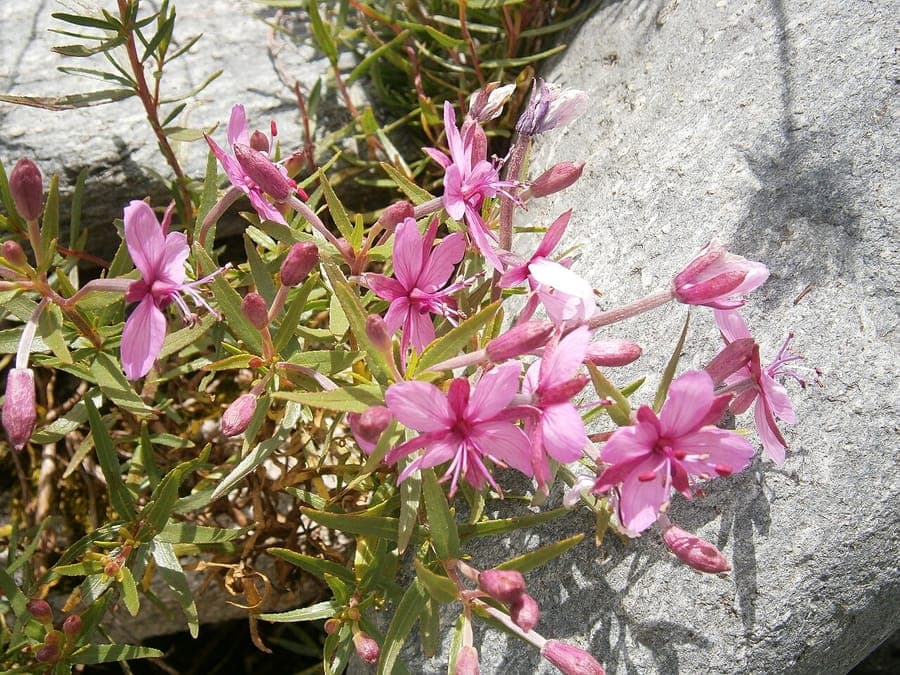
Meneerke bloem / CC BY-SA 3.0, via Wikimedia Commons
Fleischer's willowherb: complete guide
Epilobium fleischeri
Want to see Fleischer's willowherb: complete guide in your garden?
1 minute, no credit card
Overview
Fleischer's willowherb, scientifically known as Epilobium fleischeri, is a beautiful alpine flowering plant native to the mountains of Central Europe. This plant grows naturally in the Alps, particularly in Austria, Switzerland, France, and Italy. The name "willowherb" refers to the resemblance to rose-like flowers and the preference for moist, mountainous terrain where willows grow.
The plant is named after a 19th-century botanist, and its occurrence is now limited to altitudes cherished by mountain hikers. In gardens, however, it is a magnificent addition, especially for those wanting to create rock gardens or alpine plant collections.
Appearance and Bloom
Fleischer's willowherb is a compact, very low-growing plant, typically between 15-30 centimeters tall. It forms neat mats of fine, linear leaves that are green to bluish-green in color. The plant has a very orderly, almost geometric form that is very pleasing in alpine gardens.
Flowers appear from June through August in shades of purple to pink. These are quite large relative to plant size, making them very conspicuous. Each flower has four petals and four stamens protruding from the center. The flowers are very popular with bees and other insects.
Following flowering, seed pods develop, which are elongated and turn brown upon ripeness. These add even more interest to the plant's appearance after the blooming period.
Ideal Location
Fleischer's willowherb thrives best in full sun to partial shade. At least 4-5 hours of direct sunlight daily is ideal. In very hot climates, partial shade may be beneficial to protect the plant from scorch.
Ventilation is important - the plant grows best in locations with some air movement. This helps prevent fungal issues in high humidity.
Soil
Fleischer's willowherb requires excellent drainage, gritty soil. This is an alpine plant that naturally grows in rock crevices and scree slopes. In gardens, create a mixture of garden compost with grit or fine gravel, at least 50% gravel. A pH of 6.0 to 7.0 is ideal.
Ensure drainage is absolutely top-quality; prolonged moisture saturation will damage roots.
Free design
Want to see Fleischer's willowherb: complete guide in your garden? Make a free design now.
Watering
When growing in alpine environments, Fleischer's willowherb receives regular moisture from snowmelt and mountain rain. In gardens, moisture requirements depend on climate. In wetter regions, the plant can thrive with minimal supplemental irrigation. In dry climates, however, regular watering until fully established is necessary.
Ensure water does not pool around the plant; excellent drainage is essential.
Pruning
Fleischer's willowherb requires minimal maintenance pruning. If older foliage turns brown, you can gently remove the dead portions. After blooming, spent flowers and seed pods can be removed to maintain neat appearance, though this is not essential.
Maintenance Calendar
Spring (March-May): Begin watering as new foliage appears. Check drainage.
Summer (June-August): Enjoy extended bloom. Moisture requirements may be higher during heat.
Autumn (September-October): Gradually reduce watering. Allow seed pods to ripen and disperse.
Winter (November-February): Plant is nearly dormant. Minimal care required.
Winter Hardiness
Fleischer's willowherb is very hardy and tolerates temperatures down to -20°C without damage. This makes it suitable for all European climates, from Mediterranean to Scandinavian. No winter protection is needed.
Companion Plantings
Fleischer's willowherb pairs beautifully with:
- Sempervivum species - Other alpine succulents
- Saxifraga species - Classic alpine addition
- Armeria maritima - Similar growth habits
- Phlox subulata - Similar bloom time and size
- Dianthus alpinus - Similar alpine character
Closing Thoughts
Fleischer's willowherb brings alpine beauty to home gardens. This is a plant for those who enjoy subtle, refined natural beauty rather than showy spectacle. With its delicate purple flowers and compact form, this plant is an absolute treasure for alpine gardeners.
Visitors to gardenworld.app can learn how to integrate this stunning alpine flower into rock gardens and alpine designs.
Visitors to gardenworld.app receive specialized advice on cultivating alpine flowers in their front yard.
Want to see Fleischer's willowherb: complete guide in your garden? Make a free design now.
Upload a photo, pick a style, and get a photorealistic design with plant list in under a minute.
No credit card required


Similar plants
Shortfruit evening primrose: complete guide
Oenothera brachycarpa
Everything about Oenothera brachycarpa - the shortfruit evening primrose from the American Southwest. Growing tips, placement and care for your garden.
Sundrops (Oenothera tetragona): complete guide
Oenothera tetragona
Everything about Oenothera tetragona - the cheerful daytime-blooming sundrops perennial. Growing tips, placement, pruning and care for a long summer display.
Seabeach evening primrose: complete guide
Oenothera humifusa
Full guide to Oenothera humifusa, the seabeach evening primrose native to the US Atlantic coast. Yellow blooms, silvery foliage, drought-tolerant.