
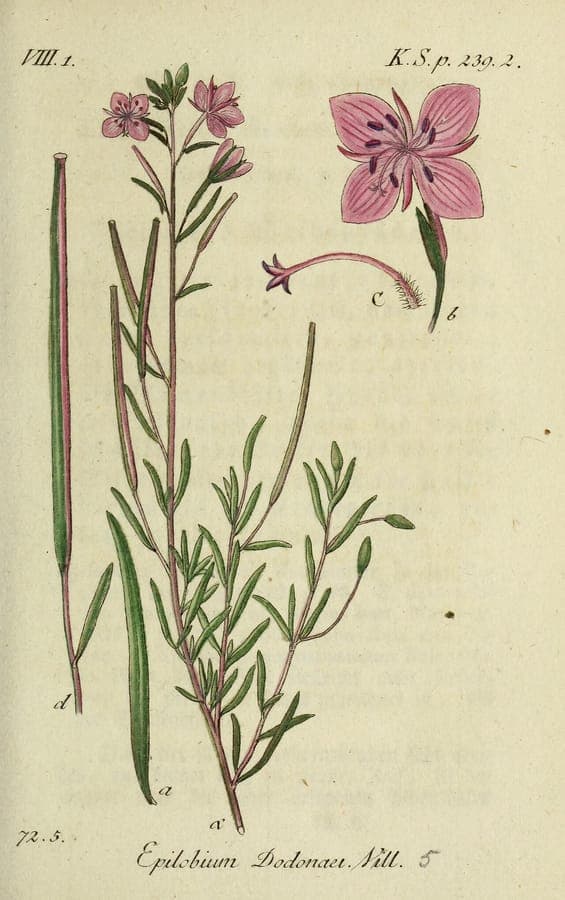
Jacob Sturm / Public domain, via Wikimedia Commons
Epilobium dodonaei: complete guide
Epilobium dodonaei
Want to see Epilobium dodonaei: complete guide in your garden?
1 minute, no credit card
Epilobium dodonaei, commonly known as rosemary willowherb or Dodonaeus' willowherb, is an elegant alpine plant originating from Europe's mountain regions from France and Italy to Iran. This compact, perennial plant prefers stony, drier soils and flowers for an extended period with striking pink-purple blooms.
Appearance and flowering
Epilobium dodonaei forms an extremely compact, densely branched plant only 20-40 centimeters tall and spreading 30-50 centimeters wide. The leaves are narrow, linear-lanceolate, approximately 2-4 centimeters long, giving the plant an elegant, fine texture reminiscent of rosemary. The flowers are the highlight: purple to pink-purple, approximately 1-1.5 centimeters across, appearing abundantly from July through October (sometimes November). After flowering, the plant produces highly decorative, silvery-gleaming seed capsules with feathery hairs (plumose seeds) whose beauty rivals clematis seeds.
Ideal location
Epilobium dodonaei prefers full sun to partial shade. Minimum 4-5 hours of direct sunlight daily, ideally 6+ hours. A very sunny, warm location with good air circulation is perfect, but the plant tolerates light shade (such as under low shrubs). The plant thrives in USDA zones 5-8 (temperate Europe is zone 8) and survives winter outdoors.
Soil requirements
Epilobium dodonaei is not particular about soil as long as it drains well. It prefers dry to moderately dry, stony to sandy soil. The plant thrives on rocky slopes, in scree gardens, and alongside mountain streams. In heavy clay, growth is poor and waterlogging causes problems. Neutral to slightly acidic pH is ideal.
Watering
Once established, Epilobium dodonaei is extremely drought-tolerant. Water regularly during the first year to establish roots properly. After that, you can almost stop watering entirely. The plant actually prefers drier conditions. In normal years with regular rainfall, this suffices. Only during very prolonged droughts (4+ weeks without rain) may you cautiously provide supplemental water.
Free design
Want to see Epilobium dodonaei: complete guide in your garden? Make a free design now.
Pruning and maintenance
Epilobium dodonaei requires virtually no pruning. The plant grows naturally compact and neat. Remove dead, browned stems in late spring (April), but retain the silvery seed capsules as long as possible because they are highly decorative. Occasionally you may gently cut back an overgrown stem to maintain shape.
Maintenance calendar
January-February: Dormancy period; no care needed. March-April: Remove dead material from previous season; no feeding. May-June: Begin growth; no feeding required (plant thrives in lean soil); check for drought stress. July-September: Flowering; retain silvery seed plumes for winter decoration. October-November: Seed plumes persist; enjoy their beauty. December: No further care; plant dies back and rests.
Winter hardiness
Epilobium dodonaei is hardy in temperate climates (USDA zones 5-8). The plant tolerates temperatures to negative 25 degrees Celsius without issue. The plant dies back above ground in fall, but roots remain protected underground. Each spring the plant regrows from its roots.
Companion plants
Rosemary willowherb combines beautifully in scree gardens and alpine gardens with other low alpines: Dianthus, Armeria, Cerastium, Sedum, Sempervivum, Dryas, Arabis, and grasses like Festuca glauca. Plant in groups of 3-5 for best effect. Also perfect for living roofs (green roofs).
In summary
Epilobium dodonaei is an elegant, perfectly hardy alpine plant for sunny, dry locations. With its fine rosemary-like foliage and long period of pink-purple blooms plus magnificent silvery seed plumes, it offers season-long interest. Minimal care and maximum beauty: that is the promise of this alpine jewel.
Want to see Epilobium dodonaei: complete guide in your garden? Make a free design now.
Upload a photo, pick a style, and get a photorealistic design with plant list in under a minute.
No credit card required


Similar plants
Shortfruit evening primrose: complete guide
Oenothera brachycarpa
Everything about Oenothera brachycarpa - the shortfruit evening primrose from the American Southwest. Growing tips, placement and care for your garden.
Sundrops (Oenothera tetragona): complete guide
Oenothera tetragona
Everything about Oenothera tetragona - the cheerful daytime-blooming sundrops perennial. Growing tips, placement, pruning and care for a long summer display.
Seabeach evening primrose: complete guide
Oenothera humifusa
Full guide to Oenothera humifusa, the seabeach evening primrose native to the US Atlantic coast. Yellow blooms, silvery foliage, drought-tolerant.