
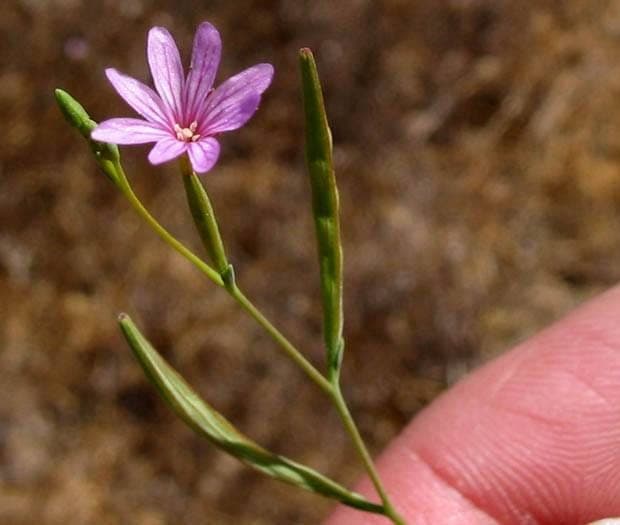
Unknown authorUnknown author / Public domain, via Wikimedia Commons
Epilobium brachycarpum: complete guide
Epilobium brachycarpum
Want to see Epilobium brachycarpum: complete guide in your garden?
1 minute, no credit card
Overview
Epilobium brachycarpum, also known as Autumn willowherb, Panicled willowherb, or Epilobe d'automne in French, is a graceful annual plant native to North America. This plant belongs to the Onagraceae family (the same family as evening primrose) and grows naturally from Canada to Mexico.
Although it is an annual, it is a vigorous grower that blooms quickly and produces abundant seed. This makes it ideal for gardeners wanting fine-textured annuals without much fuss.
Appearance and Blooming
Epilobium brachycarpum grows as a branched, upright plant, usually 30 to 100 centimeters tall, depending on growing conditions and sowing date. The plant does not form a compact shrub, but rather an airy, open growth pattern.
The leaves are narrow, lanceolate, with a soft texture. The flowers are small but abundant: approximately 0.5 to 1 centimeter wide, in shades of pink to purple, sometimes almost white. They appear in August and September in dense, branched spikes at the ends of the stems.
This late flowering pattern makes it valuable for autumn garden planning. When many spring and summer flowers fade, Epilobium brachycarpum opens up and provides color into October.
Ideal Location
Choose a location receiving at least six hours of direct sunlight daily. Epilobium brachycarpum flowers abundantly in full sun. In partial shade, it grows but produces fewer flowers.
The plant is perfect for summer gardens, borders, meadow gardens, and in groups for natural effects. It grows well along garden paths and can also be grown in containers.
The airy growth means you can place it near larger plants without shading.
Soil
Epilobium brachycarpum is incredibly flexible regarding soil type. It grows in varied soils from sand to clay, acidic to alkaline. This makes it perfect for difficult spots in your garden where little else grows.
Even well-drained soil helps, especially in rainy seasons. In very wet soils, drainage can be improved by adding sand or gravel.
The plant is not demanding and grows even in lean soils without problems.
Free design
Want to see Epilobium brachycarpum: complete guide in your garden? Make a free design now.
Watering
Epilobium brachycarpum is moderately drought-tolerant and flowers better with regular watering. During the growing season (June-October), water when the soil feels dry, typically once every two weeks.
During dry spells, it may require more frequent watering. But excessive water is not necessary and does not lead to better flowering.
In container culture, check regularly that drainage functions properly.
Pruning
As an annual, Epilobium brachycarpum requires little pruning. Do not remove dead flowers because the seed heads are decorative and attract birds.
When the plant is finished (October-November), you can remove it and put it on the compost heap.
You can pinch tops in August to encourage more side shoots and denser flowering, but this is optional.
Maintenance Calendar
March-April - Sow indoors or direct in soil May-July - Growth and flowering preparation August-October - Full bloom, seed heads November - Fade out December-February - No maintenance (annual)
Winter Hardiness
Epilobium brachycarpum cannot overwinter in most climates. It is a true annual that stops growing and dies after the first frost.
In warm climates, it can grow longer, sometimes until December. In cold climates, sow in spring and harvest autumn flowers.
Companion Plants
Epilobium brachycarpum pairs well with:
- Other airy annuals such as Cosmos
- Yellow or white flowers for color contrast
- Vigorous growing plants in background
- Long-stemmed flowers
- Grass-like plants
In meadow gardens, combine it with native flowers and grasses.
Conclusion
Epilobium brachycarpum is ideal for gardeners wanting autumn bloomers without much effort. With its airy growth and pink-purple flowers, it provides natural beauty when many gardens fade. Perfect for summer gardens, meadow gardens, or simply for full-sun spots.
By sowing it in May or June, you have flowering from August through October with minimal intervention. Ideal for resowing annually and saving seed.
Visit gardenworld.app for inspiration about summer gardens and annual design.
Want to see Epilobium brachycarpum: complete guide in your garden? Make a free design now.
Upload a photo, pick a style, and get a photorealistic design with plant list in under a minute.
No credit card required


Similar plants
Shortfruit evening primrose: complete guide
Oenothera brachycarpa
Everything about Oenothera brachycarpa - the shortfruit evening primrose from the American Southwest. Growing tips, placement and care for your garden.
Sundrops (Oenothera tetragona): complete guide
Oenothera tetragona
Everything about Oenothera tetragona - the cheerful daytime-blooming sundrops perennial. Growing tips, placement, pruning and care for a long summer display.
Seabeach evening primrose: complete guide
Oenothera humifusa
Full guide to Oenothera humifusa, the seabeach evening primrose native to the US Atlantic coast. Yellow blooms, silvery foliage, drought-tolerant.