
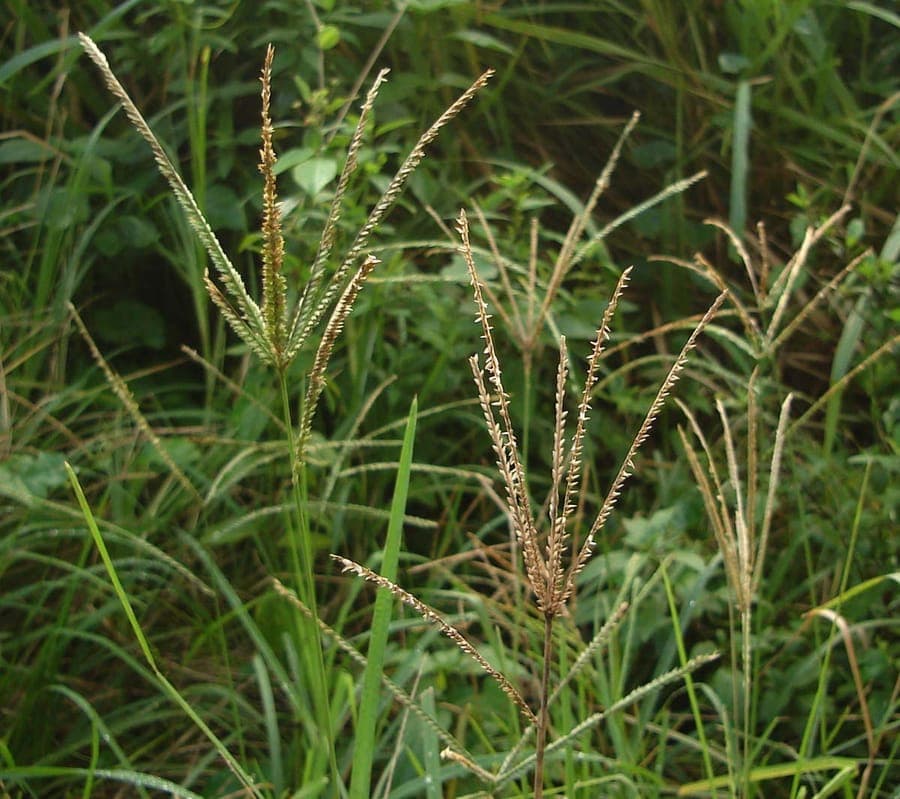
Tauʻolunga / CC BY-SA 3.0, via Wikimedia Commons
Crowfoot grass: complete guide
Eleusine indica
Want to see Crowfoot grass: complete guide in your garden?
1 minute, no credit card
Overview
Crowfoot grass, or Eleusine indica, isn't something most gardeners intentionally plant - it shows up on its own. But despite its reputation as a weed, this tropical grass has a tenacious survival instinct and a unique visual presence. Native to regions like Assam, Borneo, and Angola, it's become a common sight in gardens across Europe, especially in compacted soils, pathways, and neglected corners. A member of the Poaceae family, it thrives where other plants struggle. While often pulled out on sight, understanding its growth habits can help you manage or even use it purposefully.
On gardenworld.app, you can design a low-effort garden layout that accounts for spontaneous plants like crowfoot grass, turning what some see as a nuisance into a structured part of your landscape.
Appearance & bloom cycle
Crowfoot grass grows in a clumping, radiating habit, with stems spreading outward like fingers - hence the name. It typically reaches 20–60 cm in height, though in dry or trampled areas it stays shorter (15–30 cm). The leaves are narrow, 5–15 cm long, and slightly rough to the touch due to tiny hairs along the edges. They range from light green to a grayish-green, especially under drought stress.
Blooming occurs from July through October. During this period, 3–7 finger-like spikes emerge from a central stalk, arranged in a star pattern. The flowers are pale white to cream, not showy but adding subtle texture to the late summer garden. Each spike contains numerous tiny florets that mature into seed - and lots of them.
Ideal location
This grass thrives in full sun - think light level 9 out of 10. It's happiest in open, unshaded areas with little competition. Common spots include gravel paths, sidewalk cracks, driveways, or dry patches near walls. It won't survive in shaded lawns or moist, rich beds. If you're designing a xeriscape or urban garden, crowfoot grass might appear whether you want it or not.
To manage its presence, consider placing hardscape materials like gravel or permeable pavers in vulnerable zones. Garden centres often carry landscape fabrics that help suppress unwanted growth - useful if you're trying to keep this grass out of formal beds.
Soil requirements
It grows in almost any soil as long as drainage is excellent. Ideal pH ranges from 6.5 to 7.0. It tolerates sandy, rocky, or even disturbed soils - perfect for urban gardens with poor conditions. Avoid heavy clay or waterlogged areas; crowfoot grass will vanish there. Its ability to root from stem fragments makes it especially persistent in compacted or overused ground.
If you're trying to grow it intentionally (rare, but possible for ecological study), use a sandy loam mix in a raised bed. But more often, you'll find it where you didn't plant it.
Free design
Want to see Crowfoot grass: complete guide in your garden? Make a free design now.
Watering
Once established, crowfoot grass needs no supplemental watering. It's highly drought-tolerant and survives weeks without rain. In fact, overwatering can weaken it - this plant dislikes soggy roots. During germination (April–May), minimal moisture helps, but beyond that, it's self-sufficient.
In the UK and northern Europe, summer rainfall is usually enough. No irrigation required - one reason it's so common in poorly maintained areas.
Pruning
There's no real pruning, but you can cut back flower spikes before seeds mature to reduce spread. Use sharp shears and cut stems just above ground level. Avoid mowing - it spreads stem fragments that can root and form new plants.
If you're embracing a naturalistic garden style, you might leave it standing through winter for texture and seed for birds. Otherwise, remove it before seeding.
Maintenance calendar
- Jan: Dormant - check for debris
- Feb: No action needed
- Mar: Monitor soil surface for early sprouts
- Apr: Germination begins - tiny green shoots appear
- May: Rapid leaf growth - watch for spread
- Jun: Stem elongation - prepare for bloom
- Jul: Flowers emerge - keep dry
- Aug: Full bloom - deadhead to limit seeding
- Sep: Seed development peaks - control spread
- Oct: Plants begin to die back - remove or leave for wildlife
- Nov: Clear dead material
- Dec: Inspect ground for overwintering seeds
Winter hardiness
Crowfoot grass is not winter-hardy in temperate climates. It's an annual (sometimes short-lived perennial) that dies back with frost. USDA zones 9–11 support overwintering, but in zones 6–8, it reappears each year from seed. Seeds survive in soil for years, germinating when soil temps exceed 15°C - usually late April to early May.
Companion plants
Due to its aggressive seeding, crowfoot grass isn't a great companion for delicate perennials. But it can coexist with tough, drought-tolerant plants like sedums, thyme, or yarrow in rock gardens or gravel beds. Avoid planting near rich borders or turf lawns - it will invade.
Consider it a pioneer species in disturbed soils. Pair it with groundcovers that form dense mats, like ajuga, to reduce its foothold.
Closing
You won't find crowfoot grass in seed catalogs, but it's part of many gardens whether we like it or not. Instead of fighting it endlessly, consider designing around it. Use its presence to highlight areas that need better ground cover or improved drainage.
Want to map where weeds appear in your garden? On gardenworld.app, you can overlay observation data to predict growth patterns and adjust your planting scheme accordingly.
Want to see Crowfoot grass: complete guide in your garden? Make a free design now.
Upload a photo, pick a style, and get a photorealistic design with plant list in under a minute.
No credit card required


Similar plants
Sporobolus pungens: complete guide
Sporobolus pungens
Sporobolus pungens is a stoloniferous Mediterranean coastal grass with outstanding salt and drought tolerance, perfect for seaside and dry gardens.
Mediterranean aegilops: complete guide
Aegilops biuncialis
Everything about Aegilops biuncialis, a Mediterranean annual grass with ornamental spikes and outstanding drought tolerance for dry gardens.
Silver bluestem: complete guide
Bothriochloa saccharoides
Full guide to Bothriochloa saccharoides (silver bluestem): site, soil, watering, winter hardiness, pruning, and garden companions.