
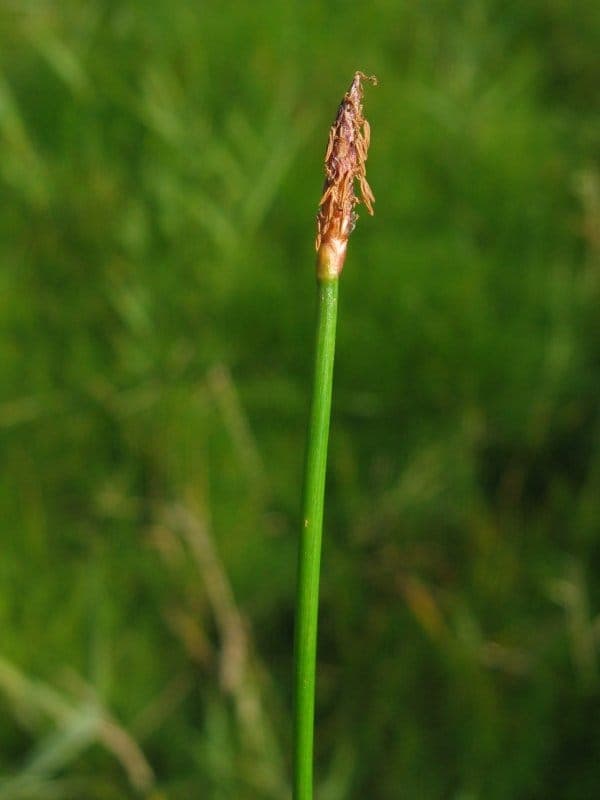
Kristian Peters -- Fabelfroh 09:34, 25 February 2007 (UTC) / CC BY-SA 3.0, via Wikimedia Commons
Onescale spikerush: complete guide
Eleocharis uniglumis
Want to see Onescale spikerush: complete guide in your garden?
1 minute, no credit card
Overview
Onescale spikerush (Eleocharis uniglumis) is a slender, grass-like perennial that thrives where few other plants dare - in saturated soils and shallow water. As a member of the Cyperaceae family, it spreads via rhizomes and forms loose clumps 20 to 60 cm tall. Native to regions from Alaska to Afghanistan and across northern Europe, it's well adapted to temperate climates. In the wild, you'll find it along slow-moving streams, marshy meadows, and pond margins with consistent moisture.
This plant is ideal for gardeners who want a naturalistic look without high maintenance. It won't take over like some invasive aquatic species but still provides year-round structure. On gardenworld.app, you can design a wetland planting scheme that features Onescale spikerush as a subtle yet essential textural element.
Appearance & bloom cycle
The plant consists almost entirely of thin, upright stems - true leaves are reduced to basal sheaths. Stems are 1–2 mm in diameter, bright green, and grow densely in rich, wet conditions. From May through August, it produces a single terminal spikelet per stem, about 3–5 mm long, with a brownish hue. These inconspicuous flowers aren't showy, but they add delicate contrast when backlit by summer sun.
In autumn, stems turn a soft tan and remain standing through winter, offering visual interest and habitat for overwintering insects. Unlike many grasses, it doesn't flop or disintegrate, making it a reliable choice for clean winter silhouettes.
Ideal location
Onescale spikerush thrives in full sun - a solid 8 out of 10 on the light scale. That means at least 6 hours of direct sunlight daily. While it tolerates light shade, growth becomes sparse and flowering is reduced. The best results come from planting it in shallow water (0–10 cm depth) along pond edges or in bog gardens with constantly damp soil.
For a natural effect, plant in groups of 5–9 plugs spaced 15 cm apart. Use gardenworld.app to sketch your planting layout digitally, helping you avoid overcrowding or gaps in coverage.
Soil requirements
Soil pH is critical: aim for 5.5 to 6.5. Above pH 7, especially in calcareous or clay-heavy soils, iron chlorosis can develop - look for yellowing leaf tips as a warning sign. Use a mix of peat, washed sand, and organic compost tailored for aquatic plants. Avoid compacted soils; good aeration supports healthy rhizome development.
In container planting, choose a pot at least 30 cm deep with drainage holes sealed or covered to retain moisture. Fill with a stable, non-floating substrate to prevent buoyancy.
Free design
Want to see Onescale spikerush: complete guide in your garden? Make a free design now.
Watering
This species demands constant moisture. In ponds, plant on shelves between 0 and 10 cm below water level. In bog gardens, maintain saturated soil - never let it dry out. During heatwaves, check daily; even a few hours of exposure to dry soil can damage roots.
Use rainwater when possible, especially in areas with hard tap water. If using irrigation, a slow drip system works best to avoid disturbing the soil surface.
Pruning
Pruning is minimal. In late winter or early spring (February to March), cut back old, brown stems to about 10 cm above the soil or pot rim. This encourages fresh, upright growth and prevents old biomass from smothering new shoots.
Leave last year's growth intact through early winter if you're supporting wildlife - dried stems shelter insects and provide perches for small birds.
Maintenance calendar
- January: Monitor for frost damage; leave dead stems if supporting biodiversity.
- February: Begin cutting back old foliage.
- March: Divide clumps if overcrowded; check soil pH.
- April: Ensure consistent moisture; watch for new sprouts.
- May: Bloom begins; inspect for early aphid activity.
- June–August: Peak growing season; maintain water levels.
- September: Reduce supplemental watering as temperatures drop.
- October: Trim or leave foliage based on garden style.
- November: Check root spread; thin if necessary.
- December: Protect container plants from deep freeze; mulch or insulate.
Winter hardiness
Onescale spikerush is hardy in USDA zones 5 to 9. In zone 7 and above, it remains evergreen or semi-evergreen. Below zone 5, protect container-grown plants by sinking the pot into the ground or insulating with burlap and straw. The key is keeping the root zone from freezing solid - a thin layer of water or organic mulch helps buffer temperature swings.
Companion plants
Pair with other moisture-loving plants such as Soft rush (Juncus effusus), Sedges (Carex vulpinoidea), or Water mint (Mentha aquatica). For contrast, plant alongside broad-leaved species like Water forget-me-not (Myosotis scorpioides) or Marsh marigold (Caltha palustris).
Avoid aggressive spreaders like Reedmace (Typha) unless you're using root barriers.
Closing
Onescale spikerush is a quiet achiever - not flashy, but deeply useful. It stabilizes wet soil, supports insects, and adds vertical rhythm to pond edges. With minimal care, it delivers reliable performance year after year.
You can find Eleocharis uniglumis at garden centres across the UK and North America, often sold in 1-litre pots or as bare-root bunches. Look for healthy green stems and avoid any with dried-out root balls. And remember: on gardenworld.app, you can build a complete wetland planting plan where this unassuming spikerush plays a key supporting role.
Want to see Onescale spikerush: complete guide in your garden? Make a free design now.
Upload a photo, pick a style, and get a photorealistic design with plant list in under a minute.
No credit card required


Similar plants
Flat-stemmed club-rush: complete guide
Bolboschoenus planiculmis
Everything about Bolboschoenus planiculmis: growing conditions, watering, care, and use as a pond margin or wetland plant in garden design.
Great Plains flatsedge: complete guide
Cyperus lupulinus
Everything about Great Plains flatsedge (Cyperus lupulinus): growing conditions, care, garden uses, and ecological value. Tips for pond margins and dry sandy soils.
Golden beak sedge: complete guide
Rhynchospora corymbosa
Everything about golden beak sedge (Rhynchospora corymbosa): a dramatic tropical marginal for pond edges, bog gardens, and wet habitats.