
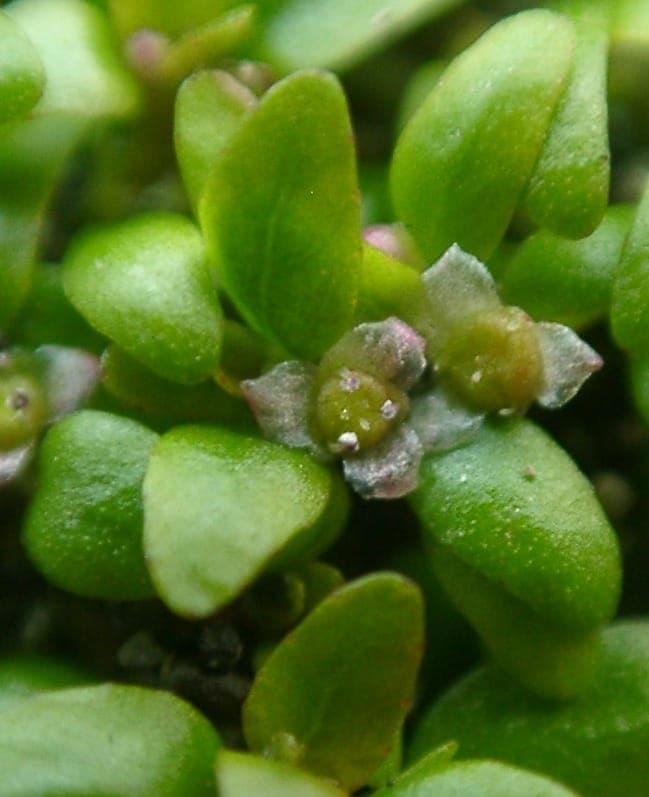
Loasa / Public domain, via Wikimedia Commons
Threestamen waterwort: complete guide
Elatine triandra
Want to see Threestamen waterwort: complete guide in your garden?
1 minute, no credit card
Overview
Threestamen waterwort (Elatine triandra) isn't the kind of plant you'll find in every garden centre, but for pond keepers and naturalistic water feature lovers, it's a quiet gem. Native across parts of Europe and temperate Asia, this low-growing aquatic thrives in still, shallow waters with high light exposure. It's not flashy, but its subtle beauty and ecological value make it worth the effort.
If you're designing a wildlife pond or a bog garden, consider using gardenworld.app to create a layout where Elatine triandra fits naturally. It works best in zones with minimal water movement and plenty of sun.
Appearance & bloom cycle
This plant forms creeping mats just below or at the water's surface, with slender stems reaching 5–15 cm in length. The leaves are small, oval to spoon-shaped, about 3–6 mm long, and arranged in opposite pairs or whorls of three to four. From June to November, it produces tiny purple flowers, only 2–3 mm wide, with exactly three petals - a key ID feature. The blooms emerge just above water if stems can anchor on submerged rocks or plant debris.
In the UK and northern Europe, peak flowering occurs in August and early September. High light (level 9 out of 10) is essential for consistent blooming. Temperatures above 24°C can reduce flower production, so keeping water cool is critical.
Ideal location
Plant threestamen waterwort in full sun to partial shade, but aim for at least 9 on the light scale. It does best in shallow water - no deeper than 10 cm. Ideal spots include pond margins, bog gardens, or shallow trays in a water feature. Avoid areas with strong filtration currents or heavy fish activity (like koi ponds), as the stems are fragile and easily uprooted.
Use fine netting or gravel mulch to protect young growth. Position near taller marginal plants like rushes or sedges for subtle shading during heatwaves.
Soil requirements
Elatine triandra prefers fine, humus-rich substrates with a pH between 5.0 and 5.5. A mix of clay, peat, and compost works well. Avoid sandy or gravel-heavy soils - they don't retain moisture or nutrients. In containers, use a 3–5 cm base layer of this mix, topped with a thin cover of fine gravel to prevent disturbance.
Watch out for phosphate buildup. High nutrient levels encourage algae that can smother the plant. Don't use fertilisers near it, and keep fish loading light.
Free design
Want to see Threestamen waterwort: complete guide in your garden? Make a free design now.
Watering
This is a true aquatic - it must remain submerged or at least have its roots permanently in water. Use rainwater or dechlorinated tap water to maintain the acidic pH. Hard, alkaline water can stunt growth or prevent flowering.
Keep water temperatures between 12°C and 22°C. In hot summers, add floating plants like water hyacinth or duckweed to cool the surface. Never let the plant dry out, even briefly.
Pruning
Pruning is minimal. Remove dead or decaying stems with clean scissors to prevent rot and encourage new growth. Use cuttings as propagation material - they root easily in moist substrate. Avoid excessive handling; the stems are fragile.
Don't overcrowd the plant. If it spreads too much, thin it out in spring to maintain healthy airflow and light penetration.
Maintenance calendar
- January–March: Dormant phase. Check for root rot, remove dead material, maintain water level.
- April: Begin active growth. Test pH (5.0–5.5), add fresh substrate if needed.
- May: Plant cuttings in shallow zones. Ensure strong light exposure.
- June–November: Bloom and growth period. Monitor water temperature, remove algae by hand.
- December: Enter dormancy. No feeding or pruning.
Using gardenworld.app, you can build a custom maintenance calendar tailored to your local climate and pond setup, making seasonal care for threestamen waterwort straightforward.
Winter hardiness
Hardy in USDA zones 5–8 (down to -20°C), Elatine triandra can survive winter if the water doesn't freeze solid. In deeper ponds (30+ cm), it often overwinters as submerged stems or roots. In shallow containers or bog gardens, move a portion indoors to a cool, bright tray of water to preserve stock.
Above-ground growth usually dies back, but the plant regenerates from base material in spring.
Companion plants
Pair with low-growing aquatics like dwarf water lily (Nymphaea pygmaea), water starwort (Callitriche spp.), or small sedges such as Carex riparia. Avoid aggressive spreaders like Canadian pondweed (Elodea canadensis), which will outcompete it for light and space.
For visual balance, surround with fine gravel or small stones to stabilise the substrate and reduce disturbance.
Closing
Threestamen waterwort isn't easy, but it's deeply rewarding for gardeners who appreciate delicate, ecologically sound water plants. It's not stocked everywhere, but you might find it at specialist garden centres or aquatic plant suppliers. While not common in mainstream retail, keep an eye out at seasonal pond plant sales. With the right conditions - high light, acidic water, and shallow depth - Elatine triandra can become a quiet highlight of your water feature.
Want to see Threestamen waterwort: complete guide in your garden? Make a free design now.
Upload a photo, pick a style, and get a photorealistic design with plant list in under a minute.
No credit card required


Similar plants
Elatine alsinastrum: complete guide
Elatine alsinastrum
The Waterpurslane is an elegant aquatic plant with white flowers that thrives in wetland habitats. Perfect for ponds and wet gardens.
Eight-stamened waterwort: complete guide
Elatine hydropiper
Eight-stamened waterwort is a delicate, water-loving plant native to Europe. Learn how to grow and maintain this unique aquatic species.
Six-stamen waterwort: complete guide
Elatine hexandra
A full guide to growing Elatine hexandra: ideal conditions, care tips, and where to buy. Perfect for pond margins and wet areas.