
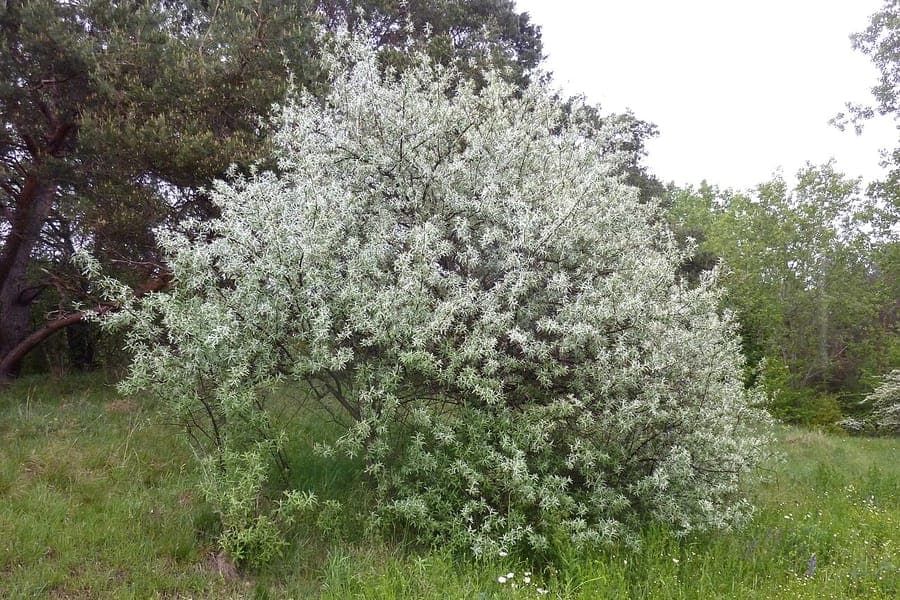
Katrin Schneider / korina.info / CC BY-SA 4.0, via Wikimedia Commons
Russian-olive: complete guide
Elaeagnus angustifolia
Want to see Russian-olive: complete guide in your garden?
1 minute, no credit card
Overview
Elaeagnus angustifolia, commonly known as Russian-olive, is a tough, resilient shrub or small tree that thrives in challenging garden conditions. Native to regions like Central Asia, Iran, and parts of China, it's adapted to poor soils, dry climates, and full sun exposure. In the UK and North America, it's often used as a windbreak, informal hedge, or standalone specimen in wildlife gardens. While it has naturalised in some areas and is considered invasive in parts of the US, in controlled settings it's a valuable, low-effort plant.
This species stands out for its silvery foliage, fragrant spring blooms, and persistent berries that feed birds through winter. It grows quickly - up to 50 cm per year - and reaches a mature height of 4–7 m with a spread of 3–5 m. If you're planning a mixed border or sheltered corner, Russian-olive can anchor the design. On gardenworld.app, you can visualise how this tree fits into your space, accounting for its spread and seasonal changes.
Appearance & bloom cycle
Russian-olive has narrow, lance-shaped leaves 4–9 cm long, silvery-white on both sides due to tiny scales. In autumn, the foliage turns yellow before dropping in November. The real show begins in late May to early June, when clusters of tiny, fragrant yellow flowers appear along the stems. These bell-shaped blooms emit a strong evening scent, attracting bees, moths, and other pollinators.
After flowering, small orange, oval drupes form - about 1–1.5 cm long - coated in a silvery russet. They ripen in October and often remain on the branches until February, providing winter interest and food for thrushes, waxwings, and robins. The bark on mature stems becomes fissured and dark, adding textural contrast in winter.
Ideal location
This plant demands full sun - rate it an 8 out of 10 for light needs - and performs best with at least 6–8 hours of direct sunlight daily. It tolerates partial shade but will flower less and grow more sparsely. Plant it as a screen, hedge, or focal point in open, well-drained areas. Avoid planting within 2 m of buildings or pipes, as the root system can spread aggressively.
Use gardenworld.app to map out spacing and sunlight patterns in your garden. This helps prevent overcrowding and ensures your Russian-olive gets the exposure it needs without shading out smaller neighbours.
Soil requirements
Russian-olive isn't fussy about soil type. It grows well in sandy, loamy, or clay soils, as long as drainage is adequate. The pH range is broad - from 6 to 9.5 - meaning it handles alkaline chalk soils and mildly acidic loams equally well. It's particularly useful on degraded or compacted soils, thanks to its nitrogen-fixing root nodules.
That said, it won't survive in waterlogged ground. If planting in heavy clay, improve drainage with grit or composted bark. No need for fertiliser; this plant thrives on neglect.
Free design
Want to see Russian-olive: complete guide in your garden? Make a free design now.
Watering
During the first growing season after planting, water weekly with 10 litres per tree. Once established - usually by year two - it's highly drought-tolerant. In prolonged dry spells (4+ weeks without rain), give a deep soak, especially to younger trees. Avoid overhead watering; direct water at the base to prevent fungal issues.
Pruning
Pruning isn't essential, but you can shape the plant in late winter or early spring (February–March). Remove dead, crossing, or inward-growing branches. For hedges, trim twice a year - once in June after flowering, and again in September if needed. Use sharp, clean secateurs to prevent disease transmission.
Note: Do not compost prunings - seeds may survive. Dispose of them via green waste or burning.
Maintenance calendar
- January: Check for winter dieback; remove damaged wood.
- February: Begin light pruning; inspect for bud swell.
- March: Complete pruning; lightly cultivate soil around trunk.
- April: Minimal care needed; water if spring is dry.
- May: Flower buds form; scent becomes noticeable.
- June: Peak bloom; pollinators active.
- July: Flowers fade; berries start to develop.
- August: No additional watering unless drought persists.
- September: Second hedge trim if required.
- October: Berries ripen; birds begin feeding.
- November: Leaf drop; collect or leave as mulch.
- December: Winter check; protect young trunks with hessian in harsh climates.
Winter hardiness
Russian-olive is hardy to USDA zone 3 (-25°C), making it suitable for nearly all of the UK and most of North America. Established trees handle freezing temperatures without issue. Young plants may benefit from trunk wrapping in exposed sites to prevent frost cracking and wind scorch. Mulch with bark chips - not manure - to avoid root rot.
Companion plants
Pair with drought-tolerant, sun-loving species: Cistus, Lavandula, Santolina, or Juniperus. Low-growing companions include Thymus, Sedum, and Origanum. Avoid moisture-loving plants like Hosta or ferns. For structural contrast, plant near grasses such as Calamagrostis or Stipa.
Closing
Russian-olive earns its place in tough, low-maintenance gardens. It's a reliable choice for hedging, wildlife support, or adding silvery texture to borders. Buy from reputable garden centres like those found in the UK or online nurseries. Always inspect the root ball before planting - tease out circling roots to prevent girdling. With proper siting and minimal care, Elaeagnus angustifolia will thrive for decades. Use gardenworld.app to plan companion planting and avoid future clashes in your garden layout.
Want to see Russian-olive: complete guide in your garden? Make a free design now.
Upload a photo, pick a style, and get a photorealistic design with plant list in under a minute.
No credit card required


Similar plants
Canadian buffalo-berry: complete guide
Shepherdia canadensis
Complete guide to Canadian buffalo-berry: location, soil, watering, pruning, and companion plants for this resilient wildlife shrub.
Broadleaf Oleaster: complete guide
Elaeagnus macrophylla Thunb.
Discover the Broadleaf Oleaster, a hardy ornamental shrub with silvery leaves and robust growth. Perfect screening plant for front gardens.
Sea-buckthorn: complete guide
Hippophae rhamnoides
Sea-buckthorn (Hippophae rhamnoides) is a resilient shrub with vibrant orange berries that lasts through winter. Hardy to -35C, perfect for sandy soils and coastal gardens.