
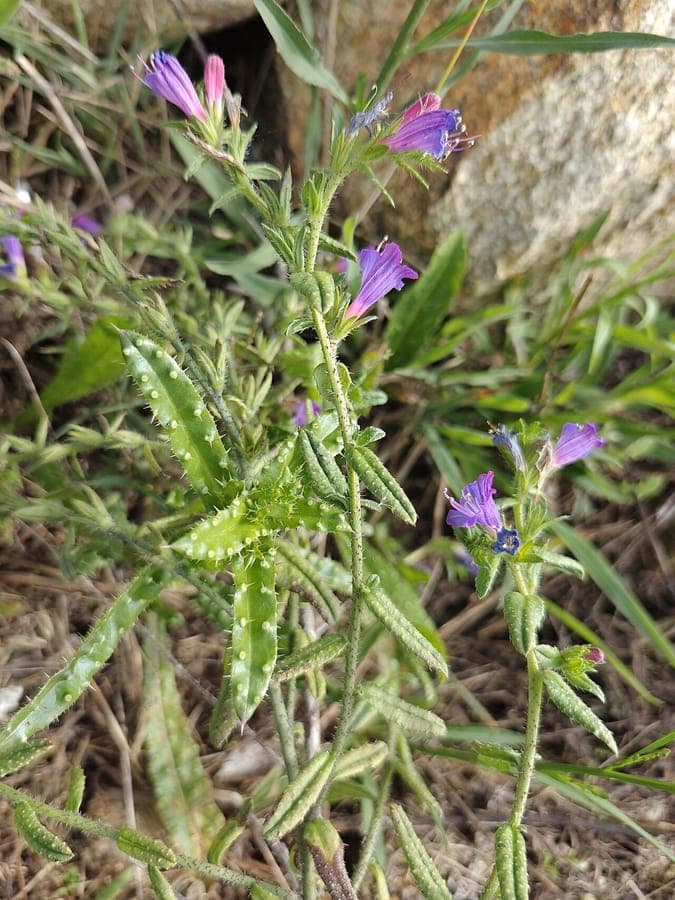
Paul Braun / CC0, via Wikimedia Commons
Echium rosulatum: complete guide
Echium rosulatum
Want to see Echium rosulatum: complete guide in your garden?
1 minute, no credit card
Overview
Echium rosulatum, commonly known as lax viper's-bugloss or in French vipérine, is an attractive and colorful flowering plant from the family Boraginaceae. This species occurs naturally in Portugal and northwestern Spain, where it grows in dry mountain areas and steep slopes. The plant is a Mediterranean succulent that is excellent for dry gardens and pot cultivation.
In the Iberian Peninsula, this plant is an important part of the local flora and is valued for its picturesque flowers.
Appearance and bloom
Echium rosulatum grows into a compact shrub with an upright form. The plant reaches a height of 30 to 60 centimeters. The leaves are lanceolate and have a greenish color with hairs on both sides. This hairiness gives the plant a characteristic velvety texture.
The flower is the most striking feature of this plant. The flowers grow in loose spikes (spica) at the tops of the stems. The flowers are small but very numerous. The color of the flowers is usually purple to blue, although pink and white variations also occur.
The blooming period runs from April to September, during which the plant continuously produces new flowers. This provides a long colorful season.
Ideal location
Echium rosulatum grows best in full sunlight. The plant tolerates no shade and grows best on very sunny locations where temperatures can run high. In its natural habitat, the plant grows on open, dry mountain slopes.
The plant is very tolerant of warm, dry conditions. In temperate climates, however, the plant can also grow, especially when planted on very dry places.
Protection from strong wind can be useful in very windy areas.
Soil
Echium rosulatum is extremely drought-tolerant and grows best in poor, well-drained soils. The plant tolerates lime-rich soils very well and grows on stones, gravel, and sandy soils. The plant also grows well on rocky soils.
It is recommended to enrich the soil minimally with organic material. The plant thrives even in very poor soils. pH 6.5 to 8.5 is ideal.
For potting, a mixture of universal potting soil, sand, and gravel is best used for excellent drainage.
Free design
Want to see Echium rosulatum: complete guide in your garden? Make a free design now.
Watering
Echium rosulatum is very drought-tolerant and rarely needs water. Once established, the plant can grow almost without watering. In pot culture, care must be taken with watering, as waterlogging can lead to stem and root rot.
Watering can be limited to dry periods or when the plant is very young. In growing seasons, water can be sparingly given if the soil becomes completely dry.
In winter, watering can be almost completely stopped except in extremely dry conditions.
Pruning
Echium rosulatum requires minimal pruning. The plant grows compactly and forms an attractive shape naturally. Remove only dead stems or damaged leaves.
After flowering, the spent flower spikes can be removed to make the plant look neater. This also stimulates continuous flowering.
Avoid aggressive pruning as this can disrupt the natural form.
Maintenance calendar
March to May: Beginning of growing season, minimal watering, no feeding needed in poor soils.
June to September: Blooming period, no watering in most conditions, possibly remove spent flowers.
October to November: Growing season begins to decline, water minimal.
December to February: Dormancy, almost no watering needed.
Winter hardiness
Echium rosulatum can tolerate temperatures down to about minus 5 to minus 10 degrees Celsius, depending on the variety. In many temperate climates, the plant can remain outdoors in mild winters but suffer damage in severe winters.
In temperate to cold regions, it is better to bring the plant indoors in winter or seriously protect it. The plant does not grow well at temperatures below 10 degrees Celsius.
Plant companions
Echium rosulatum grows in its natural habitat on dry mountain slopes with other Mediterranean vegetation. In gardens, the plant can be well combined with other Mediterranean vegetation such as lavender, rosemary, and other drought-loving green vegetation.
The plant can also be well combined with stony succulents and other small dry green vegetation for a Mediterranean garden effect.
The plant attracts bees, bumblebees, and butterflies, making it valuable for wildlife-friendly gardens.
Conclusion
Echium rosulatum is a beautiful Mediterranean plant that adds summer color and botanical interest to dry gardens. The long-lasting bloom of violet and blue flowers makes this plant a favorite for lovers of drought-tolerant plants. With minimal care and water, this plant grows into a beautiful garden addition.
Want to learn more about Mediterranean plants? Visit gardenworld.app for inspiration and professional garden design services!
Want to see Echium rosulatum: complete guide in your garden? Make a free design now.
Upload a photo, pick a style, and get a photorealistic design with plant list in under a minute.
No credit card required


Similar plants
Western waterleaf: complete guide
Hydrophyllum occidentale
Full growing guide for western waterleaf (Hydrophyllum occidentale): shade tolerance, soil needs, watering, winter hardiness and naturalistic garden use.
Limestone phacelia (Phacelia affinis): complete guide
Phacelia affinis
Full guide to Phacelia affinis, the limestone phacelia: sowing tips, purple-blue bee flowers, drought tolerance and uses in dry or wildlife gardens.
Pyrenean viper's bugloss: complete guide
Echium asperrimum
Echium asperrimum is a striking biennial from the western Mediterranean with rough bristly stems and vivid blue flowers. A magnet for bees and a bold border plant.