
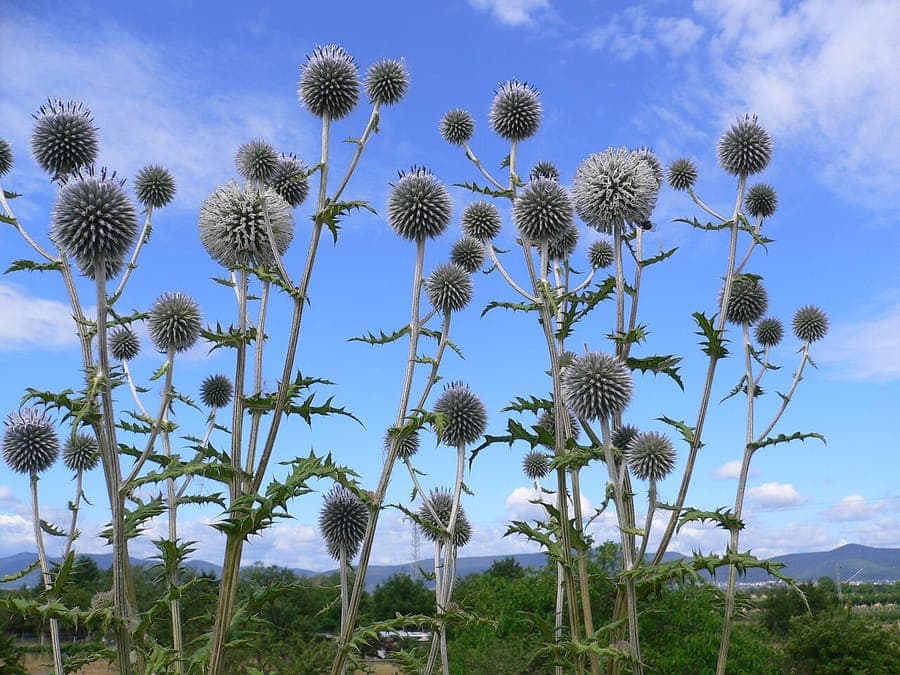
Georg Slickers / CC BY-SA 3.0, via Wikimedia Commons
Great globe thistle: complete guide
Echinops sphaerocephalus
Want to see Great globe thistle: complete guide in your garden?
1 minute, no credit card
Overview
The great globe thistle (Echinops sphaerocephalus) is a rugged, architectural perennial that brings bold texture and structure to the summer garden. Native to parts of Central and Eastern Europe-including Austria, Bulgaria, and Belarus-this member of the Asteraceae family thrives in sunny, dry spots where other plants struggle. It's not commonly found in the wild in the UK or North America, but it's a reliable and striking addition to border plantings, gravel gardens, and low-maintenance landscapes.
On gardenworld.app, you can build a custom garden layout that highlights this thistle's sculptural form among grasses and drought-tolerant perennials.
Appearance & bloom cycle
This plant reaches 60–100 cm in height, with stiff, upright stems rising from a central rosette of deeply lobed, silver-green leaves. The foliage feels slightly rough due to fine hairs, giving it a wild, natural look. The real show starts in July, when bright blue, globe-shaped flower heads-3 to 5 cm across-appear at the tips of the stems.
Each spherical bloom is made up of hundreds of tiny florets, tightly packed into a perfect ball. Blooming lasts from July through early September. The flowers hold their shape well, even when drying, making them excellent for cut arrangements.
Ideal location
Full sun is essential-aim for at least 6 hours of direct sunlight daily. This thistle performs best in open, unshaded areas. It's perfect for hot, dry borders, slopes, or gravel gardens. In shaded areas, stems stretch and flop, reducing flowering and overall vigour.
In cooler climates, position near a south-facing wall to boost warmth. Garden centres in the UK and US often stock Echinops in early spring-plant in groups of three or five for maximum impact.
Soil requirements
The great globe thistle isn't fussy about soil fertility but demands excellent drainage. Sandy, gravelly, or rocky soils are ideal. Avoid heavy clay unless amended with grit or sand to improve drainage. Poor, lean soils are actually preferred-rich soil leads to floppy growth and fewer blooms.
When planting, skip compost or fertilizer. A handful of horticultural grit mixed into the planting hole helps prevent rot. The plant's deep taproot handles dry conditions once established.
Watering
Water only during the first few weeks after planting or during prolonged droughts in the first growing season. Once rooted, it's highly drought-tolerant. Established plants rarely need supplemental watering, even in USDA zones 5–8.
Water deeply but infrequently to encourage strong root development. Shallow, frequent watering weakens the plant over time. Drip irrigation or soaker hoses work better than overhead sprinklers.
Free design
Want to see Great globe thistle: complete guide in your garden? Make a free design now.
Pruning
No pruning is required to encourage flowering, but you can deadhead spent blooms if desired. Leaving the flower heads through winter adds visual interest and provides habitat for overwintering insects.
Cut back old stems in late winter or early spring, just above ground level. Avoid cutting too early-late frosts can damage new growth. If self-seeding becomes excessive, remove seed heads before they fully dry.
Maintenance calendar
- January: Inspect old stems; remove only if damaged
- February: Leave plant material intact for winter structure
- March: Cut back last year's growth; clear debris
- April: Check for emerging shoots; thin seedlings
- May: Active growth begins; no feeding needed
- June: Stems lengthen; buds form
- July: First blooms open; peak pollinator activity
- August: Full bloom; flower heads mature
- September: Blooms fade; seed heads develop
- October: Leave standing; add winter texture
- November: Assess self-sown seedlings
- December: Minimal care; protect roots with mulch in colder zones
Winter hardiness
Hardy in USDA zones 5 to 8, the great globe thistle survives temperatures down to -20°C. It dies back to the ground in winter, but the crown remains alive below soil level. In wet winters, especially on heavy soils, root rot can be an issue.
Leave old stems standing through winter-they catch snow and insulate the crown. In zone 5, a light mulch of gravel or dried leaves offers extra protection without trapping moisture.
Companion plants
Pair Echinops with other drought-resistant perennials like Sedum 'Autumn Joy', Nepeta, Eryngium, and Salvia. The blue globes contrast beautifully with purple, silver, and warm-toned flowers.
Avoid moisture-loving plants like hostas or astilbes. Instead, choose companions that share its preference for lean soil and full sun.
Use gardenworld.app to visualize planting schemes that balance structure and colour year-round.
Closing
The great globe thistle is a dependable, low-maintenance performer with dramatic flair. It asks little-just sun and well-drained soil-and gives back with months of bloom and architectural presence. Available at garden centres in spring, it's easy to find alongside other sun-loving perennials.
Plant in odd-numbered groups for a natural look, and let it shine in a dry, open setting. If you're unsure about placement, try designing your layout on gardenworld.app-see how Echinops fits into your garden's ecosystem before you dig.
Want to see Great globe thistle: complete guide in your garden? Make a free design now.
Upload a photo, pick a style, and get a photorealistic design with plant list in under a minute.
No credit card required


Similar plants
Calendula stellata: complete guide
Calendula stellata
Complete guide to Calendula stellata, the star-flowered marigold from Sicily: location, soil, watering and companion planting tips.
Korean chrysanthemum: complete guide
Chrysanthemum x rubellum
Chrysanthemum x rubellum is a hardy autumn perennial with single pink to copper flowers from August to November. Care and combinations.
Helianthus divaricatus: complete guide
Helianthus divaricatus
Helianthus divaricatus is a North American woodland sunflower with yellow summer blooms, ideal for naturalistic borders and shady edges.