
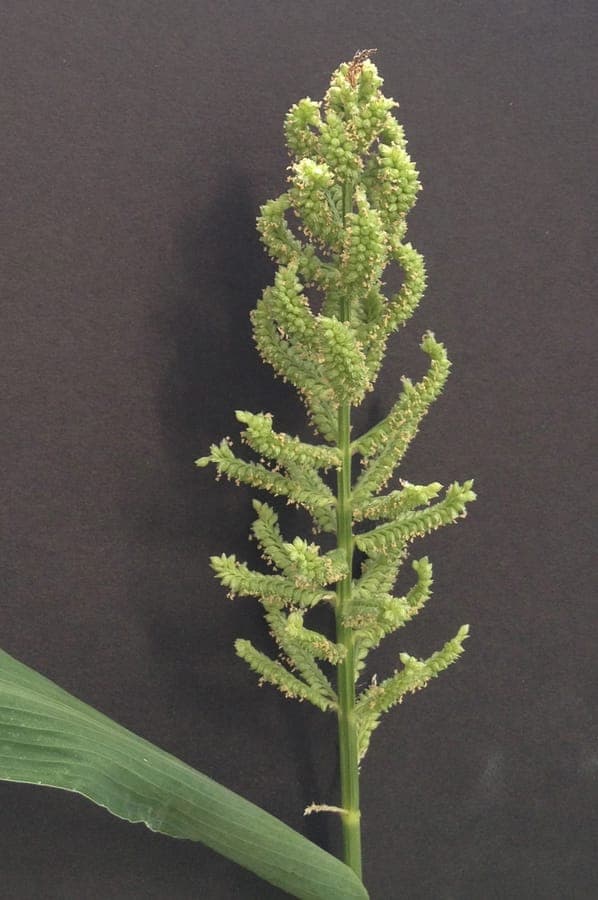
James Schnable / CC BY-SA 4.0, via Wikimedia Commons
Siberian millet: complete guide
Echinochloa frumentacea
Want to see Siberian millet: complete guide in your garden?
1 minute, no credit card
Overview
Siberian millet, or Echinochloa frumentacea, is a striking annual grass gaining popularity in ornamental gardens across temperate zones. Native to regions in central Africa and the Indian subcontinent, this plant thrives in hot, sunny conditions and can shoot up from seed to 120 cm tall in under eight weeks. Despite its name, it's not widely cultivated in Siberia-rather, it's valued in garden design for its upright habit, fine texture, and soft rustling sound in the wind. In the UK and North America, it's often used in summer borders, prairie-style plantings, or as a temporary screen in urban gardens.
On gardenworld.app, you can create a garden layout that highlights Siberian millet's vertical form, especially when paired with lower, spreading perennials. It's also a great choice for beginner gardeners-it's forgiving, fast, and requires minimal intervention once established.
Appearance & bloom cycle
Siberian millet grows in a clump-forming, upright fashion with stiff, cane-like stems and narrow, linear leaves ranging from 20 to 40 cm in length. The foliage is a fresh green with a silvery sheen, thickly arranged along the stem. From late July through September, the plant produces drooping, bristly panicles 8–15 cm long. These start out greenish and gradually mature to a warm tan or light brown, adding seasonal interest to the garden. The seed heads sway gently in the breeze, creating subtle movement and sound-ideal for sensory gardens.
Flowering begins about 6–8 weeks after transplanting, depending on sowing time. If you start seeds indoors in April and transplant in June, blooms appear by early July. While the plant can self-seed, it rarely becomes invasive in cooler climates like USDA zones 6–8 due to winterkill.
Ideal location
Full sun is non-negotiable-this plant needs a 9 out of 10 on the light scale. Choose south- or southwest-facing borders, dry slopes, or open meadow areas where it can soak up at least 8 hours of direct sunlight daily. Siberian millet will grow leggy and flop over in partial shade. Space plants 40–50 cm apart to allow airflow and reduce fungal issues. It works well in modern, naturalistic designs where movement and texture are key.
Use gardenworld.app to simulate sun exposure in your yard. The app's sunlight tracker helps you pinpoint the best spots for sun-hungry grasses like Siberian millet.
Soil requirements
This grass is adaptable but prefers well-drained, sandy, or loamy soils. It tolerates a wide pH range, from 4.7 to 7.4, making it suitable for both slightly acidic and neutral grounds. Avoid heavy clay unless amended with sand or grit. Don't enrich the soil too much-Siberian millet thrives in poor to moderately fertile conditions. Over-fertilizing leads to weak stems and lodging. A light mulch of gravel or bark chips helps suppress weeds and retain moisture without smothering roots.
Free design
Want to see Siberian millet: complete guide in your garden? Make a free design now.
Watering
Keep soil consistently moist during germination and the first month after planting. Once established, the plant is drought-tolerant and survives on rainfall in most summers. During prolonged dry spells, water deeply once a week, aiming at the base to avoid wetting foliage. Overhead watering increases the risk of fungal diseases like rust, especially in humid areas.
Pruning
No pruning is needed during the growing season. In late autumn or early spring, cut back dead stems to 10–15 cm above ground level. Leaving the seed heads over winter adds visual interest and provides food for finches and sparrows. If you prefer a tidier look, remove all biomass in November.
Maintenance calendar
- March: Start seeds indoors at 18–22°C
- April: Harden off seedlings; prepare outdoor bed
- May: Transplant outdoors after last frost; space 40–50 cm apart
- June: Monitor for aphids; water during dry spells
- July: Flowering begins; check for lodging after heavy rain
- August: Peak bloom; avoid fertilizing
- September: Seed heads mature; watch for self-seeding
- October: Plants die back after first frost
- November–February: Cut back or leave standing; collect seed if desired
Winter hardiness
Siberian millet is an annual and not hardy below USDA zone 9. It dies completely after the first hard frost (below -2°C). In most temperate regions, it must be replanted each year. The plant doesn't overwinter, so no special protection is needed. Compost old stems or use them as light mulch.
Companion plants
Pair Siberian millet with other sun-loving, drought-tolerant perennials. Good companions include Echinacea, Salvia nemorosa, Coreopsis, and ornamental sedges like Carex comans. It also contrasts beautifully with bold-flowered plants like Helenium or Rudbeckia. Avoid moisture-loving plants like astilbe or hostas, as their needs clash. In prairie-style schemes, mix with Panicum or Schizachyrium for layered height and texture.
Closing
Siberian millet is a low-effort, high-impact plant that brings vertical drama and movement to the garden. It's perfect for filling gaps quickly, adding rhythm to borders, or creating a natural screen. Seeds are widely available at garden centres across the UK and North America, or you can order them online. For inspiration, check out planting combinations on gardenworld.app-where you can visualise how Siberian millet fits into your space before you buy a single seed.
Want to see Siberian millet: complete guide in your garden? Make a free design now.
Upload a photo, pick a style, and get a photorealistic design with plant list in under a minute.
No credit card required


Similar plants
Sporobolus pungens: complete guide
Sporobolus pungens
Sporobolus pungens is a stoloniferous Mediterranean coastal grass with outstanding salt and drought tolerance, perfect for seaside and dry gardens.
Mediterranean aegilops: complete guide
Aegilops biuncialis
Everything about Aegilops biuncialis, a Mediterranean annual grass with ornamental spikes and outstanding drought tolerance for dry gardens.
Silver bluestem: complete guide
Bothriochloa saccharoides
Full guide to Bothriochloa saccharoides (silver bluestem): site, soil, watering, winter hardiness, pruning, and garden companions.