
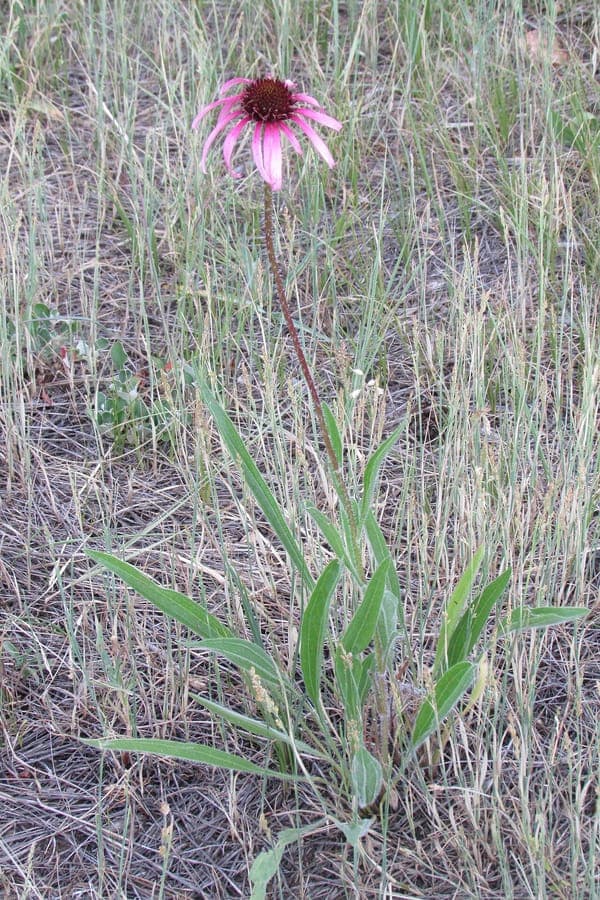
Chris Light / CC BY-SA 4.0, via Wikimedia Commons
Black-sampson echinacea: complete guide
Echinacea angustifolia
Want to see Black-sampson echinacea: complete guide in your garden?
1 minute, no credit card
Overview
Echinacea angustifolia, commonly known as Black-sampson echinacea, is a tough, upright perennial native to the central prairies of North America. Unlike its showier cousin Echinacea purpurea, this species has narrow, silvery-green foliage and a tighter growth habit, making it ideal for structured, naturalistic designs. It thrives in dry, open conditions - perfect for gardens where water is scarce or maintenance is minimal. If you're planning a xeriscape or prairie-style border, this plant deserves a spot. On gardenworld.app, you can build a custom garden layout that highlights drought-tolerant perennials like this one.
This forb grows 50 to 70 cm tall with stiff, straight stems and minimal lateral branching. It blooms from June to mid-August, producing cone-shaped flowers that attract bees, butterflies, and hoverflies. The plant dies back completely in winter, but the dried seed heads remain upright, adding winter texture and serving as a food source for birds.
Appearance & bloom cycle
The flower is classic echinacea: a raised, spiky central cone in deep brown, surrounded by narrow, reflexed petals in soft purple. Each bloom is 7 to 10 cm across, and the petals are noticeably thinner and more rigid than those of E. purpurea. The central cone matures from green to dark brown, and the seeds are rich in oils, making them attractive to goldfinches.
Foliage is narrow and linear, 10–20 cm long and less than 1 cm wide, with a fine down that gives it a silvery sheen. Leaves grow mostly at the base, forming a low clump before the flowering stems rise. The overall effect is airy and vertical - a great contrast to mounding or spreading plants.
Ideal location
Plant in full sun - at least 6 hours of direct sunlight daily. In partial shade, stems become leggy and flowers diminish. A windy, open site is beneficial; it strengthens the stems and reduces humidity, lowering disease risk. This plant excels in gravel gardens, dry meadow plantings, or structured perennial borders.
It's hardy in USDA zones 3 to 8, so it handles cold winters and hot summers alike. Avoid planting in low-lying, wet areas or under dense tree canopies. In urban gardens, place it near patios or pathways where its upright form can be appreciated.
Soil requirements
Well-drained soil is non-negotiable. Heavy clay must be amended with coarse sand and grit to improve drainage. The ideal pH is between 6.5 and 7.2 - slightly acidic to neutral. Rich, overly fertile soils encourage lush foliage but fewer flowers and floppy stems.
Use a mix of native soil, compost, and sand (1:1:1) when planting. Avoid high-nitrogen fertilizers. On gardenworld.app, there's a soil compatibility checker that helps you assess whether your garden bed suits plants like Echinacea angustifolia.
Free design
Want to see Black-sampson echinacea: complete guide in your garden? Make a free design now.
Watering
Once established, this echinacea needs no supplemental watering, even during dry spells. Young plants require weekly deep watering through their first summer to develop strong taproots. After that, rainfall is usually sufficient.
Overwatering causes root rot, especially in poorly drained soils. Water only at the base, and avoid wetting the foliage. Drip irrigation works best. In rainy summers, don't water at all.
Pruning
Pruning is minimal. Leave the seed heads intact over winter for visual interest and wildlife support. Cut back old stems in early spring, around March, to 10 cm above ground level. Use clean, sharp shears to prevent disease spread.
Deadheading isn't necessary - the plant doesn't rebloom, and spent flowers add winter structure. If you're using it as a cut flower, harvest stems when petals are fully unfurled but still firm.
Maintenance calendar
- March: Cut back old growth, check for crown rot
- April: New shoots emerge; keep area weed-free
- May: Monitor for slugs; water young plants if dry
- June–August: Peak bloom; no extra care needed
- September: Flowers fade; leave seed heads
- October–February: Dormant; no maintenance
Winter hardiness
Hardy to -34°C (USDA zone 3), Echinacea angustifolia survives harsh winters without protection. The plant retreats to its deep taproot, which stores energy for spring regrowth. Snow cover actually benefits it by insulating the crown. Avoid mulching heavily - it can trap moisture and lead to rot.
The dried stems and cones provide winter habitat for beneficial insects and look striking under frost.
Companion plants
Pair with other sun-loving, drought-tolerant perennials: Rudbeckia hirta, Salvia nemorosa, Solidago rugosa, or little bluestem grass (Schizachyrium scoparium). These share similar soil and light needs. Add low-growers like creeping thyme (Thymus serpyllum) for ground cover.
Avoid aggressive spreaders like mint or goldenrod in small gardens. Use rhythmic spacing - plant in groups of 3 or 5 for visual impact. This works well in prairie-inspired designs or modern gravel gardens.
Closing
Black-sampson echinacea is an underrated gem for low-maintenance, wildlife-friendly gardens. It's tough, long-lived, and beautiful in all seasons. You'll find it at garden centres across the UK and US, and increasingly in specialist nurseries. Look for it at stores like garden centres (generic), but check the label - it's often confused with E. purpurea.
If you're unsure about spacing or design, try the garden planner on gardenworld.app. It shows how this plant matures and fits with companions over time.
Want to see Black-sampson echinacea: complete guide in your garden? Make a free design now.
Upload a photo, pick a style, and get a photorealistic design with plant list in under a minute.
No credit card required


Similar plants
Calendula stellata: complete guide
Calendula stellata
Complete guide to Calendula stellata, the star-flowered marigold from Sicily: location, soil, watering and companion planting tips.
Korean chrysanthemum: complete guide
Chrysanthemum x rubellum
Chrysanthemum x rubellum is a hardy autumn perennial with single pink to copper flowers from August to November. Care and combinations.
Helianthus divaricatus: complete guide
Helianthus divaricatus
Helianthus divaricatus is a North American woodland sunflower with yellow summer blooms, ideal for naturalistic borders and shady edges.