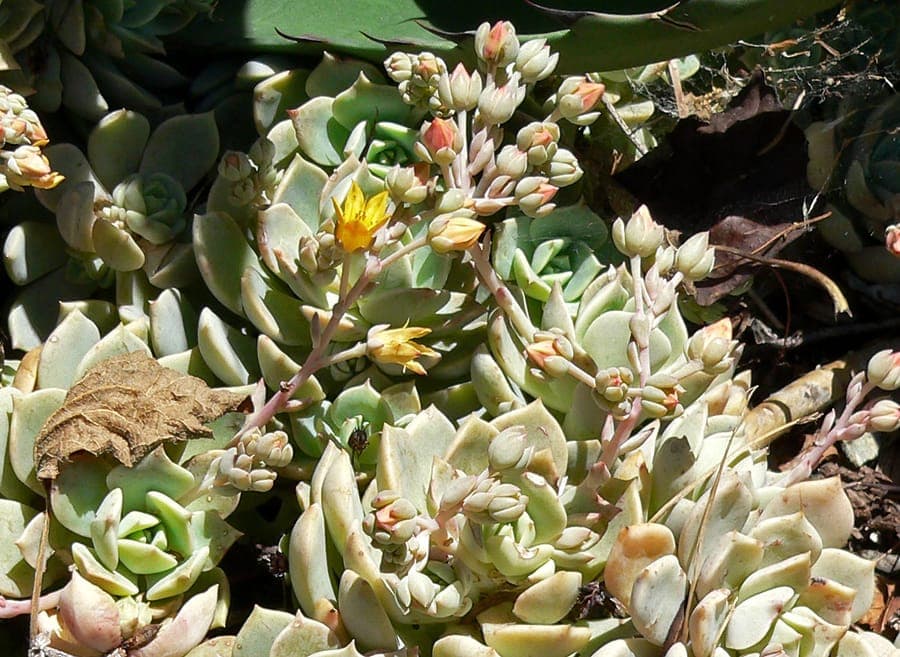
Stan Shebs / CC BY-SA 3.0, via Wikimedia Commons
Copper-roses: complete guide
Echeveria multicaulis
Want to see Copper-roses: complete guide in your garden?
Full design in HD: €7.99
Look after your Copper-roses with the GardenWorld app
Identify plants with your camera and get a care calendar with reminders for this plant.


Overview
The copper-roses (Echeveria multicaulis) is a stunning succulent from the Crassulaceae family, native to Mexico (Jalisco and Guerrero). This is a true color jewel with warm copper and bronze tones throughout. It's a drought-tolerant plant perfectly suited to hot, sunny gardens where water is precious.
Appearance and Bloom
This compact succulent grows in rosette formation, typically 15-25 cm in diameter. Leaves are thick, fleshy, and display warm copper to dark bronze tones - hence the common name "copper-roses." In summer, golden-yellow flowers emerge on tall stalks, attracting pollinators and signaling seed production.
Ideal Location
Full sun is essential for maintaining the beautiful coppery coloration. Choose a location receiving at least 6-8 hours of direct sunlight daily. The plant tolerates intense heat and UV radiation exceptionally well. In extremely hot climates, light afternoon shade may help, though usually unnecessary.
Soil Requirements
Use well-draining succulent potting soil. Add extra grit or sand to standard peat-based soil. This succulent thrives in poor, sandy soils where other plants struggle. Aim for at least 50% mineral components in your mix to prevent waterlogging.
Watering
Minimal water is required. Allow soil to dry completely between waterings. During the growing season (May-October), water sparingly - once every 2-3 weeks suffices. From November through April, water very little or not at all. Overwatering is the primary threat to this species.
Free preview
Want to see Copper-roses: complete guide in your garden? Make a free preview of your design.
Pruning
No maintenance pruning is necessary. This plant grows compactly by nature. Simply remove dead or damaged leaves at the base. Flower stalks may be removed after blooming to conserve the plant's energy, though this is optional.
Maintenance Calendar
March: Inspect for damage. Check drainage holes in containers. April-May: Begin watering cautiously. June-October: Water sparingly, once every 3 weeks. November-March: Minimal water. Note: very dormant in cold periods.
Winter Hardiness
The copper-roses is not winter-hardy outside subtropical zones. Growing temperature must remain above 10 degrees Celsius; ideal range is 15-25 degrees. In cold climates, grow as an indoor plant. Frost is fatal.
Companion Plants
Pair with other drought-loving succulents. Sedum, Sempervivum, and Crassula create lovely combinations. In gravel gardens, it's beautiful alongside Aeonium and Agave. Creates striking contrast with gray-foliaged lavender.
Closing Thoughts
The copper-roses is a jewel for drought-tolerant gardeners and succulent enthusiasts. With its warm copper coloring, compact form, and minimal water requirements, it's a classic succulent. Find young plants at gardenworld.app that will quickly mature in proper conditions. This is design gold for contemporary gardens!
Frequently asked questions about Copper-roses
Is Copper-roses winter hardy?
The copper-roses is not winter-hardy outside subtropical zones. Growing temperature must remain above 10 degrees Celsius; ideal range is 15-25 degrees.
When and how do you prune Copper-roses?
No maintenance pruning is necessary. This plant grows compactly by nature.
How much water does Copper-roses need?
Minimal water is required. Allow soil to dry completely between waterings.
Where does Copper-roses grow best?
Full sun is essential for maintaining the beautiful coppery coloration. Choose a location receiving at least 6-8 hours of direct sunlight daily.
What soil does Copper-roses need?
Use well-draining succulent potting soil. Add extra grit or sand to standard peat-based soil.

See it in your garden
See Copper-roses in your garden
One photo of your garden and a few questions. You see the result in about a minute.
Try it with a photoIdentify this plant in your own garden. Identify a plant
Similar plants
Aeonium tabuliforme: growing the saucer plant
Aeonium tabuliforme
Aeonium tabuliforme, the saucer plant, forms a flat, hairy rosette like a green plate. How to grow this Tenerife succulent, tilt it, water it and overwinter it.
String of buttons (Crassula perforata): care guide
Crassula perforata
How to grow string of buttons, Crassula perforata: light, watering, compost, cuttings and overwintering for this succulent with leaf pairs stacked like beads on a stem.
Glaucous echeveria (Echeveria secunda): complete guide
Echeveria secunda
Echeveria secunda forms mats of blue-grey rosettes with red leaf tips and is one of the toughest echeverias. Light, watering, potting mix, propagation and pet safety.
