
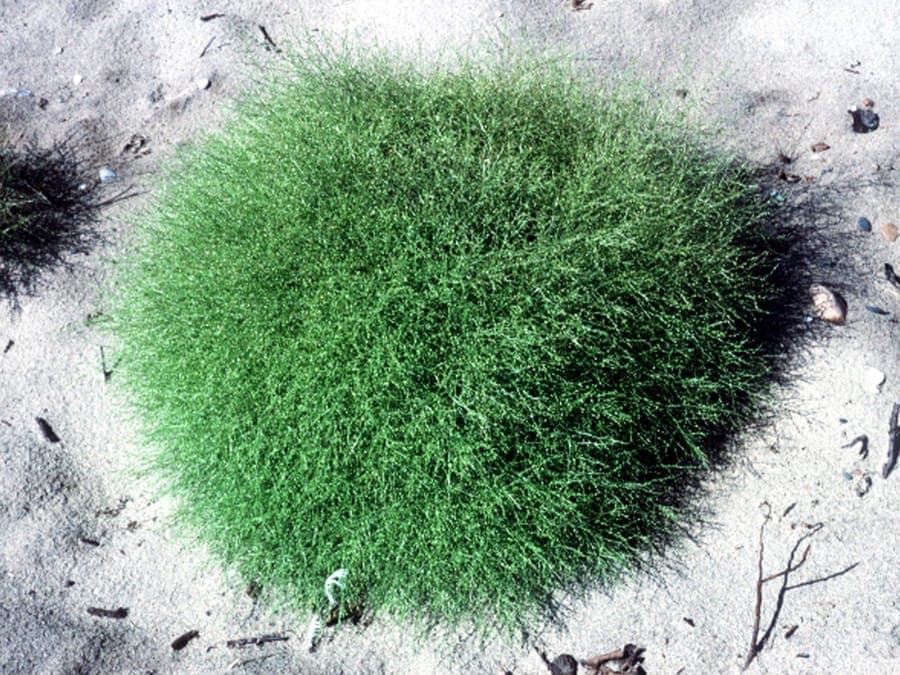
Robert H. Mohlenbrock. USDA SCS. 1989. Midwest wetland flora: Field office illustrated guide to plant species. Midwest National Technical Center, Lincoln. Courtesy of USDA NRCS Wetland Science Institute. / Public domain, via Wikimedia Commons
Winged Pigweed (Dysphania atriplicifolia): complete guide
Dysphania atriplicifolia
Want to see Winged Pigweed (Dysphania atriplicifolia): complete guide in your garden?
1 minute, no credit card
Overview
Dysphania atriplicifolia, commonly known as winged pigweed or plains tumbleweed, is a fascinating annual plant in the Amaranthaceae family. This distinctive plant grows naturally in North America from Canada to Mexico and is renowned for its peculiar rolling behavior at season's end. The plant brings unique form and structure to the garden, especially during dry summer months.
Winged pigweed distinguishes itself through rapid growth, extreme drought tolerance, and a remarkable reproduction strategy: at season's end, the entire plant dries, breaks from its roots, and rolls across the landscape as a tumbleweed, dispersing seeds with the wind.
Appearance and Growth
Dysphania atriplicifolia grows as an upright, shrubby plant reaching approximately 30-80 cm tall (sometimes taller under optimal conditions). The stems are reddish to greenish, with characteristic striped wings along the branches. The leaves are small, linear to lanceolate, and display a silver-green color.
In summer, small, inconspicuous flowers cluster along the stems. After blooming, tiny seeds form within small wing-like structures. These wings are highly characteristic and give the plant its name.
At season's end, the roots break and the entire plant becomes tan-brown, after which the plant forms into a sphere and rolls like a tumbleweed across the ground.
Ideal Location
Winged pigweed prefers full sun to partial shade. The plant grows best in sunny, open locations receiving abundant light. In semi-arid regions, this is truly the plant for dry terrain.
Position the plant where it will not obstruct walkways when it forms tumbleweeds at season's end. A somewhat remote, dry garden area is ideal. When planted in groups, it looks quite decorative, especially as it develops its characteristic tumble form.
Soil
Dysphania atriplicifolia is not particular regarding soil. It grows on virtually all soil types, from sand to clay, provided drainage is good. Ideal pH is neutral to slightly acidic (6.5-7.5). The plant prefers poor to moderately fertile soils.
Ensure the soil drains well. Permanent water pooling can cause plant failure. In very heavy soils, amend with sand or gravel.
Watering
Once established, winged pigweed is extremely drought-tolerant. Water when first sown until the plant is established, but thereafter minimal watering suffices. The plant actually thrives in semi-arid conditions.
During extremely hot, dry periods, supplemental water can stimulate growth, but it is not necessary. Ensure water does not pool around the plant base, as this invites root rot. Reduced summer watering will actually hasten maturity and tumbleweed formation.
Free design
Want to see Winged Pigweed (Dysphania atriplicifolia): complete guide in your garden? Make a free design now.
Pruning
Pruning is not necessary and usually undesirable. Allow the plant to develop its natural form. If you have overly congested branches, you can prune them back, but allow enough plant material for reproduction.
At season's end, if you wish to prevent tumbleweed formation, you can remove the entire plant before senescence. Otherwise, simply let it happen and enjoy the characteristic form.
Maintenance Calendar
May-June: Sow outdoors after frost danger passes. Water well until established.
July-August: Growth at full strength. Regular watering stimulates further growth. Monitor for insects.
September: Flowering peaks. Gradually reduce watering.
October-November: Plant begins senescence. Roots loosen. Characteristic tumbleweed form develops.
December: Tumbleweed rolls away, seed disperses. Plant dies completely.
January-April: Dormancy period. Self-seeding may occur from dispersed seed.
Winter Hardiness
Dysphania atriplicifolia is an annual plant and cannot tolerate frost. After the first frost, the plant dies completely. This is normal and expected. New plants grow the following summer from self-seeding or fresh seed.
In very warm climates (zone 10+), the plant may sometimes overwinter, but this is rare. It is actually better to allow seed to fall and repeat the cycle.
Companion Plants
Dysphania atriplicifolia works well in dry gardens with other drought-tolerant annuals such as zinnia, statice, and cosmos. Combinations with low-growing ground covers in rock gardens are also interesting. For contrast, plant it with larger, darker-leaved specimens.
In prairie gardens, it is part of a natural composition. The seeds feed birds, especially later in the season when other food is scarce.
Conclusion
Dysphania atriplicifolia is a fascinating annual for dry, sunny gardens. With minimal care and water, it thrives excellently. Plant in groups for maximum effect. Seed is sometimes difficult to find, but specialized seed companies stock it. You can also collect seed from previous seasons.
At GardenWorld, design your dream front yard with color and structure year-round. Upload a photo and let our designers create a complete plan with plant recommendations, including interesting annuals like Dysphania atriplicifolia where suitable.
Want to see Winged Pigweed (Dysphania atriplicifolia): complete guide in your garden? Make a free design now.
Upload a photo, pick a style, and get a photorealistic design with plant list in under a minute.
No credit card required


Similar plants
Bassia laniflora (woolly summer-cypress): complete guide
Bassia laniflora
Full guide to Bassia laniflora: origin, appearance, ideal location, soil, watering and care for this drought-tolerant annual.
Suaeda spicata: complete guide
Suaeda spicata
Everything about Suaeda spicata (spiked seablite): a rare salt-tolerant coastal succulent from the western Mediterranean and Macaronesia.
California amaranth: complete guide
Amaranthus californicus
Full guide to California amaranth (Amaranthus californicus): growing tips, ideal location, soil needs, watering, and garden design ideas.