
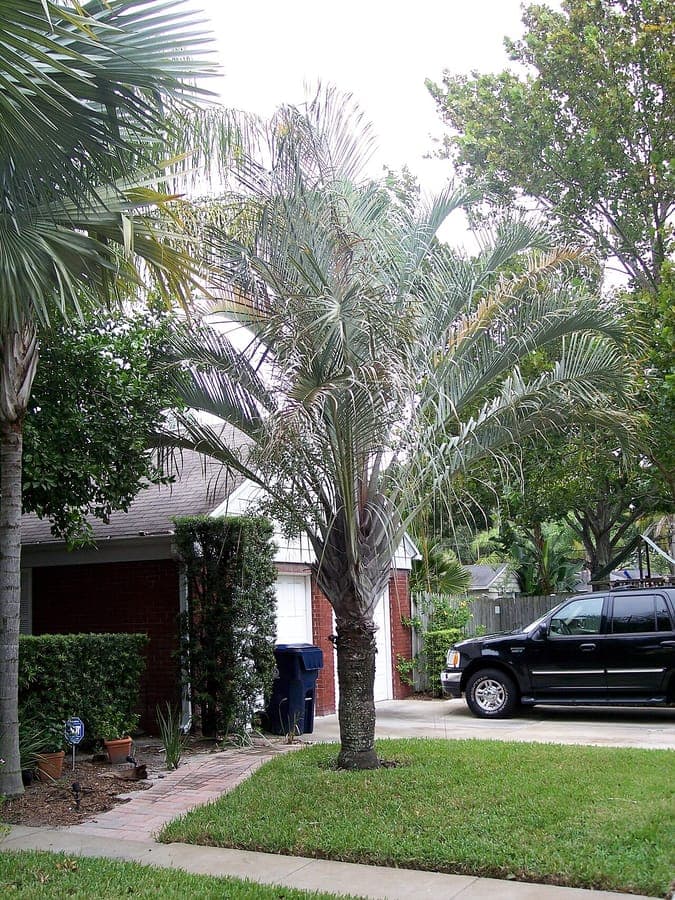
Mmcknight4 / Public domain, via Wikimedia Commons
Dypsis decaryi: complete guide
Dypsis decaryi
Want to see Dypsis decaryi: complete guide in your garden?
1 minute, no credit card
Overview
Dypsis decaryi, known as the Triangle palm, is one of the most striking and decorative palms from Madagascar. This tree belongs to the Arecaceae family (palm family) and is prized for its unique, three-sided leaf arrangement that creates an unparalleled triangular silhouette. It is widely used in luxury and tropical gardens for its spectacular appearance and fine architectural form.
As a native plant of southeastern Madagascar, it is adapted to warm, subtropical climates. While it does not grow well outdoors in temperate Europe, it is an excellent container plant for sheltered locations or conservatories.
Appearance and Bloom
Dypsis decaryi is immediately recognizable because of its unique leaf shape. The fronds - the large leaves - grow in three distinct rows that together form an exact triangle when viewed from above. This gave the palm its popular name.
Each frond is approximately 50-80 cm long and has a gray-green color. The fronds are pinnate (comb-like) divided, meaning smaller leaflets grow along a central axis.
In its natural habitat, Dypsis decaryi grows to about 6-8 meters in height, though in containers it usually remains considerably more compact.
The flowers are small, yellow flowers that appear below the leaf sheaths. They are followed by red fruits approximately 1 cm in diameter.
Ideal Location
Dypsis decaryi prefers very sunny, warm locations. In subtropical and tropical gardens it can grow in full sun, although some afternoon shade in extremely hot climates can be beneficial.
The plant must be protected from strong winds due to its slender trunk. A windbreak on the north or west side is important, especially for young plants.
Ensure sufficient space for the plant's full growth - at least 3-4 meters from other structures.
Soil
Dypsis decaryi grows best in well-draining, fertile soil. A mixture of:
- 40% universal potting soil
- 30% fine sand
- 20% compost
- 10% perlite
The plant accepts neutral to slightly acidic pH (6.0-7.0). Crucial element: good drainage is essential. Standing water leads to root rot.
Free design
Want to see Dypsis decaryi: complete guide in your garden? Make a free design now.
Watering
During the growing season (spring and summer), water regularly. Water when the top inch of soil feels dry. This may be two to three times per week in very warm climates.
Reduce watering in autumn and winter as growth slows. In these seasons, water only once every two weeks.
Monitor for overwatering - this is the main cause of death for Dypsis decaryi in containers. The plant prefers the dry side rather than waterlogged.
Pruning
Dypsis decaryi requires minimal pruning. Carefully remove dead or damaged fronds at the base. Do not prune healthy leaf material - it does not help growth and can damage the plant.
The plant needs no topping - it assumes its natural triangular shape. Allow the structure to develop naturally.
Maintenance Calendar
Spring (March-May): Begin growth. Regular watering. Apply slow-release fertilizer focused on potassium. Check for scale insects.
Summer (June-August): Peak growth. Frequent watering. Afternoon shade can be beneficial. Monitor for moisture problems.
Autumn (September-October): Growth slows. Reduce watering. Check humidity levels.
Winter (November-February): Plant enters dormancy. Minimal watering. No fertilizing.
Winter Hardiness
Dypsis decaryi is not winter-hardy. Temperatures below 10°C stop growth, and temperatures below 5°C can cause serious damage.
In temperate climates, the plant must grow in containers and be moved indoors in winter. Outdoors it can only grow in very warm, sheltered gardens in southeastern Spain, southern France, or southern Portugal.
Companion Plants
In tropical and subtropical gardens, Dypsis decaryi combines beautifully with:
- Other Madagascar palms such as Cataractarum
- Exotic flowers such as Strelitzia and Heliconia
- Dark-leaved plants such as Coleus for contrast
- Shade-tolerant ground covers
The triangular form of Dypsis decaryi works particularly well as a focal point in the center of a garden.
Closing
Dypsis decaryi is an extraordinary palm with an unparalleled form and elegance. For tropical and subtropical garden owners, it is a must-have focal plant. For European garden owners in temperate climates, it can be a specimen plant that spends winter in a greenhouse, conservatory, or well-sheltered porch.
For purchase: Intratuin (exotic palms section), Gamma, and gardenworld.app.
Want to see Dypsis decaryi: complete guide in your garden? Make a free design now.
Upload a photo, pick a style, and get a photorealistic design with plant list in under a minute.
No credit card required


Similar plants
Needle palm: complete guide
Rhapidophyllum hystrix
Everything about the needle palm: the world's hardiest palm, suitable for gardens in temperate climates down to USDA zone 7b.
Saw palmetto: complete guide
Serenoa repens
A complete guide to saw palmetto (Serenoa repens), the iconic fan palm from Florida and the southeastern United States, prized for its toughness.
Puerto Rican hat palm: complete guide
Sabal causiarum
Grow Puerto Rican hat palm successfully. A majestic fan palm with tropical presence suited to sheltered Mediterranean-style gardens.