
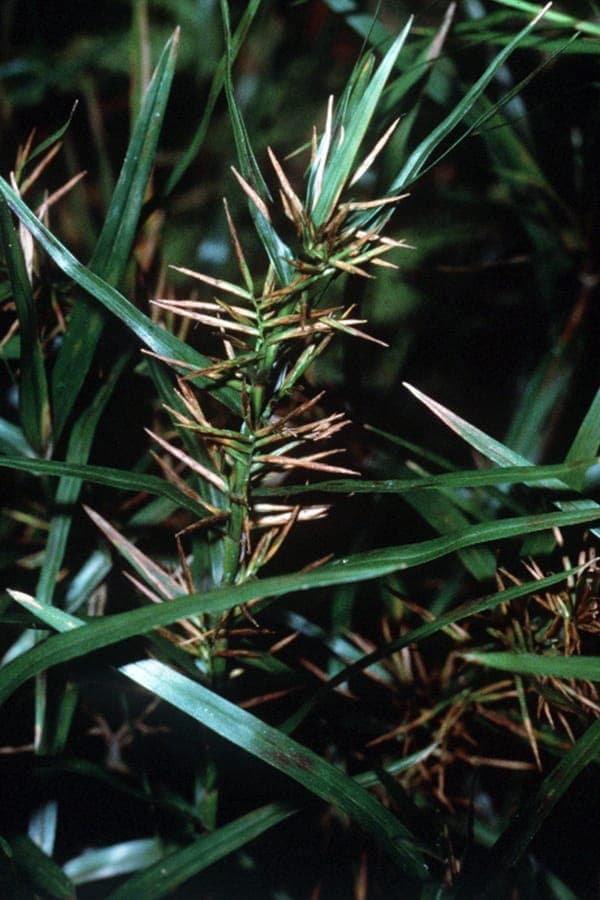
Robert H. Mohlenbrock. USDA SCS. 1989. Midwest wetland flora: Field office illustrated guide to plant species. Midwest National Technical Center, Lincoln. Courtesy of USDA NRCS Wetland Science Institute. / Public domain, via Wikimedia Commons
Threeway sedge: complete guide
Dulichium arundinaceum
Want to see Threeway sedge: complete guide in your garden?
1 minute, no credit card
Overview
Dulichium arundinaceum, the threeway sedge, is a remarkable aquatic and wetland plant native to much of North America - from Canada south through the eastern and central United States to Florida and Texas, and with populations extending to the Pacific coast states. It is the only species in the genus Dulichium, making it monotypic and botanically unique within the sedge family Cyperaceae.
The species name 'arundinaceum' - meaning reed-like or resembling Arundo - refers to the hollow, bamboo-like stems that give the plant its distinctive appearance. The common name 'threeway sedge' describes the arrangement of leaves in three ranks (tristichous) along the stem, creating a visually striking pattern unlike most other sedges.
For pond margins, bog gardens, rain gardens, and naturalistic water features, threeway sedge is an outstanding choice. It stabilises banks with its rhizomatous root system, tolerates a wide pH range, and provides year-round structural interest. At gardenworld.app you can explore water garden and pond margin designs that incorporate plants like this one.
Appearance and Bloom Cycle
Threeway sedge grows as a rhizomatous clump, sending up hollow, round stems that reach 30 to 100 cm tall depending on water depth and fertility. The stems closely resemble small bamboo canes - jointed, round in cross-section, and relatively rigid. Narrow, strap-like leaves are arranged in three ranks along each stem, creating a tidy, three-dimensional pattern that sets this plant apart from flat-leaved sedges.
Flowers are small, brown spikelets borne in the leaf axils, inconspicuous individually but adding a quiet texture when numerous. Flowering runs from July through September. The plant is primarily a foliage and structural plant rather than a flowering one: its appeal lies in the elegant stem habit and fresh green colour through the growing season.
In autumn, stems turn yellow before dying back. The stubble of dried stems persists through winter. The rhizomatous growth means clumps expand steadily from year to year, gradually colonising available wet ground.
Ideal Location
Threeway sedge is a true wetland plant that performs best in permanently wet or waterlogged conditions - the margins of ponds, streams, ditches, bogs, and rain gardens. It grows in standing water up to about 15-20 cm deep and is at its most vigorous when the root zone stays consistently saturated.
Full sun to partial shade are both acceptable. In full sun, growth is lush and the green colour most vivid. Partial shade reduces vigour slightly but is well tolerated. Unlike many aquatic plants, threeway sedge handles dappled shade under trees reasonably well, expanding its usefulness in gardens where sunny pond margins are not always possible.
A particularly notable feature is the wide pH tolerance: from pH 4.7 to 7.5. This makes it suitable for acid bog gardens, rain-fed wildlife ponds with low pH, and heathland-style water features - situations where most marginal plants struggle. It is one of the most pH-versatile marginal plants available.
Soil Requirements
Threeway sedge is unfussy about soil type provided moisture is adequate. It grows in peaty, silty, clay, and sandy substrates, adapting to a range of wetland soil types. The unifying requirement is a high and stable moisture level.
The remarkable pH tolerance from 4.7 to 7.5 distinguishes this species from many marginals that prefer neutral to slightly alkaline conditions. It thrives in acidic bog conditions, making it valuable for specialist wildlife ponds and rain garden systems using collected rainwater.
When planting in a new pond margin, use an aquatic planting medium or a mix of loam and horticultural grit. Avoid using general peat-based compost in open water as it can affect water quality. In bog gardens, existing wet, peaty soil needs no amendment.
Watering
In the right location, threeway sedge needs no supplemental watering: it should be planted where the soil is permanently wet or in shallow standing water. For plants in bog border situations where the ground dries occasionally in summer, ensure consistent moisture by deep mulching and watering during dry spells.
Do not allow the root zone to dry out completely even briefly. Unlike many ornamental grasses that recover from drought, this true wetland plant suffers setback when the soil dries, and recovery is slow. This is the most common cultural mistake when placing it in garden borders rather than true pond margins.
When first planted, monitor water levels closely until the plant is established and sending out new rhizomes. Once established, it is highly self-sufficient in a true wetland setting.
Free design
Want to see Threeway sedge: complete guide in your garden? Make a free design now.
Pruning
Threeway sedge requires minimal pruning. In early spring, March to April, cut back the previous season's dead stems to 5-10 cm above the water or ground level. This is cosmetic rather than essential, but it tidies the plant and makes room for new growth.
If the clump expands beyond its intended area, restrain it in early spring by cutting back rhizomes at the desired boundary with a spade. This is the most practical form of maintenance for this species. Annual edge control keeps the plant in bounds without harming it.
Division in early spring or early autumn is a simple way to propagate the plant or rejuvenate a large clump. Lift the clump, divide it with a spade, and replant sections. Each division quickly establishes and begins spreading again.
Maintenance Calendar
January-February: Leave dried stems in place for winter structure and insect shelter. No action needed.
March-April: Cut back dead stems to 5-10 cm. Check and control rhizome spread if needed. Good time for division.
May-June: Rapid new growth. Bamboo-like stems elongate quickly. Monitor water level around the plant.
July-August: Summer flowering period. Brown spikelets visible. Plant at its structural best. Check for unwanted spread.
September-October: Growth slows. Stems turn yellow-green. Last opportunity for division if needed.
November-December: Dormant period. Leave dried stems for winter interest and wildlife. No maintenance needed.
Winter Hardiness
Threeway sedge is reliably cold-hardy across most of its native range and in cultivation in northern Europe. It is rated to USDA zone 4, tolerating temperatures down to around -34°C. In the UK, Belgium, the Netherlands, and northern Germany, no winter protection is needed.
When the pond or bog freezes, the above-ground portions die back, but the rhizomes in the soil survive hard freezes well. New growth emerges in spring as soon as temperatures rise. Even after exceptionally cold winters, established clumps regenerate fully.
In container culture on terraces, the roots are more exposed to freezing and may need protection such as moving the container to a sheltered spot or wrapping it in insulating material during severe frost spells.
Companion Plants
Threeway sedge pairs naturally with other wetland and marginal plants that share its habitat requirements. Typha species (bulrushes) provide bold, upright contrast with their distinctive brown seed heads. Yellow flag iris (Iris pseudacorus) is a classic pond margin companion that flowers brilliantly alongside the structural green of threeway sedge.
For a more layered, naturalistic bog garden, combine with Carex riparia, Carex acutiformis, and other native sedges for varied texture and leaf width. Water mint (Mentha aquatica) fills shallower wet zones with aromatic foliage. For a rain garden or wildlife pond, native rushes (Juncus species) are ideal companions.
For personalised water garden design incorporating marginal plants like threeway sedge, visit gardenworld.app and explore pond margin planting combinations that suit your garden.
Conclusion
Dulichium arundinaceum, the threeway sedge, is a botanically unique and garden-worthy plant that brings architectural elegance to any water feature or bog garden. Its hollow, bamboo-like stems, three-ranked leaf arrangement, and exceptional pH tolerance set it apart from other marginals. Hardy, low-maintenance, and ecologically valuable, it provides habitat and nesting material for water birds and shelter for aquatic invertebrates.
Look for it at specialist aquatic plant nurseries and water garden suppliers. Plant at pond margins or in shallow standing water, in groups of two to four plants per metre of bank, and allow the rhizomes to spread naturally into a dense, stabilising fringe. Within a few seasons, threeway sedge will create a naturalistic, self-sustaining margin that rewards with year-round structure and seasonal interest.
Want to see Threeway sedge: complete guide in your garden? Make a free design now.
Upload a photo, pick a style, and get a photorealistic design with plant list in under a minute.
10,000+ gardens designed already
No credit card required


Similar plants
Tufted hairgrass: complete guide
Deschampsia cespitosa
Discover Deschampsia cespitosa, an elegant ornamental grass with fine plumes year-round. Thrives in moist to wet soils and adds winter structure to borders.
Barnyard grass: complete guide
Dactylis glomerata
Comprehensive guide to Dactylis glomerata: ideal soil, sun exposure, care tips, and companion plants. Perfect for low-maintenance meadow or wild gardens.