
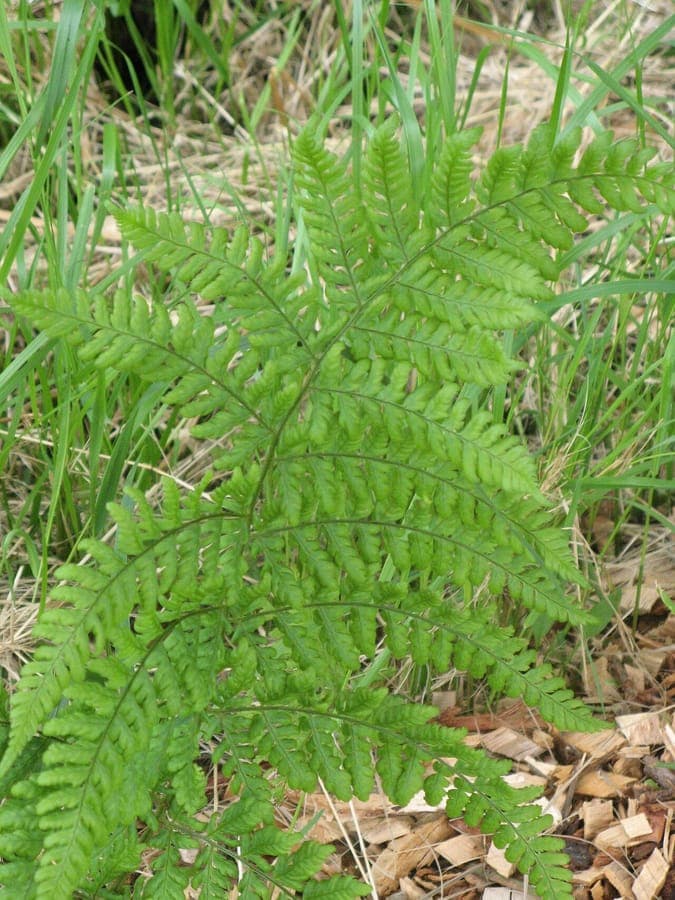
Southgeist / CC BY-SA 3.0, via Wikimedia Commons
Mountain wood fern: complete guide
Dryopteris dilatata
Want to see Mountain wood fern: complete guide in your garden?
1 minute, no credit card
Overview
Dryopteris dilatata, commonly known as the Mountain wood fern, is a rugged, evergreen fern native to woodlands across Europe, including the UK, Belgium, and parts of Eastern Europe. It's a staple in shade gardens thanks to its bold, arching fronds and ability to thrive where many other plants struggle. Mature specimens reach 50–90 cm in height and spread 60–80 cm wide, forming dense clumps over time. Hardy in USDA zones 5–8, it's a long-lived perennial that adds structure and texture year-round.
This fern doesn't flower, but its presence is felt through its foliage alone. It's a go-to for naturalistic planting schemes, especially in damp, shaded corners under trees or along north-facing walls. On gardenworld.app, you can visualise how this fern integrates into a layered woodland design with just a few clicks.
Appearance & bloom cycle
The fronds of Dryopteris dilatata are triangular in outline, deeply divided, and appear in a rich, dark green. In spring, new growth emerges as tightly coiled fiddleheads that unfurl into broad, 3-pinnate fronds. These can last through winter in milder climates, though they may brown slightly in harsh conditions. The plant doesn't bloom, but fertile fronds develop clusters of round, brown sori (spore cases) along the underside of the leaflets from June to September.
There's no true bloom cycle, but the rhythm of growth is clear: new fronds appear from March to May, peak in summer, and persist into winter. In colder zones, older fronds are trimmed back in late winter to make way for fresh growth.
Ideal location
This fern thrives in dappled shade to full shade – aim for a light level of 3 on a 1–10 scale (1 being full sun, 10 full shade). It performs best under deciduous trees, on woodland edges, or in sheltered, moist areas of the garden. Avoid hot, south-facing spots with afternoon sun, as this will scorch the fronds and dry out the soil too quickly. East- or north-facing positions are ideal.
If you're unsure about light conditions in your garden, gardenworld.app offers a sun mapping tool that helps pinpoint the best spots for shade-loving plants like the Mountain wood fern.
Soil requirements
Dryopteris dilatata prefers moist, humus-rich, well-drained soil with a pH between 5.0 and 5.5. It tolerates clay and loam but struggles in dry, sandy soils. Amend the planting hole with leaf mould, composted bark, or well-rotted compost to improve moisture retention and fertility. Avoid liming the soil, as alkaline conditions can lead to yellowing fronds.
Free design
Want to see Mountain wood fern: complete guide in your garden? Make a free design now.
Watering
Keep the soil consistently moist, especially in the first growing season. Water deeply once a week during dry spells in summer. Once established, it can handle short dry periods, but prolonged drought will cause frond dieback. Mulch with leaf litter or compost in spring to retain moisture and suppress weeds. Rainwater is preferred – this fern evolved in forest settings where rain, not tap water, is the norm.
Pruning
Pruning is minimal. In late winter (February to early March), cut back any damaged, brown, or tattered fronds at the base. This clears space for new growth and reduces disease risk. Use clean, sharp secateurs and avoid cutting into the crown. Don't prune in autumn – old fronds help insulate the plant over winter.
Maintenance calendar
- January: Check for winter damage, keep area tidy
- February: Begin removing old fronds
- March: Finish cleanup, apply thin mulch of compost
- April: Monitor for new fiddleheads, ensure soil moisture
- May: Peak growth; water if dry
- June: Fertile fronds develop sori; no feeding needed
- July–August: Water during extended dry periods
- September: Reduce watering, let plant harden off
- October: Leave fronds in place for winter protection
- November–January: Minimal care; mulch if container-grown
Winter hardiness
Hardy to -20°C (USDA zone 5), Dryopteris dilatata survives most UK and northern US winters without issue. In exposed sites or pots, add a 5–10 cm layer of mulch around the base to protect the rhizome. Container plants should be moved to a sheltered spot or insulated with hessian and bubble wrap. In zone 8 and above, the fronds often remain fully evergreen.
Companion plants
Pair with other shade-tolerant perennials like Helleborus, Hosta, Epimedium, or Alchemilla mollis. Small spring bulbs like Erythronium or Chionodoxa peek through the emerging fronds beautifully. Avoid invasive groundcovers like Vinca minor that might smother it. A naturalistic mix with Tiarella or Carex divulsa enhances texture and interest.
Closing
The Mountain wood fern is a resilient, elegant choice for shaded areas. It demands little, yet delivers big in terms of form and foliage. With proper planting and care, it'll thrive for years, slowly expanding into a lush clump. Look for healthy plants in 2L or 3L pots at garden centres across the UK and US. Reputable retailers often stock it in spring. Avoid specimens with dry soil or yellowing fronds. Once planted, this fern becomes a quiet backbone in the garden – dependable, textured, and perfectly at home in the cool, damp corners where other plants hesitate.
Want to see Mountain wood fern: complete guide in your garden? Make a free design now.
Upload a photo, pick a style, and get a photorealistic design with plant list in under a minute.
No credit card required


Similar plants
Dryopteris sieboldii: complete guide
Dryopteris sieboldii
Discover Dryopteris sieboldii (Siebold's Buckler Fern), an elegant evergreen fern from Asia. Growing tips, care, and uses in shade gardens.
Dryopteris tyrrhena: complete guide
Dryopteris tyrrhena
Discover Dryopteris tyrrhena (Mediterranean Buckler-fern), a rare and exquisite fern species. Growing tips, care, and shade garden design.
Dryopteris villarii: complete guide
Dryopteris villarii
Dryopteris villarii, known as rigid buckler fern, is a shade-loving fern form from the Alps. Discover how to grow and maintain this elegant alpine fern in your garden.