
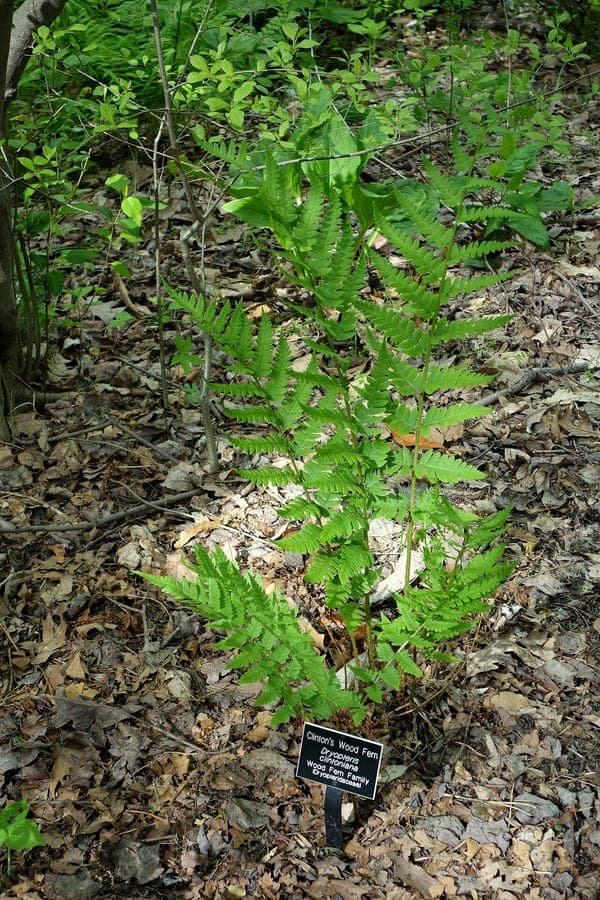
Daderot / CC0, via Wikimedia Commons
Clinton's Woodfern (Dryopteris clintoniana): complete guide
Dryopteris clintoniana
Want to see Clinton's Woodfern (Dryopteris clintoniana): complete guide in your garden?
1 minute, no credit card
Overview
Dryopteris clintoniana, commonly known as Clinton's woodfern or Clinton's wood fern, is a semi-evergreen fern in the Polypodiaceae family. This attractive native North American fern naturally grows from eastern Canada to North Carolina and is becoming increasingly popular in European gardens. With its delicate, feathery foliage, this fern brings elegance, texture, and shade to shadowed gardens.
Clinton's woodfern stands out for its upright growth habit and ability to thrive in moist, shaded conditions. The plant is extremely hardy and requires minimal care.
Appearance and Growth
Dryopteris clintoniana grows as an upright fern reaching approximately 30-60 cm tall. The fronds (leaves) are twice-divided (bipinnate) and have a fine, feathery structure. They emerge in clusters from the rhizome and display a bright to deep green color.
The croziers (young unfolding fronds) have a golden or bronze tint, making the plant particularly attractive in spring. The fern is semi-evergreen in temperate climates, meaning the foliage sometimes persists through winter depending on frost intensity.
The undersides of the leaves display sporangia (spore cases), allowing the plant to reproduce and giving it a natural biological quality.
Ideal Location
Clinton's woodfern thrives in partial shade to full shade. This makes it an excellent choice for dark corners of the garden where little else grows. Avoid full sun, as this can lead to leaf scorch and desiccation.
The plant grows well under trees, along shaded walls, and in woodland gardens. Position it where you can admire the fine fronds well, as the texture is one of its primary attractions.
Soil
Dryopteris clintoniana prefers moist, humus-rich soil. Ideal pH is slightly acidic to neutral (6.0-7.0). Add plenty of organic matter such as leaf mold or compost to improve the soil.
The fern does not grow well in dry, compacted clay soil. Ensure the soil drains well, as permanent stagnation can cause root rot. In heavy soil, amend with sand and humus.
Watering
Water regularly, especially during growth periods (spring and summer). Clinton's woodfern loves consistently moist soil, but not waterlogged. During dry spells, check daily and mist if needed.
In winter, when growth slows, the fern tolerates some dryness but water occasionally so the soil does not completely dry. Mulch with leaves or compost to help retain moisture.
Free design
Want to see Clinton's Woodfern (Dryopteris clintoniana): complete guide in your garden? Make a free design now.
Pruning
Pruning is mainly maintenance. Remove dead or damaged fronds by cutting them close to the base. In spring, as new foliage begins to emerge, remove any previously overwintered brown fronds.
General maintenance: no aggressive pruning needed. The fern forms a natural, elegant silhouette that does not require cutting.
Maintenance Calendar
March-April: New growth appears. Remove previous year's foliage. Ensure adequate water and mulch.
May-June: Full growth period. Water regularly and feed if needed.
July-August: Growth slows. Check for drought. Mist fronds regularly to deter pests.
September-October: Growth period ends. Watering can be reduced. Winter preparation begins.
November-February: Winter dormancy. Minimal watering. Protect from severe frost with mulch.
Winter Hardiness
Clinton's woodfern is extremely hardy to about -20 degrees Celsius. In temperate climates (zones 4-8), fronds often persist through winter. In cold areas, a layer of mulch around the base helps.
Ensure the soil is not permanently wet in winter, as this can cause foot rot. Also protect against simultaneous freeze-thaw cycles, which can damage the plant.
In mild climates, foliage remains greener and more vital throughout winter.
Companion Plants
Dryopteris clintoniana grows well alongside other ferns such as Osmunda, Athyrium, and Polystichum. Also attractive with wild ginger (Hexastylis), liriope, and variegated sedge (Carex oshimensis). For spring interest, plant Helleborus niger or Pulmonaria beneath.
In shaded borders, it combines well with hosta, astilbe, and coral bells. The fine texture of Clinton's woodfern forms a beautiful contrast with larger, thick-leaved plants.
Conclusion
Clinton's woodfern is an elegant and low-maintenance plant for shaded gardens. With regular watering and organic-rich soil, it thrives. Plant in groups for maximum effect. You will not always find seed and young plants at regular garden centers, but specialized fern nurseries typically stock it.
At GardenWorld, design your dream front yard with shade and texture. Upload a photo and let our designers create a complete plan with plant recommendations, including ferns like Clinton's woodfern where suitable.
Want to see Clinton's Woodfern (Dryopteris clintoniana): complete guide in your garden? Make a free design now.
Upload a photo, pick a style, and get a photorealistic design with plant list in under a minute.
No credit card required


Similar plants
Dryopteris sieboldii: complete guide
Dryopteris sieboldii
Discover Dryopteris sieboldii (Siebold's Buckler Fern), an elegant evergreen fern from Asia. Growing tips, care, and uses in shade gardens.
Dryopteris tyrrhena: complete guide
Dryopteris tyrrhena
Discover Dryopteris tyrrhena (Mediterranean Buckler-fern), a rare and exquisite fern species. Growing tips, care, and shade garden design.
Dryopteris villarii: complete guide
Dryopteris villarii
Dryopteris villarii, known as rigid buckler fern, is a shade-loving fern form from the Alps. Discover how to grow and maintain this elegant alpine fern in your garden.