
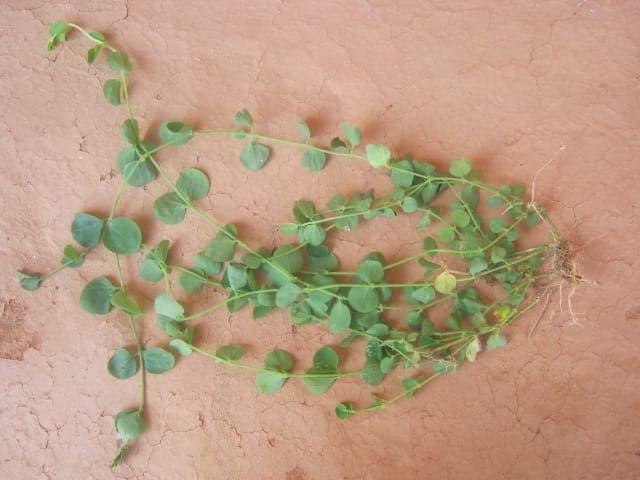
Krish Dulal / CC BY-SA 3.0, via Wikimedia Commons
Drymaria cordata: complete guide
Drymaria cordata
Want to see Drymaria cordata: complete guide in your garden?
1 minute, no credit card
Overview
Drymaria cordata, commonly known as Tropical chickweed or Whitesnow, is a versatile plant from tropical and subtropical regions spanning Mexico to South America and beyond. This herbaceous, continuously growing plant forms dense mats with fine foliage and delicate white flowers. Its flexibility and low-growing habit make it ideal as a ground cover in warm climates.
The plant behaves as an annual in temperate zones but thrives as a perennial in frost-free regions. It is excellent for container cultivation and as a houseplant, rewarding patient growers with lush green foliage.
Appearance and Bloom
Drymaria cordata is a slender, creeping plant reaching 10 to 30 centimeters in height with a flexible system of thin, sometimes reddish-tinged stems. The foliage consists of tiny heart-shaped leaves (hence the name "cordata") approximately 3 to 5 millimeters long, arranged in opposite pairs along the stems.
Flowers appear almost continuously throughout the growing season (May to October) as tiny white blooms about 3 millimeters across. While not showy, these flowers are extremely numerous, creating a light, airy appearance. Following flowering, minuscule seeds develop.
Ideal Location
Drymaria cordata grows best in partial to full shade. Unlike many tropical plants, it actually scorches in direct midday sun, especially in hot climates. A location with morning sun and afternoon shade is ideal.
In hotter zones (USDA 10-11), it tolerates full sun if soil remains consistently moist.
Soil
This plant is remarkably flexible regarding soil type. It thrives in virtually any soil from sand to clay, provided drainage is reasonable. It prefers rich, humus-laden soils and grows considerably better when compost or decomposed organic matter is incorporated.
For pot culture, use a mixture of garden soil with 40 percent compost. The plant tolerates acidic to neutral terrain well.
Free design
Want to see Drymaria cordata: complete guide in your garden? Make a free design now.
Watering
Drymaria cordata is surprisingly drought-tolerant once established. However, regular watering promotes lush growth and abundant flowers. Water when the top 2 centimeters of soil feel dry.
In pot culture, prevent complete drying out. Overwatering can cause problems, especially during cooler seasons. Ensure good drainage in all cases.
Pruning
This plant requires minimal pruning. Remove occasionally ragged stems to maintain neatness. Cut back to approximately 5 centimeters in early spring to encourage new growth.
In containers, regular pinching ensures fuller, more compact plants with better branching.
Maintenance Calendar
April-May: Sow seed indoors in moist seed-starting mix until frost-free. Pot up seedlings once they develop true leaves.
June-September: Active growing period. Water regularly. Apply liquid fertilizer every three weeks.
October-November: Growth slows. Reduce watering. Cut back to 5-10 centimeters height.
December-March: In temperate climates, plant dies back (annual cycle). In warmer zones, minimal activity persists.
Winter Hardiness
Drymaria cordata is not winter hardy in temperate zones and grows as an annual outdoors. In warm regions (USDA 9-11), it becomes perennial. Indoors, it can be cultivated year-round in suitable conditions.
The plant dies when frost arrives. For continuous growth, bring container plants indoors for overwintering in temperate climates.
Companion Plants
Drymaria cordata combines well with:
- Taller plants: Plumbago, impatiens, begonias
- Trailing plants: Portulaca, Verbena, Tradescantia
- Shade lovers: Fuchsia, Fittonia, Anthurium
- Scented plants: Jasmine, Trachelospermum
The plant works excellently in hanging baskets and as underplanting in mixed borders.
Conclusion
Drymaria cordata provides easy maintenance, continuous growth, and delicate white flowers. With minimal care and proper moisture management, you gain a charming plant for warmer gardens. Available from various nurseries as seed. Discover more plant guides on gardenworld.app and enhance your garden.
Want to see Drymaria cordata: complete guide in your garden? Make a free design now.
Upload a photo, pick a style, and get a photorealistic design with plant list in under a minute.
No credit card required


Similar plants
Dianthus karami: complete guide
Dianthus karami
Dianthus karami is a rare Lebanese mountain pink with fringed pink blooms on limestone cliffs, ideal for rock gardens and troughs.
Sicilian pink: complete guide
Dianthus siculus
Discover Dianthus siculus, an elegant purple bloomer from Sicily. Cultivation, June-September flowering and garden combinations.
Alpine mouse-ear chickweed: complete guide
Cerastium pedunculatum
Full growing guide for Cerastium pedunculatum: ideal location, soil, watering, winter hardiness, and companion plants for rock gardens.