
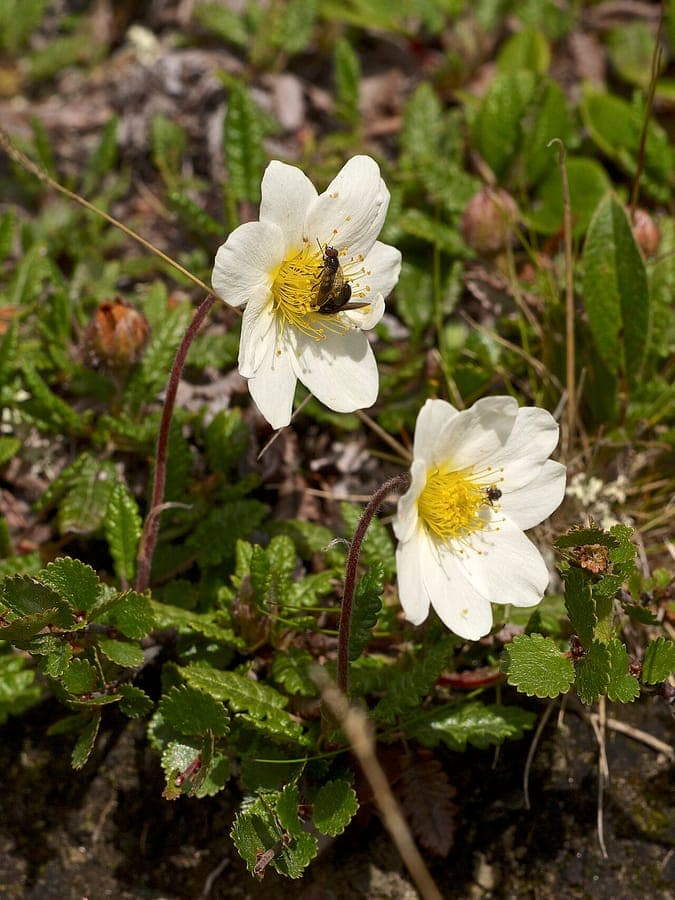
Jörg Hempel / CC BY-SA 3.0 de, via Wikimedia Commons
Eight-petal mountain-avens: complete guide
Dryas octopetala
Want to see Eight-petal mountain-avens: complete guide in your garden?
1 minute, no credit card
Overview
Dryas octopetala, commonly known as eight-petal mountain-avens, is a compact, low-growing perennial with a refined presence in alpine and rock gardens. Native to mountainous regions of central and northern Europe - including Austria, Finland, and the Balkans - this member of the Rosaceae family thrives where most plants struggle. It's not native to the UK or North America, but it adapts well to garden settings that mimic its natural habitat. As a subshrub or herbaceous perennial, it forms dense mats no taller than 10 cm. It's perfect for gardeners who value resilience, minimal upkeep, and subtle beauty. If you're designing a drought-prone area, this is one to watch.
Appearance & bloom cycle
The plant forms tight, cushion-like mats with dark green, leathery leaves that are silver-haired underneath - giving it a soft, shimmering effect in sunlight. From June to July, it produces striking white flowers with exactly eight glossy petals, each bloom measuring 3–4 cm across. The flowers have a faint lemony scent and attract early pollinators. After blooming, the seed heads develop into fluffy, feathery plumes that persist well into autumn, resembling miniature dandelion clocks. These are wind-dispersed, but in the garden, spread is usually minimal due to sterile hybrids or poor seed set.
Ideal location
This plant demands full sun - a 9 out of 10 on the light scale. It needs at least 6–8 hours of direct sunlight daily. A south- or southeast-facing rock crevice, wall, or gravel bed works best. It's ideal for rock gardens, alpine troughs, or dry borders. Avoid shaded areas or spots under large trees. It's not a candidate for woodland gardens. If you're planning a sun-drenched, well-drained spot, consider using gardenworld.app to design a layout that maximizes exposure and complements Dryas with texture and height.
Soil requirements
The soil must be sharply drained and lean - think sandy, gritty, or gravelly. It tolerates a wide pH range from 6 to 9, but performs best in neutral to alkaline conditions (pH 7–8.5). Avoid rich compost or heavy clay. Amend heavy soils with coarse sand, perlite, or crushed brick to improve drainage. A surface mulch of gravel helps keep the crown dry and enhances visual appeal. Do not fertilize - this plant evolved in nutrient-poor environments and can suffer from excess nutrients.
Free design
Want to see Eight-petal mountain-avens: complete guide in your garden? Make a free design now.
Watering
Once established, Dryas octopetala is extremely drought-tolerant. Water only during the first growing season if rainfall is below 25 mm per month. Thereafter, it survives on natural precipitation. Overwatering is its biggest threat - especially in winter, when wet soil leads to root rot. Water at the base in early morning, and never wet the foliage. In typical UK or Pacific Northwest climates, no supplemental irrigation is needed after year one.
Pruning
No pruning is required. You can gently remove old, tired foliage in early spring to make way for fresh growth. Do not cut into woody stems - they won't regenerate. The seed heads can be left for winter interest or trimmed if self-seeding is a concern. Use clean, sharp shears to avoid disease transmission.
Maintenance calendar
- Jan: Check for frost heave; leave snow cover undisturbed
- Feb: No action needed
- Mar: Remove old leaves; inspect for pests
- Apr: Watch for emerging flower buds
- May: Protect from late frosts; keep dry
- Jun: Peak bloom; avoid watering or feeding
- Jul: Flowers fade; seed heads begin to form
- Aug: Plumes mature; no intervention
- Sep: Collect seeds if desired (germination is slow)
- Oct: Clear debris; avoid fertilizing
- Nov: Protect young plants with twiggy brush to prevent rot
- Dec: Dormant; snow cover is beneficial
Winter hardiness
Dryas octopetala is hardy to USDA zones 3–7. It tolerates winter lows down to -35 °C. Its natural alpine origin makes it well-adapted to snow cover, which acts as insulation. Young plants may suffer from freeze-thaw cycles, so protect them with a light mulch of gravel or twiggy brush. Mature plants are self-sufficient. Wet winter soil is more dangerous than cold - ensure drainage is perfect.
Companion plants
Pair Dryas with other sun-loving, drought-tolerant species: Sedum acre, Thymus praecox, Sempervivum arachnoideum, and Arabis blepharophylla. Avoid moisture-loving plants like hostas or ferns. The silver foliage contrasts beautifully with green sedums and red creeping thyme. Use gardenworld.app to experiment with companion planting and create a cohesive, low-maintenance design.
Closing
Eight-petal mountain-avens is a quiet achiever - it won't shout for attention, but it delivers year after year. Its combination of early bloom, long-lasting seed heads, and rugged hardiness makes it a smart choice for rockeries and dry slopes. You'll find it at garden centres across the UK and US, often in the alpine or rock garden section. Always choose cultivated stock - never dig from the wild. With thoughtful placement and a design from gardenworld.app, Dryas octopetala becomes a lasting feature in your garden.
Want to see Eight-petal mountain-avens: complete guide in your garden? Make a free design now.
Upload a photo, pick a style, and get a photorealistic design with plant list in under a minute.
No credit card required


Similar plants
Siberian crab apple: complete guide
Malus x robusta
Complete guide to the Siberian crab apple (Malus x robusta): location, soil, pruning, winter hardiness and the best companion plants for your garden.
Chinese flowering crabapple (Malus x spectabilis): complete guide
Malus x spectabilis
Meet the Chinese flowering crabapple (Malus x spectabilis): a classic spring bloomer with carmine buds and pink blossom.
Potentilla crassinervia: complete guide
Potentilla crassinervia
Potentilla crassinervia, the Corsican cinquefoil, grows wild on Corsica and Sardinia's peaks. Discover how to grow this hardy alpine rock garden gem.