
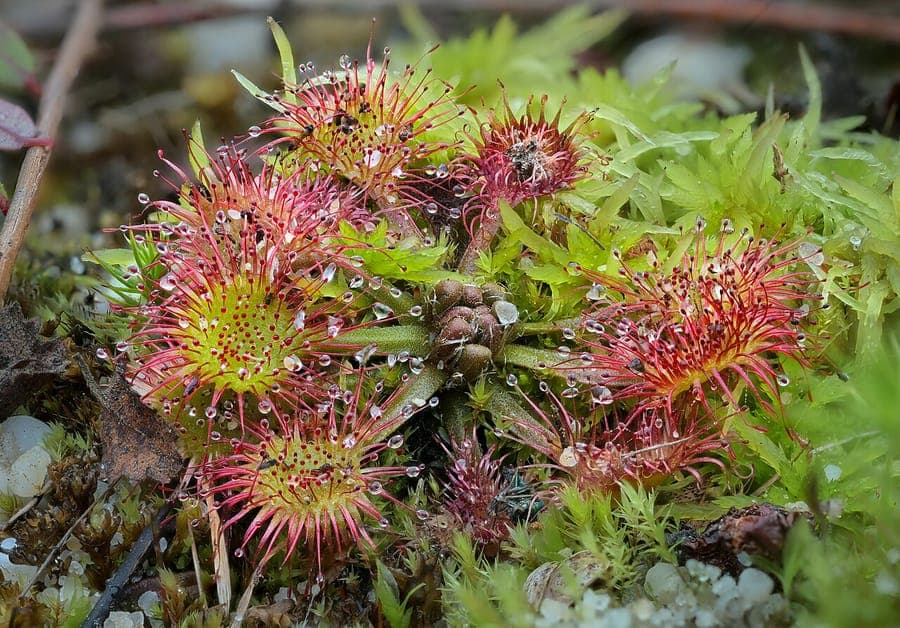
Alan Rockefeller / CC BY-SA 4.0, via Wikimedia Commons
Round-leaf sundew: complete guide
Drosera rotundifolia
Want to see Round-leaf sundew: complete guide in your garden?
1 minute, no credit card
Overview
Drosera rotundifolia, commonly known as round-leaf sundew, is a captivating carnivorous plant native to bogs and wetlands across Europe and North America. This petite herb forms rosettes of sticky, glandular leaves that trap and digest small insects, supplementing its nutrient intake in poor soils. It thrives in open, sunny, waterlogged environments and reaches just 5–10 cm in height. Hardy in USDA zones 4–8, it's a resilient addition to naturalistic gardens, bog pots, or wet rock crevices.
On gardenworld.app, you can design a garden layout that mirrors the native habitat of Drosera rotundifolia, ensuring proper sunlight, moisture, and companion planting.
Appearance & bloom cycle
The plant grows in tight, ground-hugging rosettes with circular to slightly oval leaves, 5–10 mm wide. Each leaf is covered in red-tinted tentacles tipped with sticky, glistening mucilage droplets. These droplets attract, trap, and slowly digest insects like gnats and springtails. The entire mechanism is a marvel of evolution, and the plant visibly responds to prey with leaf curling.
From June through August, slender flower stalks rise 10–15 cm above the foliage, bearing 3–8 small white flowers. Each bloom is only a few millimeters across, with five delicate petals. They open in the morning and close at dusk or during overcast weather. While short-lived individually, the blooming period lasts several weeks in healthy plants.
Ideal location
Round-leaf sundew needs full sun to light shade-ideally a light level of 8 out of 10. This means at least 5–6 hours of direct sunlight daily. In low light, the plant becomes pale, stretches upward, and produces fewer sticky droplets. It performs best in open, unshaded spots such as bog margins, shallow water containers, or sunny rockeries.
Avoid placing it under dense shrubs or trees. If your garden lacks natural bog conditions, use a raised bog bed or a dedicated pot. On gardenworld.app, you can assess your garden's light and moisture levels to determine the best spot for this plant.
Soil requirements
This species demands nutrient-poor, acidic soil. Use a mix of 2 parts sphagnum peat moss (or coconut coir) and 1 part washed silica sand or perlite. Never use compost, garden soil, or fertiliser-these introduce salts and nutrients that burn the delicate roots. The ideal pH range is 5.5 to 6.5.
The soil must stay consistently moist but well-aerated. Avoid adding gravel or perlite to the bottom of pots, as this creates perched water tables. Use wide, shallow containers to mimic natural bog conditions.
Free design
Want to see Round-leaf sundew: complete guide in your garden? Make a free design now.
Watering
Water exclusively with rainwater, distilled water, or reverse osmosis water. Tap water contains dissolved minerals and chlorine that will kill the plant over time. Keep the soil saturated at all times-maintain a water level of 1–2 cm in the saucer or tray beneath the pot.
Use the tray method: fill the tray from below and let the soil wick moisture upward. Avoid overhead watering, as it washes away the sticky mucilage. Check moisture daily during dry summer spells.
Pruning
No pruning is needed. Dead leaves can be gently removed if they look unsightly, but leaving them in place contributes to the natural decomposition cycle. Spent flower stalks can be snipped off if you don't want self-seeding, but it's not required. Never add compost or leaf litter-this enriches the soil and harms the plant.
Maintenance calendar
- Jan: Dormant. Keep moist.
- Feb: Still dormant. No action needed.
- Mar: New growth begins. Check for mold.
- Apr: Move outdoors after frost. Full sun.
- May: Prep for bloom. Prevent drying.
- Jun: Bloom starts. Max sunlight.
- Jul: Peak flowering. No feeding.
- Aug: Flowers fade. Allow seed if desired.
- Sep: Growth slows. Reduce no care.
- Oct: Rosettes retreat. Keep wet.
- Nov: Dormancy begins. Maintain moisture.
- Dec: Fully dormant. Protect from deep freeze.
Winter hardiness
Drosera rotundifolia survives winters in USDA zones 4–8. In colder zones, it forms a hibernaculum-a tight bud of dormant tissue at the soil surface. The plant survives freezing temperatures as long as the crown doesn't dry out. In containers, a layer of pine needles or straw can insulate against extreme cold.
Do not bring indoors-this disrupts dormancy. Only in prolonged temperatures below -15°C is extra protection advised.
Companion plants
Pair with other bog lovers like Sphagnum moss, Pinguicula, Utricularia, or low-growing heathers such as Calluna vulgaris. Avoid aggressive spreaders or nutrient-demanding plants. Good companions maintain acidic, wet conditions without competing for space.
Available seasonally at garden centres in spring, especially those specialising in carnivorous plants. Check local stockists or online retailers.
Closing
Round-leaf sundew isn't just a plant-it's a living ecosystem. With the right conditions, it thrives for years with minimal care. It's perfect for educational gardens, sensory rockeries, or natural bog features. The key is commitment to its simple but strict needs: sun, pure water, and poor soil.
On gardenworld.app, you can create a garden design that fully supports Drosera rotundifolia's ecological niche-from water retention to microclimate planning.
Want to see Round-leaf sundew: complete guide in your garden? Make a free design now.
Upload a photo, pick a style, and get a photorealistic design with plant list in under a minute.
No credit card required


Similar plants
Threadleaf sundew: complete guide
Drosera filiformis
Everything about Drosera filiformis, the threadleaf sundew from North America: cultivation, substrate, watering, and overwintering of this carnivorous bog plant.
Cape Sundew: complete guide
Drosera capensis
The fascinating Cape Sundew is a carnivorous plant with sticky leaves. Learn how to grow this unique plant successfully and watch it thrive.
Waterwheel plant: complete guide
Aldrovanda vesiculosa
A detailed guide to growing Aldrovanda vesiculosa: light, water, pH and dormancy. Perfect for ponds and aquatic setups.