
Jörg Hempel / CC BY-SA 3.0 de, via Wikimedia Commons
Dragon arum: complete guide
Dracunculus vulgaris
Want to see Dragon arum: complete guide in your garden?
1 minute, no credit card
Overview
Dracunculus vulgaris, commonly known as dragon arum, is a bold, eye-catching tuber that's gaining popularity among gardeners looking to add a touch of the dramatic to their borders. Native to the Mediterranean - especially Greece, Italy, Albania, and islands like Crete and Sardinia - it thrives in USDA zones 6 to 9. Despite its exotic flair, it adapts well to temperate climates, including the UK and northern Europe. It's a member of the Araceae family, related to calla lilies and skunk cabbage, and known for its striking appearance and… distinctive scent.
Reaching heights of 80 to 120 cm, dragon arum emerges in late spring, with a brief but unforgettable bloom. The plant dies back completely by late summer, retreating into its underground tuber until the next season. It's not a high-maintenance plant, but it does demand the right conditions to truly shine.
On gardenworld.app, you can design a planting scheme that highlights the bold silhouette of dragon arum against softer foliage. Think ferns, hostas, or silver-leaved plants for contrast.
Appearance & bloom cycle
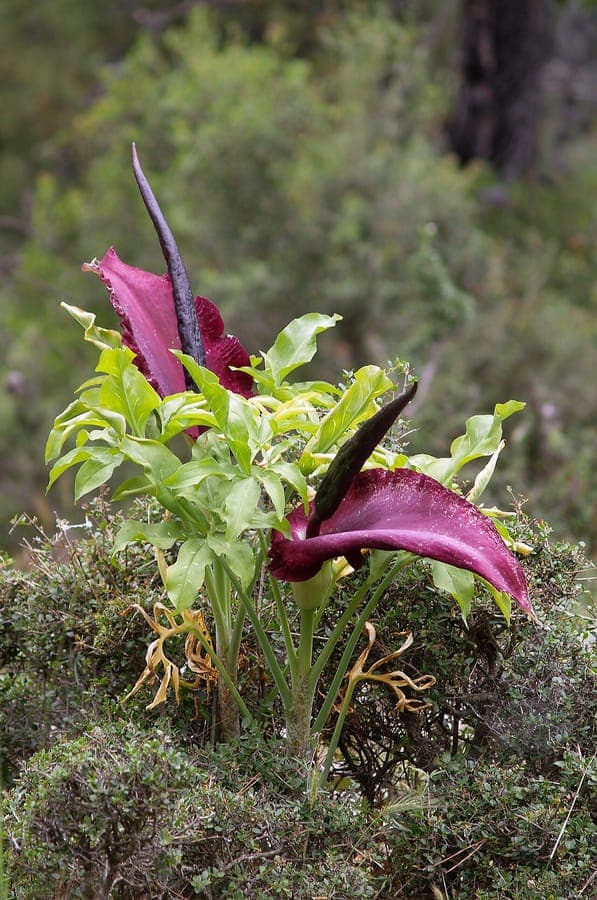
The bloom period runs from May into early June. What sets this plant apart is its unique inflorescence: a deep maroon to nearly black spathe, up to 40 cm tall, curling around a long, phallic spadix that can extend 10–15 cm beyond the hood. The flower is often described as blue-purple, but in reality, it's a rich, velvety burgundy-black with a waxy sheen that catches the light.
The bloom lasts about a week. During this time, the plant emits a strong smell of rotting meat - a trick to attract pollinating flies. It's effective, but it means you should avoid planting it near patios or open windows. After flowering, large, glossy, divided leaves unfurl, reaching up to 60 cm across. These stay green through summer, giving the plant a lush, tropical look long after the flower fades.
Ideal location
Dragon arum prefers a light level of 6 out of 10 - meaning partial shade. An east- or northeast-facing spot is ideal, where it gets gentle morning sun but is shaded from harsh afternoon rays. Too much sun scorches the leaves; too much shade reduces flowering.
A spot under a light-canopy tree, like a young birch or crabapple, works well. It also blends into woodland gardens or the middle of a mixed border. Just keep it away from seating areas due to the scent. If you're growing it in containers, move the pot to a discreet corner during bloom.
Free design
Want to see Dragon arum: complete guide in your garden? Make a free design now.
Soil requirements
This plant needs well-drained, alkaline soil with a pH between 7.5 and 8.0. It naturally grows in limestone-rich areas, so if your soil is acidic, amend it with ground limestone or chalk. Add compost or well-rotted manure to improve structure, but avoid heavy clay unless you've improved drainage with grit or sand.
The tuber is prone to rot in wet soil, so raised beds or sloped ground are ideal. Avoid waterlogged spots at all costs.
Watering
Water regularly from April through August, especially during dry springs. Check the top inch of soil - if it's dry, it's time to water. Once-a-week watering is usually sufficient, more in heatwaves. As the leaves yellow in late summer, gradually reduce watering. By September, stop completely.
The plant goes fully dormant in winter and doesn't need any moisture until new shoots appear.
Pruning
No pruning is required. Let the foliage die back naturally - it feeds the tuber for next year's growth. Only remove leaves if they're damaged or diseased, using clean, sharp shears. Cut the flower stalk only after it has fully collapsed and turned brown.
Maintenance calendar
- Feb–Mar: Check tubers for rot. Plant new ones 15–20 cm deep, 30 cm apart.
- Apr: Start light watering as shoots emerge.
- May–Jun: Peak bloom. Watch for slugs and heavy rain that can damage the spathe.
- Jul–Aug: Reduce watering as foliage dies back.
- Sep–Jan: Dormant period. No action needed.
Winter hardiness
Hardy in USDA zones 6–9. In zone 8 and above, the tuber usually survives winter without protection. In colder zones or wet soils, add a light mulch of straw or leaf mould. Avoid plastic covers - they trap moisture and promote rot.
Companion plants
Pair dragon arum with plants that complement its drama without competing. Alliums provide a nice contrast with their purple pom-poms and clean scent. Ferns like Athyrium or Dryopteris add soft texture. Hostas work well in shadier spots, and Euphorbia robbiae offers evergreen structure with yellow-green bracts.
On gardenworld.app, you can simulate how dragon arum fits into your existing planting plan, especially in partial shade beds with bold foliage contrasts.
Closing
Dracunculus vulgaris isn't for every garden - the scent alone rules it out for some. But if you're after something bold, architectural, and a little wild, it's a standout choice. It's low maintenance, drought-tolerant once established, and rewards careful placement with a rare spectacle. Find tubers in spring at garden centres across the UK and online. Look for healthy, firm bulbs without mould or soft spots.
Want to see Dragon arum: complete guide in your garden? Make a free design now.
Upload a photo, pick a style, and get a photorealistic design with plant list in under a minute.
No credit card required


Similar plants
Arrowhead vine: complete guide
Syngonium auritum
Everything about Syngonium auritum, the tropical five-fingers houseplant. Care, location, watering, and pruning explained clearly for beginners and enthusiasts.
Minute duckweed: complete guide to Lemna perpusilla
Lemna perpusilla
Everything about Lemna perpusilla, the minute duckweed: ecology, pond management, water quality and care in garden water features.
Dead horse arum lily: complete guide
Helicodiceros muscivorus
Everything about the dead horse arum lily (Helicodiceros muscivorus): growing conditions, spectacular bloom, thermogenesis, and care for this Mediterranean aroid.