
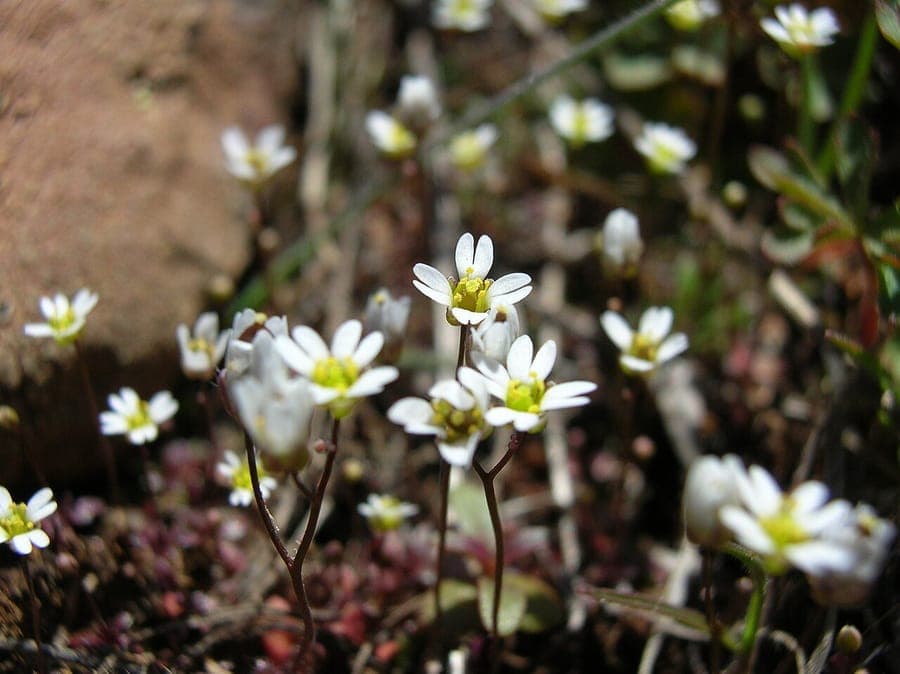
Gauna / Public domain, via Wikimedia Commons
Spring Draba (Draba verna): complete guide
Draba verna
Want to see Spring Draba (Draba verna): complete guide in your garden?
1 minute, no credit card
Overview
Draba verna, commonly known as spring draba or spring whitlowgrass, is a tiny but charming herbaceous plant in the Brassicaceae family. This delicate plant blooms in early spring, months before most garden plants, bringing welcome color to an otherwise dormant garden. With its minuscule white flowers and compact growth habit, it is ideal for bird feeding, alpine borders, and roof gardens.
Spring draba has been cultivated since the 18th century and naturally occurs in Europe, North Africa, and Central Asia. In countries like the Netherlands and Belgium, the plant is popular with gardeners seeking early-spring helpers.
Appearance and Bloom
Draba verna grows as a tiny rosette-former, usually only 10-15 cm tall. The leaves are lanceolate and finely serrated, with a slightly rough surface. In spring, numerous thin stems emerge bearing tiny white flowers that resemble stonecrop flowers.
The flowers are very small cross-flowers (characteristic of Brassicaceae), about 3-4 mm in diameter. They appear as early as February and can bloom until April, depending on weather. After flowering, small hair-like seed capsules (siliquae) form.
The foliage dies back after summer, preparing the plant for the next season.
Ideal Location
Draba verna loves full sun to partial shade. For maximum flowering, choose a sunny spot. The plant performs well on south, east, and west-facing areas. In warm zones (zones 7+), afternoon shade can be beneficial as it provides cooling relief during heat.
Place the plant where you can see it well from windows or paths, so you do not miss the early blooms. When planted in groups, it looks very decorative.
Soil
Draba verna is not particular and grows on virtually any well-draining soil. It dislikes permanently wet conditions. Slightly acidic to neutral pH (5.5-6.5) is ideal, although the plant also thrives in calcareous soils.
Ensure the soil drains well, especially in winter. Add coarse sand or perlite if you have heavy clay soil. The plant can even grow in highly fertile soils, but prefers moderately nutrient-rich conditions.
Watering
Water the plant regularly during the growing season (fall and spring), but do not let the soil dry completely. Spring draba performs best with consistent moisture.
In summer, when the plant is dormant, it can tolerate dry periods. If grown in containers, the substrate can dry slightly between waterings, but not to the point of wilting. In autumn, as the plant begins growing again, increase watering frequency.
Ensure water does not pool on the rosettes, as this invites rot.
Free design
Want to see Spring Draba (Draba verna): complete guide in your garden? Make a free design now.
Pruning
Draba verna requires minimal pruning. Simply remove faded flowers or damaged foliage. After seed set, you can cut back withered stems. This does not particularly encourage more blooms but keeps the plant neat.
If the plant causes unwanted self-seeding, remove seed capsules before they burst.
Maintenance Calendar
February-March: Peak bloom. Check for disease. Ensure adequate moisture.
April-May: Seed formation. Hand harvest if desired, or allow natural self-seeding.
June-July: Foliage dies back. Reduce watering if soil remains moist from rain.
August-September: Plant begins new growth. Resume regular watering. Transplant seedlings or sow new seed for next season.
October-November: Bloom preparation. Water and feeding at normal levels.
December-January: Dormancy period. Minimal watering. Protection against freeze-thaw cycles.
Winter Hardiness
Draba verna is extremely hardy and tolerates temperatures to -20 degrees Celsius. The plant thrives better in harsh winters because it is less prone to premature growth from warm spells.
However, ensure the soil is not permanently wet in winter, as wet cold can cause rot. In very wet regions, plant on a raised bed or in well-draining soil.
In very warm climates (zone 9+), spring draba may struggle, as it does not thrive in heat. Here, sow in autumn on shaded sites.
Companion Plants
Draba verna grows well alongside other early bulbs such as snowdrops, crocuses, and pinks. Combinations with early stonecrop, moss phlox, and alpine thyme are also attractive. In stone troughs and walls, it is an excellent choice.
In roof gardens and sand beds, it combines well with other xerophytic partners. Its bird-feeding value also interests environmentally conscious gardeners.
Conclusion
Draba verna is an ideal plant for early-season garden color. With minimal care and hardy constitution, it is a valuable garden addition. Plant in groups in borders, stone troughs, or roof gardens and enjoy the first spring colors of the year. You will find seed and young plants at garden centers like Intratuin.
At GardenWorld, design your dream front yard. Upload a photo and let our designers create a complete plan with plant recommendations, including species like Draba verna where appropriate.
Want to see Spring Draba (Draba verna): complete guide in your garden? Make a free design now.
Upload a photo, pick a style, and get a photorealistic design with plant list in under a minute.
No credit card required


Similar plants
Brassica cretica: complete guide
Brassica cretica
Brassica cretica, the Cretan cabbage, grows wild on Aegean cliffs. Discover how to grow this drought-tolerant, yellow-flowered Mediterranean perennial.
Corsican cabbage: complete guide
Brassica insularis
Corsican cabbage is a rare Mediterranean rock cabbage with white flowers and blue-green leaves. Location, soil and winter protection.
Prostrate cabbage: complete guide
Brassica procumbens
Prostrate cabbage is a creeping North African cliff plant with yellow flowers. Discover location, soil type and winter protection.