
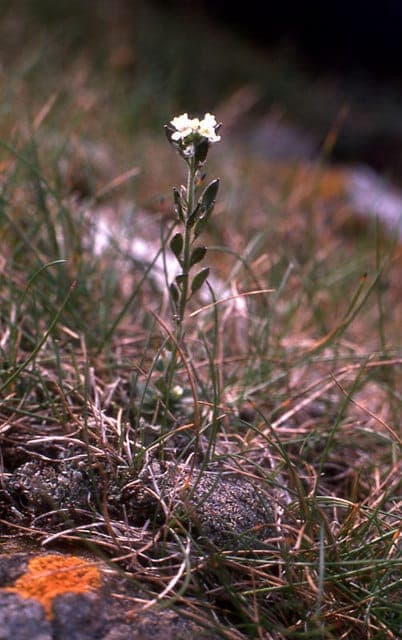
Mike Pennington / CC BY-SA 2.0, via Wikimedia Commons
Hoary whitlow-grass: complete guide
Draba incana
Want to see Hoary whitlow-grass: complete guide in your garden?
1 minute, no credit card
Overview
Hoary whitlow-grass (Draba incana) is a resilient little herb that thrives in tough, exposed spots where other plants hesitate. Native to northern Europe and Arctic regions - from Greenland to Finland and across the British Isles - it's adapted to rocky, nutrient-poor soils and cold climates. Standing just 5–10 cm tall, it forms soft, silvery cushions that bloom with cheerful white flowers in late spring. If you've got a sunny rock wall or a gravel garden that dries out fast, this plant deserves a spot.
It's not flashy, but that's its charm. On gardenworld.app, you can design a rock garden layout that highlights low-growing perennials like Hoary whitlow-grass, pairing them with textures and heights that create depth without fuss. This is a plant for gardeners who appreciate subtle beauty and long-term resilience.
Appearance & bloom cycle
The plant grows in dense, cushion-like mounds up to 15 cm wide. Its leaves are narrow, lance-shaped, and densely covered in fine white hairs, giving them a soft, hoary appearance - hence the name. These hairs protect the plant from drying winds and temperature swings.
From May through July, slender flowering stalks rise just above the foliage, bearing clusters of tiny white cruciform flowers - four petals in a cross shape, typical of the Brassicaceae family. Each flower is about 5 mm across, but en masse, they create a delicate white haze over the rock surface. After blooming, seed pods form and eventually split open, scattering seeds naturally. If you like self-sown charm, leave them be; otherwise, pinch off spent blooms to limit spread.
Ideal location
Full sun is non-negotiable. This plant won't perform in shade or even partial shade - it'll stretch, thin out, and likely rot. Choose south- or west-facing slopes, rock crevices, dry stone walls, or gravel beds. It also works in shallow troughs or alpine pots, as long as drainage is excellent.
In a dry, modern garden design, Hoary whitlow-grass adds texture without bulk. On gardenworld.app, you can visualize how it fits into a xeriscape or gravel scheme, blending with sedums, thymes, and dwarf irises for a low-water, high-character planting.
Soil requirements
Well-drained, lean soil is key. Sandy, gritty, or chalky soils are ideal. Avoid heavy clay or rich compost-heavy mixes - they hold too much moisture and will kill the roots. If your soil is dense, build a raised mound or crevice bed with a mix of coarse sand, small gravel, and a bit of loam (2:1:1).
pH range: 6.5 to 8.0. It tolerates slightly acidic to alkaline conditions. Do not fertilize - excess nutrients promote weak growth and fewer flowers. A light top-dressing of gravel helps mimic its natural habitat and keeps the crown dry.
Free design
Want to see Hoary whitlow-grass: complete guide in your garden? Make a free design now.
Watering
Water lightly during establishment, but once settled, it's drought-tolerant. In average UK or northern European summers, rainfall is usually enough. During prolonged dry spells, a quick soak is fine, but never let the plant sit in wet soil. In containers, water only when the top 2–3 cm of soil is dry, and ensure pots have drainage holes.
Use rainwater when possible, especially in hard water areas - lime buildup can affect sensitive alpines over time.
Pruning
No pruning needed. You can deadhead spent flowers to keep it tidy or encourage rebloom, but it's not required. If the foliage gets sparse or leggy, gently lift and divide the plant in early spring, replanting the fresh rosettes. Remove any dead or rotting leaves in spring to prevent fungal issues.
Maintenance calendar
- january: Dormant. No action.
- february: Check for frost heave or soggy crowns.
- march: Clear old leaves. No feeding.
- april: Watch for new growth. Water lightly if dry.
- may: Bloom begins. Keep soil well-drained.
- june: Peak flowering. Deadhead if desired.
- july: Flowers fade. Let seeds mature or remove.
- august: Rest period. No extra water.
- september: Monitor for self-sown seedlings.
- october: Clean up debris. No pruning.
- november: Prepare for winter. Keep crowns dry.
- december: Full dormancy. Protect containers from freeze-thaw cycles.
Winter hardiness
Extremely hardy - USDA zones 3 to 8. It handles -30°C with ease. In the ground, it's fully winter-hardy across most of the UK, Ireland, and northern Europe. In pots, roots are more exposed. Move containers against a sheltered wall or wrap them in hessian during harsh spells. Avoid covering with plastic - trapped moisture causes rot.
Companion plants
Pair with other alpines: Aurinia saxatilis, Saxifraga × arendsii, Thymus praecox, Sedum spurium, or creeping Dianthus. Avoid vigorous growers that will smother it. In rock walls, tuck it between stones with moss or Sempervivum for a natural look.
Closing
Hoary whitlow-grass is a quiet achiever - not loud, but endlessly reliable. It asks for little and gives back texture, early-season interest, and habitat for pollinators. You'll find it at select garden centres or alpine nurseries. In the UK, check specialist growers or botanical garden sales. With the right spot and a thoughtful layout from gardenworld.app, this little plant can become a lasting feature in your garden.
Want to see Hoary whitlow-grass: complete guide in your garden? Make a free design now.
Upload a photo, pick a style, and get a photorealistic design with plant list in under a minute.
No credit card required


Similar plants
Brassica cretica: complete guide
Brassica cretica
Brassica cretica, the Cretan cabbage, grows wild on Aegean cliffs. Discover how to grow this drought-tolerant, yellow-flowered Mediterranean perennial.
Corsican cabbage: complete guide
Brassica insularis
Corsican cabbage is a rare Mediterranean rock cabbage with white flowers and blue-green leaves. Location, soil and winter protection.
Prostrate cabbage: complete guide
Brassica procumbens
Prostrate cabbage is a creeping North African cliff plant with yellow flowers. Discover location, soil type and winter protection.