
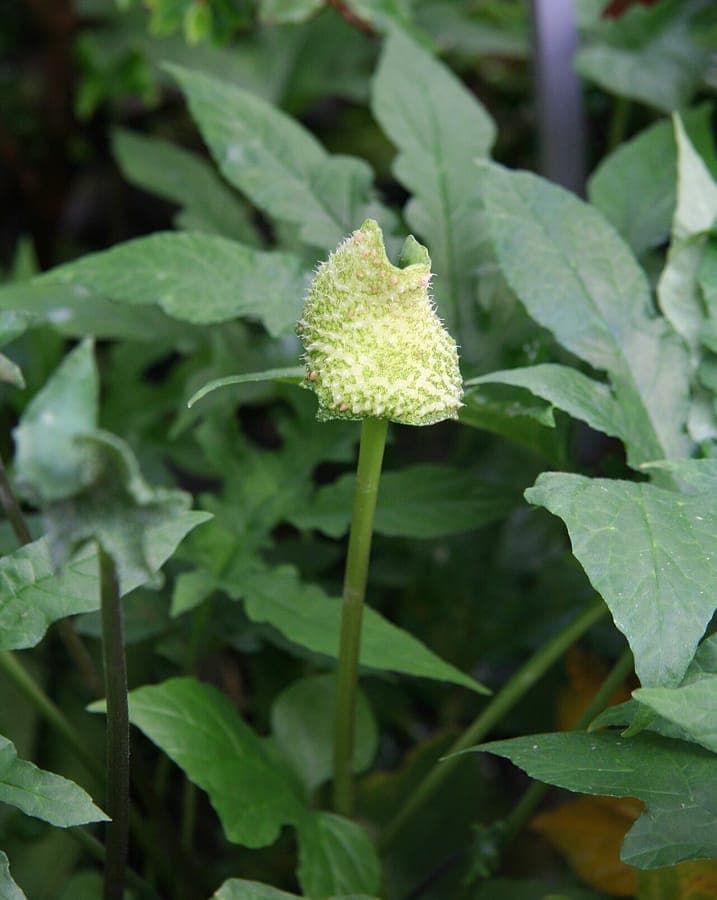
Michael Wolf (Webseite) / CC BY-SA 3.0, via Wikimedia Commons
Dorstenia contrajerva: complete guide
Dorstenia contrajerva
Want to see Dorstenia contrajerva: complete guide in your garden?
1 minute, no credit card
Overview
Dorstenia contrajerva, commonly known as snakewort, herbe aux serpents (French), or bezoarwurz (German), is a fascinating tropical herbaceous plant from the Moraceae (fig) family. Native to Mexico through tropical America (Colombia, Costa Rica, Ecuador, Peru, Venezuela), this plant thrives on forest floors and mountain slopes in semi-shade. For temperate-climate gardeners, Dorstenia contrajerva is a botanical rarity with ethnobotanical and ethnomedicinal significance, ideally suited to greenhouse cultivation.
Appearance and Bloom
Dorstenia contrajerva grows as a compact herbaceous plant 20-60 centimetres (8-24 inches) tall. Leaves are large, heart-shaped to deeply lobed (often 3-7 lobed), rough-textured with prominent veining and dark green coloration. Rather than typical flowers, the plant produces characteristic, flat, disc-shaped flowering structures (inflorescence) approximately 2-5 centimetres in diameter, usually greenish-yellow, superficially embedded in the stem. These flower discs are botanically fascinating: they contain both male and female reproductive parts. Fruit development results in small, round fruits (approximately 5mm diameter) that ripen to red-orange or yellow.
Ideal Location
Semi-shade to lightly filtered sun. Direct midday sun can cause leaf scorch, especially in intense summers. Dorstenia contrajerva thrives in half-shade with indirect morning sun. In greenhouse: position on south-facing windows with partial shade-cloth protection in summer. Minimum temperature: 16-18 degrees Celsius; preference 20-25 degrees. Avoid cold drafts and sudden temperature fluctuations.
Soil
Rich, humus-laden, well-draining soil is essential. Mixture: 40% garden soil with organic matter, 30% leaf-mould, 20% perlite, 10% fine sand. The plant thrives in neutral to slightly acidic soil (pH 6.0-6.8). Heavy clay soils must be avoided; poor drainage leads to slow growth. For greenhouse plants: large terracotta pots (25-30cm diameter) with high-quality potting mix are ideal. Additions of orchid bark help structure in long-term container culture.
Watering
Regular moisture without waterlogging. Allow the top 1-2 centimetres of soil to dry moderately between waterings, but keep subsurface soil consistently moist (not waterlogged). Dorstenia contrajerva tolerates drought poorly; leaf-drop and growth inhibition occur rapidly. Summer intensive watering (3-4 times weekly in warm periods). Winter moderate watering (1-2 times weekly). Ensure excellent pot drainage; waterlogging causes root rot. Summer misting with distilled water promotes humidity levels.
Free design
Want to see Dorstenia contrajerva: complete guide in your garden? Make a free design now.
Pruning
Minimal pruning required. Remove dead or diseased leaves carefully. Older stems can be cut back in early spring to encourage compactness. This plant has no formal pruning requirement; natural growth creates pleasant form. Heavy pruning may cause growth inhibition.
Maintenance Calendar
March-April: Growth resumes. Start feeding (monthly, half-strength). May-August: Peak growth. Regular watering essential. Continue feeding. September-October: Growth slows. Halve feeding. Reduce watering. November-February: Rest period. Minimal feeding. Water cautiously (only if necessary). February-March: Inspect for pest damage; prepare for new season.
Winter Hardiness
Dorstenia contrajerva is neither frost-hardy nor cold-tolerant. Temperatures below 10 degrees Celsius cause damage; below 5 degrees fatal. Entirely unsuitable for outdoor cultivation in temperate climates. Must overwinter in heated greenhouse (minimum 15-18 degrees Celsius). No temperate European outdoor winter conditions are tolerable. In heated greenhouse/conservatory: excellent winter survival possible with careful watering and good drainage.
Companion Plants (Greenhouse)
Pair Dorstenia contrajerva in greenhouse environments with other Central American tropical specimens: Anthurium clarinervium, Scaphiphyllum wallisii, Alocasia species, Rhaphidophora tetrasperma. Foliage backdrops: Hosta sieboldii or Helleborus niger (for cool-climate greenhouse). Underplanting with low growers: Peperomia caperata or Pilea peperomioides. Humidity promoter: layer gravel or foam on pot undersides for air drainage.
Closing Remarks
Dorstenia contrajerva is a botanical rarity for specialized greenhouse gardeners and ethnobotanically-minded collectors. The plant combines botanical uniqueness (unusual flower structure) with ethnomedicinal value (traditionally used for snakebite and digestive complaints). Cultivation requires immersion in tropical conditions, demanding greenhouse expertise. On GardenWorld.app: whilst beyond most temperate gardeners' reach, this plant merits niche placement in southern European heated gardens or botanical collections.
Where to Buy and Precautions
Specialist ethnobotanical and tropical plant merchants (Europe-wide) offer seed and young plants. Seed requires warmth (24-27C) and high humidity to germinate (2-4 weeks). Young plants are easier and require less expertise than seed-raising. Botanical gardens in warm regions (southern Europe) occasionally offer surplus plants. Medicinal properties are under international protection in some countries; check regulations before transporting plant material.
Want to see Dorstenia contrajerva: complete guide in your garden? Make a free design now.
Upload a photo, pick a style, and get a photorealistic design with plant list in under a minute.
No credit card required


Similar plants
Morus macroura: complete guide
Morus macroura
Himalayan mulberry with long fruits. Fast-growing, edible berries, winter hardy. Suitable for large gardens and landscapes.
Brosimum guianense: complete guide
Brosimum guianense
Guiana snakewood: exotic tree from South America with valuable timber. Cultivation and care for warm-climate gardens.
Maclura tinctoria: complete guide
Maclura tinctoria
Learn how to grow Maclura tinctoria or Cubanwood. This beautiful tree offers shade, food and dye possibilities in your garden.