
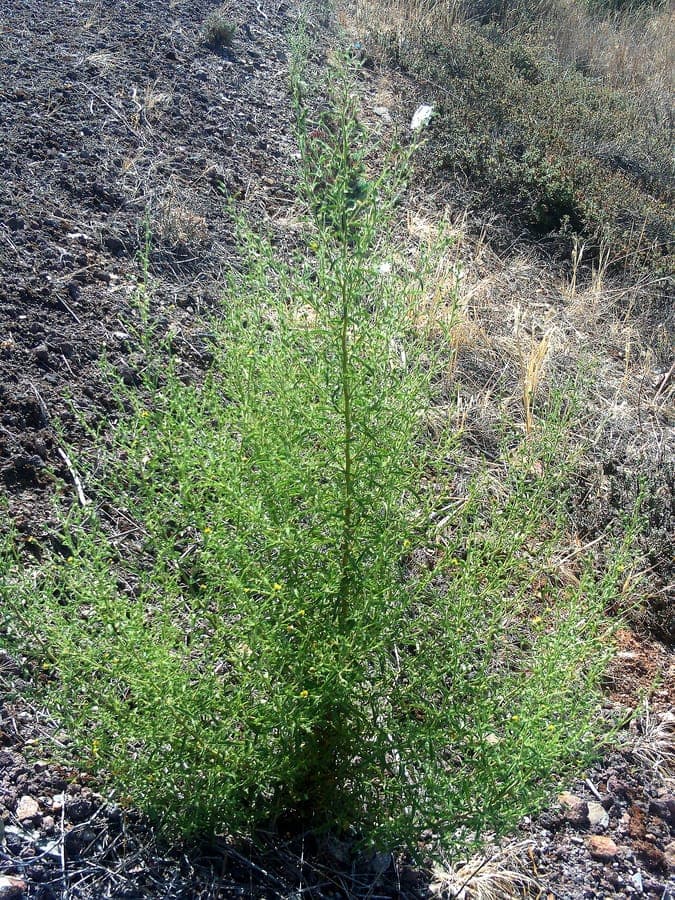
Javier martin / Public domain, via Wikimedia Commons
Camphor inula: complete guide
Dittrichia graveolens
Want to see Camphor inula: complete guide in your garden?
1 minute, no credit card
Overview
Camphor inula (Dittrichia graveolens) is a striking annual herb native to southern Europe and parts of the Mediterranean. While it's often seen as a roadside weed, it's a resilient plant that thrives in tough conditions - making it an underrated choice for modern gardens facing hotter, drier summers. It grows 60–100 cm tall, with sticky foliage and a strong camphor-like scent when touched. Don't let the smell put you off - the bright yellow flowers are a magnet for bees, hoverflies, and butterflies from late summer into autumn.
On gardenworld.app, you can design a drought-tolerant border that includes camphor inula as a late-season anchor, pairing it with other hardy perennials and grasses.
Appearance & bloom cycle
This upright, branching plant develops lance-shaped, dark green leaves covered in glandular hairs, giving them a sticky, almost resinous feel. The scent - a mix of camphor and something slightly medicinal - is strongest when leaves are bruised.
Flowering begins in August and continues through October. The flower heads are 2–3 cm wide, composed of many small ray florets surrounding a central disc. They appear in dense, flat-topped clusters, creating a bold splash of yellow in the back of the border. Because it blooms so late, it fills a gap when many other plants have finished flowering.
Ideal location
Camphor inula needs full sun - rate it an 8 to 10 on the light scale. It performs best in hot, open spots: south-facing slopes, dry rock gardens, gravel beds, or against sun-baked walls. It's ideal for urban gardens with compacted soil and limited moisture.
Avoid shaded or damp areas. In cooler climates like the UK, plant it in a sheltered spot to maximise heat retention. Use the sun mapping tool on gardenworld.app to confirm your garden gets enough direct light before planting.
Soil requirements
It thrives in poor, well-drained soils. Sandy, gravelly, or chalky soils with a pH of 7.5–8.0 are perfect. It tolerates low fertility and doesn't need rich compost or fertiliser - in fact, too much nitrogen leads to leggy growth and fewer flowers.
Avoid heavy clay or waterlogged ground. If your soil is dense, mix in grit or horticultural sand to improve drainage. This plant colonises disturbed ground in the wild, so don't over-prepare the bed.
Free design
Want to see Camphor inula: complete guide in your garden? Make a free design now.
Watering
Once established, camphor inula is highly drought-tolerant. Young plants may need watering during dry spells in late spring and early summer. After July, it rarely needs supplemental water unless you're in an extended drought.
Overwatering is a bigger risk than underwatering - soggy soil promotes root rot. Water at soil level to keep foliage dry and reduce fungal issues.
Pruning
No pruning is required for healthy growth, but you can pinch back young plants in June to encourage bushier, more compact forms. Deadheading isn't necessary, but cutting back after flowering can prevent excessive self-seeding if you want to control spread.
Wear gloves when handling - the sticky sap can cling to skin and tools.
Maintenance calendar
- Jan: Dormant - no action needed
- Feb: Start seeds indoors if desired (optional)
- Mar: Sow seeds under cover
- Apr: Harden off seedlings; direct sow outdoors from mid-April
- May: Thin seedlings; keep area weed-free
- Jun: Pinch back for bushiness
- Jul: Monitor for drought stress
- Aug: Bloom begins - pollinators arrive
- Sep: Peak bloom - great for garden photos
- Oct: Flowering ends; seed heads form
- Nov: Cut back or leave for winter texture and wildlife
- Dec: Clear debris if desired; prepare for next year
Winter hardiness
As an annual, camphor inula doesn't survive winter. However, it self-seeds readily in sunny, warm spots. Seedlings typically emerge in late spring. It grows well in USDA zones 8–10, but even in zone 7, it can reappear if conditions are favourable.
Leave some seed heads intact to encourage natural regeneration - or remove them to prevent it.
Companion plants
Pair it with drought-loving perennials like Echinacea purpurea, Salvia nemorosa, or Festuca glauca. The yellow blooms contrast beautifully with purple, blue, and silver foliage. It also works well in gravel gardens with Stachys byzantina or Sedum species.
Avoid planting near moisture-loving species like hostas or ferns. The sticky foliage and scent may not suit every planting scheme, but in the right context, it adds bold structure and late-season colour.
Closing
Camphor inula isn't a show-off plant, but it's tough, reliable, and ecologically valuable. It's perfect for gardeners looking to reduce watering and support pollinators in late summer. While not common in garden centres yet, you can find seeds online or order them from specialist suppliers.
In the UK, try independent garden centres or online seed banks. For design inspiration, check planting combinations on gardenworld.app that feature camphor inula in low-water, sun-drenched schemes.
Want to see Camphor inula: complete guide in your garden? Make a free design now.
Upload a photo, pick a style, and get a photorealistic design with plant list in under a minute.
No credit card required


Similar plants
Calendula stellata: complete guide
Calendula stellata
Complete guide to Calendula stellata, the star-flowered marigold from Sicily: location, soil, watering and companion planting tips.
Korean chrysanthemum: complete guide
Chrysanthemum x rubellum
Chrysanthemum x rubellum is a hardy autumn perennial with single pink to copper flowers from August to November. Care and combinations.
Helianthus divaricatus: complete guide
Helianthus divaricatus
Helianthus divaricatus is a North American woodland sunflower with yellow summer blooms, ideal for naturalistic borders and shady edges.