
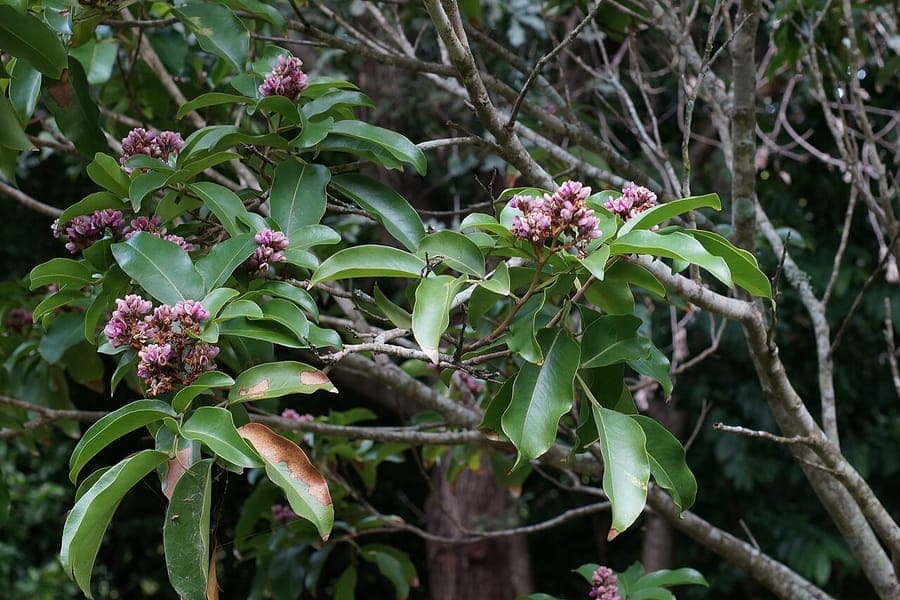
Tatters ✾ / CC0, via Wikimedia Commons
Dipteryx odorata: complete guide
Dipteryx odorata
Want to see Dipteryx odorata: complete guide in your garden?
1 minute, no credit card
Overview
Dipteryx odorata, commonly known as Tonka bean, Cumaru, or Tonkabohne (German), is a captivating tropical tree from the Amazon basin of South America. Native to Brazil, Colombia, Peru, Suriname, and Venezuela, this tree flourishes in tropical rainforests at lower elevations. For temperate-climate gardeners outside the tropics, Dipteryx odorata is chiefly valuable as a greenhouse or conservatory specimen. The tree is renowned for its aromatic, vanilla-scented beans used in perfumery and flavouring.
Appearance and Bloom
Dipteryx odorata grows in nature to 20-30 metres (65-100 feet) tall, but in greenhouse conditions remains considerably smaller (3-6 metres after years of cultivation). The tree forms a thick, trunk-like stem with dark-brown, roughened bark. Leaves are compound, odd-pinnate, with 13-25 oval, glossy green leaflets arranged along a central rachis. Flowers are small, yellow to cream-coloured, arranged in loose panicles. The characteristic fruits are distinctive: oval, flattened seed-pods (approximately 5cm long) with two wing-like extensions (hence the name 'Dipteryx' - two wings). Each pod contains a single aromatic brown bean intensely fragrant of vanilla and coumarin (vanilla-like compounds).
Ideal Location
For greenhouse plants in temperate climates: warm, very bright position. Minimum 18-20 degrees Celsius, ideal 22-28 degrees Celsius. South-facing window or bright, shaded greenhouse position with abundant natural light is required. Dipteryx odorata is frost-sensitive; temperatures below 15 degrees Celsius cause damage. Outside the tropics: only suitable for heated greenhouse or conservatory. In Mediterranean regions (southern France, Spain, southern Italy): potentially feasible outdoors in very protected, south-facing locations during warmest summers, but winters require indoor housing.
Soil
Nutritious, well-draining potting medium is essential. Mixture: 40% fibrous loam, 30% perlite or vermiculite, 20% leaf-mould, 10% composted bark. The plant thrives in neutral to slightly acidic soil (pH 6.0-7.0). Heavy, water-retaining soils must be avoided; waterlogging causes root rot. For container cultivation: use large containers (minimum 30-40 litres for mature specimens) with excellent drainage holes.
Watering
Regular moisture during growing season (spring/summer), less during rest (autumn/winter). Allow the top 2-3 centimetres of soil to dry between waterings, especially in winter. Excessive moisture, particularly with cool temperatures, causes root rot. In greenhouse: ensure good air circulation to prevent stagnation. Humidity: 50-70% is ideal; misting leaves with water helps during dry periods. In winter: keep moderately moist but reduce watering substantially.
Free design
Want to see Dipteryx odorata: complete guide in your garden? Make a free design now.
Pruning
Pruning encourages compactness in greenhouse environments. Young plants: pinch growing tips to encourage branching. Older specimens: remove dead or diseased wood. However, heavy pruning is stressful; perform judiciously in early spring. Naturally, the tree will form a central stem without intervention. For greenhouse rotation: gentle annual pruning helps regulate shape.
Maintenance Calendar
March-April: Growth begins; start feeding (half-strength, quarterly). May-August: Peak growth period; continue feeding; water regularly. September-October: Growth rate decreases; reduce feeding. November-January: Rest period; minimal feeding; water moderately. February: Prepare for new season; inspect for pest damage.
Winter Hardiness
Dipteryx odorata is neither winter-hardy nor frost-tolerant. Temperatures below 15 degrees Celsius cause serious damage. No European winter conditions (outdoor) can be tolerated. Plants must overwinter in warm environments (minimum 16-18C), ideally in a heated greenhouse or conservatory. For outdoor cultivation in warm climates: protect from cold winds and nocturnal frost risks during winter.
Companion Plants (Greenhouse)
Pair Dipteryx odorata in greenhouse environments with other tropical specimens: Vanilla planifolia, Passiflora edulis, Manihot esculenta, Hibiscus rosa-sinensis. For contrast: foliage plants like Monstera deliciosa or Philodendron hederaceum. Underplanting: low-growing, aromatic species like Plectranthus forskahlii. Structural backdrop: tall greenhouse walls with trellising for climbing plants.
Closing Remarks
Dipteryx odorata is an exotic speciality for advanced greenhouse gardeners and botanical institution curators. This tree demands knowledge of tropical plant cultivation but rewards with botanical rarity and aromatic intrigue. Young plants are easier to manage than mature specimens. On GardenWorld.app: whilst this plant lies beyond most temperate-climate gardeners' reach, it merits consideration for greenhouse planning in warm Mediterranean regions.
Where to Buy
Specialist tropical seed and plant merchants (Europe-wide) offer seed and young plants. Seeds require warmth (25-28C) and high humidity to germinate (3-6 weeks). Young plants are more efficient and require less expertise. Botanical gardens in warm regions occasionally offer surplus specimens.
Want to see Dipteryx odorata: complete guide in your garden? Make a free design now.
Upload a photo, pick a style, and get a photorealistic design with plant list in under a minute.
No credit card required


Similar plants
Tall Silky Lupine: complete guide
Lupinus elatus
Tall silky lupine is a fast-growing Californian perennial with silvery foliage and blue-purple flower spikes, ideal for a prairie-style garden.
Garfield Lupine: complete guide
Lupinus garfieldensis
The Garfield lupine is a rare, fast-growing American perennial for alkaline, dry grassland gardens, with striking blue flower spikes.
Lupinus elegans: complete guide
Lupinus elegans
Lupinus elegans, the elegant lupine, is a spectacular blooming plant from Mexico with blue flower spikes. Care, cultivation and garden use.