
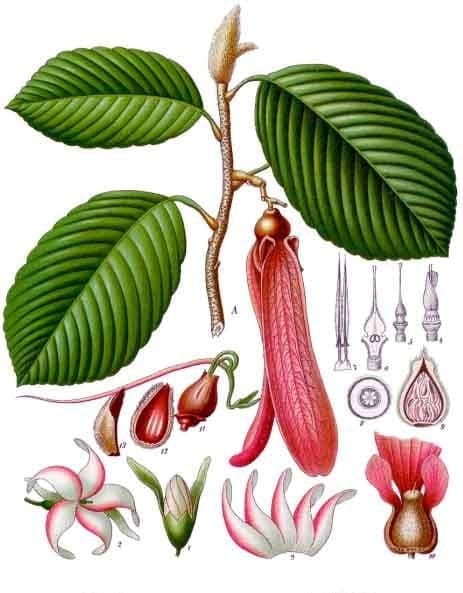
Franz Eugen Köhler, Köhler's Medizinal-Pflanzen / Public domain, via Wikimedia Commons
Hollong: complete guide
Dipterocarpus retusus
Want to see Hollong: complete guide in your garden?
1 minute, no credit card
Overview
Dipterocarpus retusus, commonly known as Hollong or Hollong gurjuntree, is a remarkable tropical tree native to the Asian continent. This species belongs to the family Dipterocarpaceae and occurs naturally in countries such as Assam, China, Myanmar, Thailand, Laos, Vietnam, Cambodia, and Indonesia. The name Hollong is particularly used in Northern Asia, while other regions employ different local names. This tree is not only botanically fascinating but also economically valuable as useful products can be obtained from its wood and resin.
The Hollong tree is one of the largest and most impressive trees of tropical Asia, known for its growth to impressive heights. The wood is highly valuable and used in cabinetmaking and construction, while the resin (gujun) has traditionally been applied in various uses.
Appearance and bloom
The Hollong tree grows into a majestic tree with an impressive crown volume. The tree is characterized by a strong and upright trunk structure with dense foliage canopy. The leaves are typical of the Dipterocarpaceae family, but what distinguishes Dipterocarpus retusus is the growth pattern and the overall proportions of the plant.
The wood of the Hollong is reddish-brown in color, very dense and durable. The tree produces characteristic fruits consisting of wings (diptera means two wings). This fruit structure is typical of all Dipterocarpus species and aids in wind dispersal.
The flower of Dipterocarpus retusus is less spectacular than that of many other tropical trees, but the production of gujun is an important characteristic. This gujun has traditionally been used in various applications, from medicines to moisture retention in traditional construction.
Ideal location
The Hollong tree makes high demands on its growing environment. For optimal growth, place the tree in full sun to light shade. The tree grows best in tropical and subtropical climates with warm weather and sufficient moisture during the growing season. In temperate climates, this tree is practically unsuitable unless you have access to large heated greenhouse facilities.
The tree prefers growing at elevations between 500 and 2500 meters, where temperatures remain mild and stable. This suggests that less extreme heat sometimes gets preference over tropical heat.
In traditional growing areas, this tree grows in mountain forests and slopes, so protection from strong winds is recommended. For container cultivation, you would need a very large container, given the ultimate size of the tree.
Soil
Dipterocarpus retusus is not very particular about soil type but grows best in well-draining, nutrient-rich soils. In tropical forests, the tree grows in humus-rich soil with plenty of organic material. The tree tolerates acidic to neutral pH values (pH 5.5 to 7.0).
It is recommended to enrich the soil with compost, leaf mold, or rotted wood chips. This helps with moisture and nutrient retention, especially important in the first growing period of young trees. In pot culture, you can use a mixture of universal potting soil, perlite, and compost.
The tree does not make very high demands on nutrients, although a well-balanced nutrition pattern promotes growth and health.
Free design
Want to see Hollong: complete guide in your garden? Make a free design now.
Watering
As a tropical tree, Dipterocarpus retusus most appreciates regular water, especially during the growing season. Ensure the soil remains moist but not waterlogged. Poorly draining soils can lead to root rot, a common problem in tropical cultivation.
Watering should be seasonal: in the warm growing season (spring to fall) water more frequently than in cold months. In tropical areas where no clear winter season exists, watering remains consistently high throughout the year.
In pot culture, water when the top centimeter of potting soil begins to dry. Drip irrigation is very suitable for this tree in garden conditions.
Pruning
Dipterocarpus retusus requires minimal pruning. The tree grows naturally in an attractive form and pruning can disturb the natural shape. Pruning is mainly done to remove damaged, diseased, or dead branches.
Young trees can be directed to develop a strong, central trunk with good branch structure. This can be done by applying some selective formative pruning in the first years.
The best time to prune is at the end of winter dormancy or the beginning of the growing season. Avoid pruning during blooming or fruiting season.
Maintenance calendar
March to May: Beginning of growing season, increase watering, first seasonal feeding.
June to August: Peak of growth, regular water and feeding, check for pests.
September to November: Growing season begins to decline, gradually reduce watering frequency.
December to February: Quiet season in many regions, minimal watering, no feeding.
Winter hardiness
Dipterocarpus retusus is not winter hardy and cannot tolerate temperatures below 15 degrees Celsius without damage. In mixed climates, the tree must be protected in winter or brought indoors to a heated space.
The tree is sensitive to frost and can die at temperatures below zero degrees Celsius. In subtropical regions, winter protection may be necessary, especially for young plants.
Death from frost happens quickly and completely, so prevention is essential.
Plant companions
Dipterocarpus retusus grows in its natural environment in tropical rainforests where many other species are present. In gardens, the tree can be well combined with other tropical plants such as various Ficus species, palms, and other large-leafed greenery.
In temperate climates, the tree can enjoy indirect proximity to other heat-loving houseplants, such as various Araceae and Aralaceae species.
Conclusion
Dipterocarpus retusus is a botanical beauty that commands respect through its size and character. Although cultivation in temperate climates is difficult without suitable facilities, knowledge about this special tree is valuable for enthusiastic plant lovers and garden designers. The tree represents the richness of Asian tropical flora and serves as a constant reminder of the importance of rainforests.
Want to learn more about tropical trees? Visit gardenworld.app for inspiration and professional garden design services!
Want to see Hollong: complete guide in your garden? Make a free design now.
Upload a photo, pick a style, and get a photorealistic design with plant list in under a minute.
No credit card required


Similar plants
Acer pycnanthum: complete guide
Acer pycnanthum
Acer pycnanthum, the Japanese swamp maple, is a fast-growing tree with early red flowers and brilliant autumn color, ideal for damp garden settings.
Freeman maple: complete guide
Acer × freemanii
Everything about the Freeman maple (Acer x freemanii): a fast-growing shade tree with spectacular autumn colour for large gardens.
Silver vine: complete guide
Actinidia polygama
Discover silver vine (Actinidia polygama): a hardy climbing plant with silvery foliage, loved by gardeners and cats alike.