
Simon Eugster --– Simon / ?! 07:03, 9 September 2007 (UTC) / CC BY-SA 3.0, via Wikimedia Commons
Cut-leaf teasel: complete guide
Dipsacus laciniatus
Want to see Cut-leaf teasel: complete guide in your garden?
1 minute, no credit card
Overview
Cut-leaf teasel (Dipsacus laciniatus) is a striking herbaceous biennial or short-lived perennial native to parts of Central and Southeastern Europe, including Austria, Greece, and Bulgaria, as well as regions in Western Asia like Iran and Afghanistan. Reaching heights of 150 to 200 cm, this upright plant forms a dramatic vertical accent in gardens and natural landscapes. While not commonly planted in ornamental settings, it's a powerhouse for biodiversity, drawing in pollinators and providing winter seed sources for birds.
On gardenworld.app, you can visualise how this tall, structural plant fits into a mixed border or meadow-style garden. Use the planting planner to space it correctly among grasses and late-summer bloomers, ensuring it doesn't shade out smaller companions.
Appearance & bloom cycle
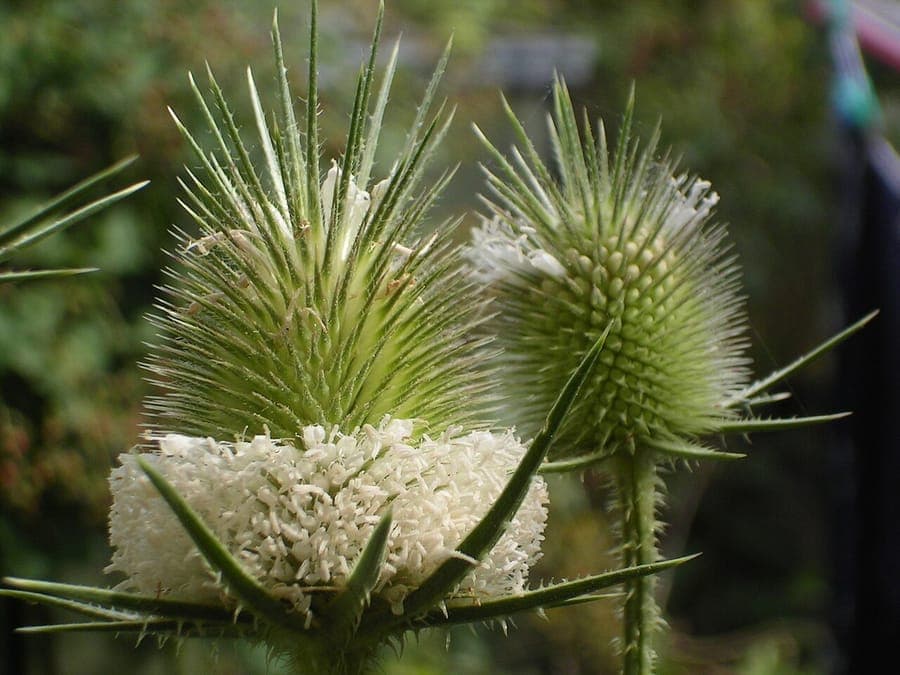
The most distinctive feature of cut-leaf teasel is its deeply divided, lacy foliage. The leaves are arranged in opposite pairs along the stem and partially fuse around it, forming water-collecting cups - an adaptation thought to deter herbivores and possibly aid in nutrient uptake. From July through August, conical flower heads 5–8 cm long emerge, densely packed with small white to pale green florets. These are surrounded by long, stiff, bristly bracts that flare outward like a crown.
After flowering, the seed heads dry and persist through winter, offering visual interest and food for finches and other small birds. The rigid structure also provides shelter for overwintering insects.
Ideal location
Cut-leaf teasel thrives in full sun, needing at least 7 out of 10 on the light scale - that's around 6 to 8 hours of direct sunlight daily. It performs best in open, unshaded areas with good air circulation. Avoid planting it in dense shade or under tree canopies, as it will stretch, weaken, and likely fall over.
Ideal spots include dry slopes, roadside verges, or the back of a sunny border. In naturalistic designs, it works well in wildflower meadows or gravel gardens. Use gardenworld.app to map sun exposure in your garden and position teasel where it won't cast excessive shade on shorter plants.
Soil requirements
This plant prefers well-drained, neutral to slightly alkaline soils with a pH between 7.0 and 7.5. It tolerates poor, sandy, or loamy soils but struggles in heavy clay unless amended with grit or compost to improve drainage. Avoid overly fertile ground - too much nitrogen leads to floppy growth and reduced flowering.
Cut-leaf teasel is adapted to lean conditions, so skip the fertiliser. Organic matter can be added sparingly during planting, but ongoing enrichment isn't necessary.
Free design
Want to see Cut-leaf teasel: complete guide in your garden? Make a free design now.
Watering
Once established, Dipsacus laciniatus is highly drought tolerant. Young plants need regular watering for the first 4–6 weeks, especially during dry springs. Water at the base to prevent fungal issues on leaves. After that, natural rainfall is usually sufficient, even during long dry spells.
If you notice leaf curling or wilting in June or July, give a deep soak once, but avoid frequent shallow watering. Overwatering promotes root rot, particularly in winter.
Pruning
Pruning isn't required for plant health, but you may want to deadhead spent flowers if you're limiting self-seeding. Leave some seed heads intact through winter for wildlife value. Cut stems back in late winter or early spring before new growth starts.
Use clean, sharp shears to avoid spreading disease. If stalks are tall and exposed, consider light staking in early summer to prevent breakage in strong winds.
Maintenance calendar
- Jan: No action. Leave dead stems for wildlife.
- Feb: Same as January.
- Mar: Clear debris if needed. Watch for emerging seedlings.
- Apr: Thin out unwanted seedlings. No feeding.
- May: Water young plants during dry spells.
- Jun: Monitor for aphids. Support tall stems if necessary.
- Jul: Peak bloom. Avoid cutting back.
- Aug: Flowers fading. Begin seed formation.
- Sep: Remove excess seed heads if self-seeding is a concern.
- Oct: Cut back old growth if desired.
- Nov: Lightly rake soil around base.
- Dec: Let remaining structure stand for winter interest.
Winter hardiness
Cut-leaf teasel is hardy to USDA zone 5 (-29°C). While the parent plant dies after seeding, it reliably self-sows in suitable conditions. Seeds germinate in spring, often in disturbed soil. Ensure good drainage to prevent rot during wet winters. The plant struggles in waterlogged sites.
Companion plants
Pair with Echinacea, Verbena bonariensis, Stachys, or Calamagrostis grasses. These combinations bloom at the same time and attract bees, butterflies, and hoverflies. Avoid aggressive spreaders like mint or goldenrod that may outcompete seedlings.
Closing
Cut-leaf teasel brings architectural form and ecological value to the garden with minimal input. It's ideal for gardeners who want low-maintenance, wildlife-friendly planting. While not sold at every garden centre, you can find seeds or young plants at specialist nurseries or through online retailers. Check with local garden centres in late spring. For design inspiration, use gardenworld.app to create a border layout that balances height, texture, and bloom time.
Want to see Cut-leaf teasel: complete guide in your garden? Make a free design now.
Upload a photo, pick a style, and get a photorealistic design with plant list in under a minute.
No credit card required


Similar plants
Yellow honeysuckle (Lonicera tragophylla): complete guide
Lonicera tragophylla
Meet yellow honeysuckle (Lonicera tragophylla): a Chinese climber with large golden flowers that thrives in partial shade.
Lonicera korolkowii: complete guide
Lonicera korolkowii Stapf
Discover blueleaf honeysuckle, a vigorous shrub with beautiful flowers. Guide on growing, shaping and why this Asian climbing plant is perfect for gardens.
Lonicera oblongifolia: complete guide
Lonicera oblongifolia Hook.
Discover swamp fly honeysuckle, a North American woodland plant. Guide on growing, caring and why this native species is valuable for gardens.