
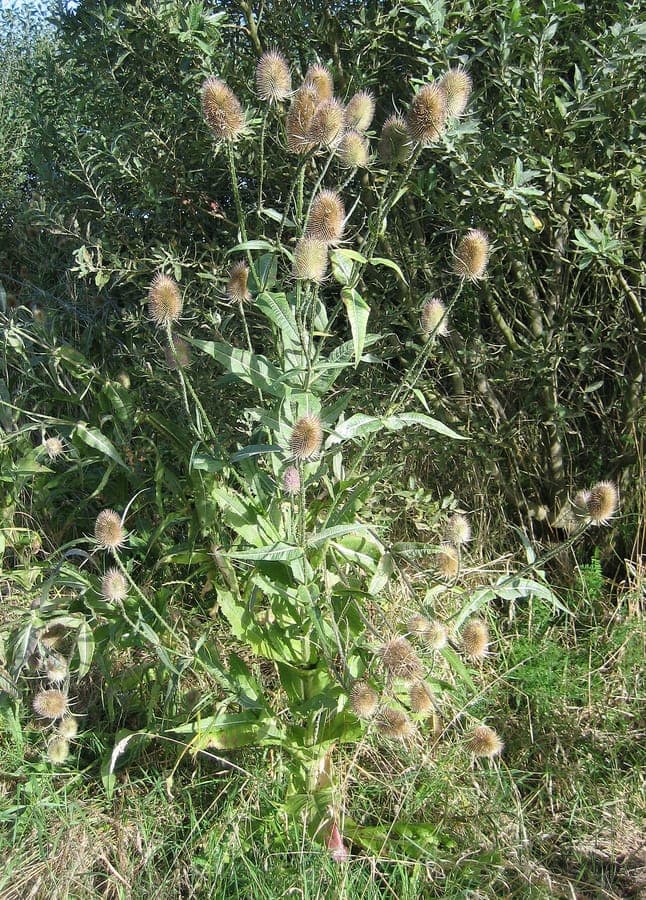
MPF / CC BY-SA 3.0, via Wikimedia Commons
Common teasel: complete guide
Dipsacus fullonum
Want to see Common teasel: complete guide in your garden?
1 minute, no credit card
Overview
Common teasel (Dipsacus fullonum) is a bold, biennial plant that commands attention with its tall, spiny stems and distinctive cylindrical flower heads. Native to southern and central Europe, as well as parts of North Africa, it's often found in disturbed soils, roadside verges, and woodland edges. In gardens, it's gaining popularity for its architectural form and ecological benefits. While it can self-seed vigorously, it's manageable with some oversight.
Hardy in USDA zones 3 to 8, common teasel thrives across much of the UK and northern US. It's perfect for naturalistic planting schemes and cottage-style borders. On gardenworld.app, you can design a planting plan that integrates teasel into a wildlife-friendly garden with strong seasonal interest.
Appearance & bloom cycle
In its second year, common teasel reaches 4 to 6 feet (120–180 cm) in height, with a spread of about 20 inches (50 cm). The stems are square and lined with small spines. The opposite leaves form a cup-like rosette around the stem, capable of holding rainwater - a trait reflected in its genus name, from the Greek 'dipsa' meaning 'thirst'.
Flowering occurs from July to September. The flower heads are 2–3 inches (5–8 cm) long and 1–1.5 inches (3–4 cm) wide, with narrow, pale purple to lavender florets that open from the middle outward. After blooming, the head hardens into a bristly, cone-shaped structure that persists through winter. These dried heads are a major draw for finches, especially goldfinches and siskins, which feed on the seeds.
Ideal location
Common teasel prefers full sun to light shade. For strong stems and maximum flowering, aim for at least 6 hours of direct sunlight per day. In heavy shade, plants become leggy and prone to flopping. It works best in the back of borders, along fences, or in meadow-style plantings.
Plant in groups of 3 to 5 for visual impact. Due to its height and texture, it adds vertical interest and movement. Use gardenworld.app to preview how teasel will fit into your existing garden layout, especially when pairing with grasses or perennials.
Soil requirements
Teasel isn't fussy about soil but grows best in moist, well-drained loam or clay-loam with a pH between 6.0 and 7.5. It tolerates sandy soils if moisture is consistent. Avoid overly rich soils - excess nutrients lead to weak, floppy growth.
Don't amend the soil with compost or manure at planting. A leaner mix encourages stronger root development and sturdier stems.
Free design
Want to see Common teasel: complete guide in your garden? Make a free design now.
Watering
During the first year, when the plant forms a basal rosette, keep the soil consistently moist, especially in dry spells. Once established, it's fairly drought-tolerant. In the second year, water only during prolonged dry periods. Avoid overhead watering to reduce the risk of fungal issues, especially in humid climates.
Pruning
No formal pruning is needed. In late winter or early spring, cut back the previous year's dead stems to ground level before new growth emerges. Leave a few seed heads over winter for visual interest and bird foraging. If you want to limit self-seeding, remove spent heads before seeds disperse - usually by late November.
Maintenance calendar
- Jan: Leave seed heads for birds; inspect for rodent nests
- Feb: Cut back old stems
- Mar: New rosettes appear; watch for slugs
- Apr: Apply light mulch if needed
- May: Water during dry spells
- Jun: Stake tall stems if necessary
- Jul: Flowers begin; check for aphids
- Aug: Peak bloom; seeds start maturing
- Sep: Allow some heads to set seed
- Oct: Stop deadheading; prepare for winter
- Nov: Remove excess seed heads to control spread
- Dec: Enjoy winter structure
Winter hardiness
Common teasel is fully hardy in USDA zones 3–8. The first-year rosette stays green through winter and survives freezing temperatures. The second-year stems die back but often remain upright, providing winter texture. In wet soils, especially heavy clay, ensure good drainage to prevent crown rot.
Companion plants
Pair teasel with tall grasses like Calamagrostis x acutiflora 'Karl Foerster' or Molinia caerulea for movement and contrast. Good perennial partners include Echinacea, Rudbeckia, and Verbascum. Avoid aggressive ground covers that might smother the first-year rosettes.
Closing
Common teasel isn't for every garden, but if you appreciate bold forms and wildlife value, it's a standout choice. Its winter persistence, architectural quality, and bird appeal make it a powerful element in naturalistic designs. Just be mindful of its seeding habit - plant it where seedlings won't be a nuisance. You can find seeds or young plants at garden centres across the UK and US, often in spring. Trays of seedlings sometimes appear at local nurseries or conservation sales. With thoughtful placement, common teasel can become a signature feature in your garden - one that moves with the wind and feeds the birds all winter. Check gardenworld.app for layout ideas that make the most of its striking silhouette.
Want to see Common teasel: complete guide in your garden? Make a free design now.
Upload a photo, pick a style, and get a photorealistic design with plant list in under a minute.
No credit card required


Similar plants
Yellow honeysuckle (Lonicera tragophylla): complete guide
Lonicera tragophylla
Meet yellow honeysuckle (Lonicera tragophylla): a Chinese climber with large golden flowers that thrives in partial shade.
Lonicera korolkowii: complete guide
Lonicera korolkowii Stapf
Discover blueleaf honeysuckle, a vigorous shrub with beautiful flowers. Guide on growing, shaping and why this Asian climbing plant is perfect for gardens.
Lonicera oblongifolia: complete guide
Lonicera oblongifolia Hook.
Discover swamp fly honeysuckle, a North American woodland plant. Guide on growing, caring and why this native species is valuable for gardens.