
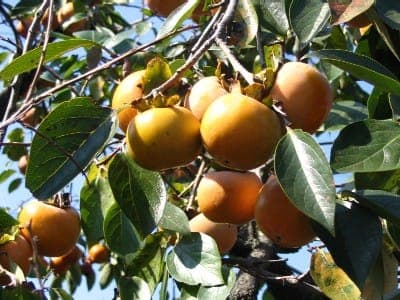
Sphl / CC BY-SA 3.0, via Wikimedia Commons
Japanese persimmon: complete guide
Diospyros kaki
Want to see Japanese persimmon: complete guide in your garden?
1 minute, no credit card
Overview
The Japanese persimmon, or Diospyros kaki, is a striking deciduous tree that brings both beauty and harvest to temperate gardens. Native to southern China, Taiwan, and parts of Vietnam, this member of the Ebenaceae family has found a home in gardens across Europe and North America. It grows slowly, reaching 6 to 10 meters in height over 10 to 15 years, forming a broad, rounded canopy. Though called "Japanese," the fruit has deep roots in Chinese horticulture and was later refined in Japan.
Persimmons are best known for their vibrant, tomato-like fruit that ripens in autumn. The taste ranges from honeyed and mild in non-astringent types like 'Fuyu' to intensely sweet and jelly-like when fully soft in astringent varieties such as 'Hachiya'. Unripe fruit contains high levels of tannins, making them mouth-puckeringly bitter-patience is key. Allow them to fully soften or expose them to ethylene (e.g., in a paper bag with an apple) to speed up ripening.
On gardenworld.app, you can design a layout that accommodates your persimmon's mature spread and seasonal interest, whether you're planting in a backyard orchard or a spacious border.
Appearance & bloom cycle
Japanese persimmon trees have large, glossy, dark green leaves that turn brilliant shades of yellow, orange, and crimson in autumn. The foliage drops after the fruit appears, often leaving clusters of bright orange orbs hanging like ornaments. This visual impact makes the tree a standout in late-season gardens.
Flowering occurs from late May to early July, depending on climate. The small, bell-shaped flowers are creamy white to pale yellow and appear along new growth. Most cultivars are either male or female, though some are self-fertile. For reliable fruiting, especially in marginal climates, it's wise to plant a second variety nearby for cross-pollination. Fruit set begins in August and continues to develop through fall.
Fruit size ranges from 5 to 10 cm in diameter, with smooth, thin skin and a characteristic calyx at the base. Harvest time varies: non-astringent types can be picked firm from mid-October, while astringent types benefit from light frost to reduce tannins, usually ready by late November.
Ideal location
Choose a sunny, sheltered spot-ideally south- or southwest-facing-for optimal growth and fruit ripening. The tree needs at least 6 to 8 hours of direct sunlight daily. Young trees are vulnerable to wind-rock, so stake them for the first 2 to 3 years. In colder regions, planting near a warm wall can help trap heat and protect against spring frosts.
Avoid low-lying areas where cold air settles. Japanese persimmons thrive in USDA zones 7b to 10. In zone 7b, winter protection for young trees is essential. Mature trees handle occasional dips to -12°C, but late spring frosts can damage emerging buds.
Soil requirements
Well-drained, loamy soil rich in organic matter is ideal. The pH should be between 6.0 and 7.5. Heavy clay soils can be improved with compost and coarse sand to enhance drainage. Sandy soils need regular additions of compost to retain moisture and nutrients.
Avoid waterlogged conditions-persimmons are prone to root rot, especially Phytophthora. If drainage is poor, plant in a raised bed or mound. Incorporate well-rotted manure or compost at planting time to boost fertility.
Free design
Want to see Japanese persimmon: complete guide in your garden? Make a free design now.
Watering
Consistent moisture is crucial, especially during the first 2 to 3 years. Water deeply once or twice a week during dry spells, ensuring the root zone stays moist but not soggy. Drip irrigation works well for establishing trees.
Once established, persimmons are moderately drought-tolerant but produce better fruit with regular watering from July to September. Mulch with 5 to 8 cm of wood chips or leaf mould to retain moisture and suppress weeds. Keep mulch a few inches away from the trunk to prevent rot.
Pruning
Prune in late winter or early spring before bud break. Focus on creating an open, vase-shaped structure with 3 to 5 main scaffold branches. Remove dead, damaged, or crossing branches. Avoid heavy pruning, as fruit forms on the previous year's growth.
Use clean, sharp tools and disinfect between cuts to prevent disease spread. Light summer pruning can help control size and improve air circulation, but avoid pruning after mid-August to prevent stimulating late growth vulnerable to frost.
Maintenance calendar
- January: Inspect for winter damage. Plan pruning.
- February: Prune young trees. Remove dead wood.
- March: Plant container-grown trees if soil isn't frozen.
- April: Apply balanced fertiliser. Watch for aphids.
- May: Flowers emerge. Avoid root disturbance.
- June: Monitor fruit set. Water during dry spells.
- July: Deep water weekly. Check for fungal spots.
- August: Fruit expands. Protect trunk from lawnmowers.
- September: Begin reducing water. Prepare for harvest.
- October: Harvest non-astringent types. Install rodent guards.
- November: Harvest astringent types after frost. Rake fallen leaves.
- December: Apply winter mulch. Check tree ties.
Winter hardiness
Japanese persimmons are hardy to USDA zone 7b (-12°C to -15°C). Young trees need protection: wrap trunks with burlap or use tree guards to prevent frost cracks and rodent damage. In colder zones, grow in containers and move to an unheated greenhouse over winter.
Late spring frosts are a bigger threat than winter cold. Choose late-blooming cultivars like 'Fuyu' to reduce risk.
Companion plants
Pair with other fall-interest plants: serviceberry, crabapple, or autumn olive. Beneath the canopy, plant shade-tolerant perennials like hellebores, ferns, or hostas. Herbs such as oregano and thyme work well at the base, requiring similar sun and drainage.
Avoid aggressive ground covers like English ivy, which can compete for nutrients and trap moisture against the trunk.
Closing
The Japanese persimmon rewards patience with stunning autumn color and delicious fruit. Start with a healthy tree from reputable garden centres that specialise in fruit trees. Look for grafted specimens of named cultivars like 'Fuyu' or 'Hachiya' for reliable performance.
On gardenworld.app, you can visualise your tree's mature size and plan companion plantings that enhance both yield and aesthetics. Whether you're in a suburban backyard or a rural orchard, this tree brings a touch of exotic elegance to the temperate garden.
Want to see Japanese persimmon: complete guide in your garden? Make a free design now.
Upload a photo, pick a style, and get a photorealistic design with plant list in under a minute.
No credit card required


Similar plants
Diospyros malabarica: complete guide
Diospyros malabarica
Malabar ebony: a tropical tree from Asia with narrow leaves and edible fruits. For warmer climates. Decorative tree form and bird-attracting qualities.
Mabolo: complete guide
Diospyros discolor
Diospyros discolor, or Mabolo, is an exotic tropical fruit tree with distinctive velvety fruits. Learn cultivation, care, and harvesting techniques for this unique Southeast Asian treasure.
Diospyros mespiliformis: complete guide
Diospyros mespiliformis
African ebony brings dramatic structure to tropical landscapes. Discover distinctive foliage, attractive fruit production, and how to cultivate this impressive specimen.