
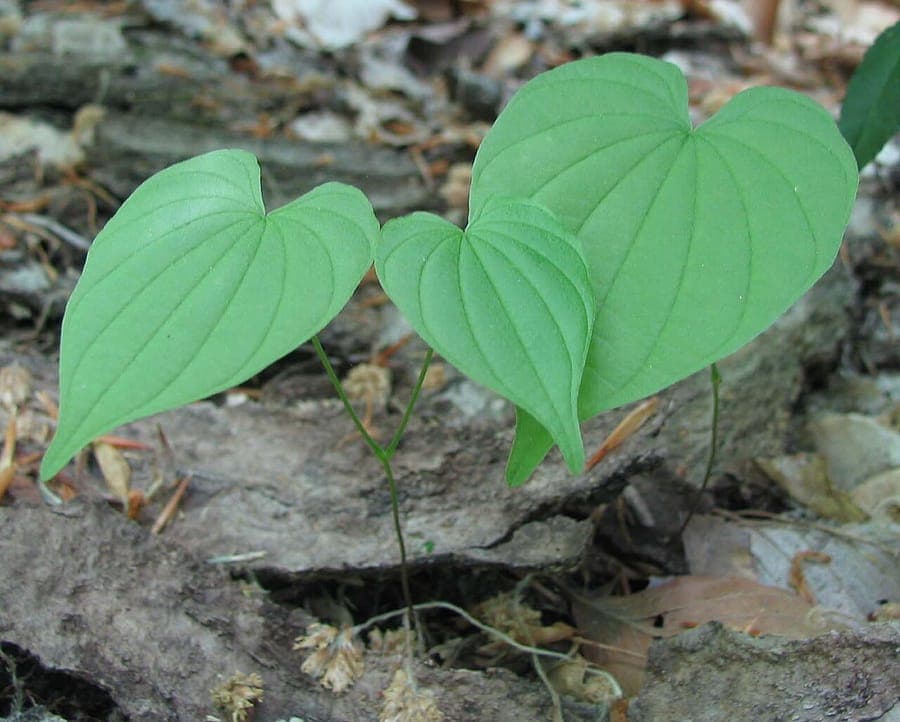
No machine-readable author provided. Phyzome assumed (based on copyright claims). / CC BY-SA 3.0, via Wikimedia Commons
Dioscorea villosa: complete guide
Dioscorea villosa
Want to see Dioscorea villosa: complete guide in your garden?
1 minute, no credit card
Overview
Dioscorea villosa, better known as wild yam, colic root, or wild yam root, is a fascinating climbing vine from North America. This plant belongs to the Dioscoreaceae family and naturally grows from Southern Ontario to the central and eastern United States. Throughout Europe and beyond, it becomes increasingly popular as an ornamental plant for its elegant foliage and interesting stems.
It is a herbaceous plant that grows in forests and along riverbanks in its natural habitat. The plant is known for its underground tubers, which were historically and traditionally used. In modern gardens, it is primarily appreciated for its visual beauty.
Appearance and bloom
Dioscorea villosa forms graceful heart-shaped leaves along slender, twining stems. The leaves are approximately 5 to 10 centimeters long, with a heart-shaped base and pointed tip. They have an attractive green color that turns golden-yellow in autumn.
The blooms appear in May to July and consist of small, inconspicuous yellow-green flowers that grow in distinctive, drooping panicles. After flowering, grooved, winged seeds form that are interesting to observe.
Ideal location
Dioscorea villosa grows best in partial to full shade, though it can also thrive in full sun if it receives sufficient moisture. Choose a location where the plant is protected from intense midday heat.
Use this plant as a climbing vine along a trellis, screen, or pole. It also works well as a groundcover under trees. The plant adds a natural, forest-like quality to any garden design.
Soil
Dioscorea villosa grows best in loamy, moist soil that is still reasonably well-draining. A pH range of neutral to slightly acidic (6.0 to 7.0) is ideal.
Improving the soil with plenty of humus and organic matter promotes growth and root establishment. However, the plant has adapted to poor soil as well, so it is not very critical.
Free design
Want to see Dioscorea villosa: complete guide in your garden? Make a free design now.
Watering
Dioscorea villosa requires regular water during the growing season. The soil should remain moist but not waterlogged. Water deeply when the top inch feels dry.
Water more frequently during dry periods, especially when planting. Once established, the plant is fairly drought-tolerant, though regular watering stimulates better growth. Water sparingly for winter if the plant is in a container.
Pruning
Dioscorea villosa requires minimal pruning. Remove dead or damaged stems in spring. After the plant dies back in autumn, you can cut off all dried material.
To encourage more branched growth, you can pinch off the tips of young stems in early growing season. This promotes fuller, bushier appearance.
Maintenance calendar
Spring (March-May): New growth appears. Provide regular watering. Clean off dead material from previous year. Summer (June-August): Water deeply and regularly. Enjoy the blooms and growing vines. Check for pests. Fall (September-November): Gradually reduce watering. Leaves turn golden-yellow. Plant dies back to ground level. Winter (December-February): Plant is dormant. In very cold zones, protect the tubers with mulch.
Winter hardiness
Dioscorea villosa is hardy in zones 5-9 (minimum temps to about -26 degrees C). The plant dies back to ground level in winter but returns each spring from underground tubers.
In zone 4 or colder, protect the root zone with a thick layer of mulch. In zones warmer than 10, grow in containers that are brought indoors for winter.
Companion plants
Dioscorea villosa combines well with:
- Other native vines: Ampelopsis brevipedunculata, Parthenocissus
- Forest plants: hellebores, erythronium, trillium
- Shrubs: Viburnum, Sambucus, Lindera
- Perennials: Heuchera, Carex, Astilbe
The plant adds structure and interest to shaded, forest-like gardens.
Closing
Dioscorea villosa is a unique addition to any garden, especially for those with woodland shade. It combines tradition, natural beauty, and ornamental value in a single plant. With minimal care, this native gem grows for years. Find seeds or plant material from Intratuin or Gamma, or from specialized garden centers. Discover more garden inspiration at gardenworld.app.
Want to see Dioscorea villosa: complete guide in your garden? Make a free design now.
Upload a photo, pick a style, and get a photorealistic design with plant list in under a minute.
No credit card required


Similar plants
Cush-cush yam: complete guide
Dioscorea trifida
Everything about Dioscorea trifida, the tropical cush-cush climbing yam with ornamental lobed leaves and edible tubers from South America.
Dioscorea hispida: complete guide
Dioscorea hispida Dennst.
Explore the Asiatic bitter yam, an exotic climbing tuber with dramatic foliage. Perfect for warm-season growing and tropical front yard effects.
Forest yam: complete guide
Dioscorea praehensilis
Discover the forest yam, a vigorous climbing vine with heart-shaped leaves and delicate flowers. Tropical character with twining tendrils from West Africa.