
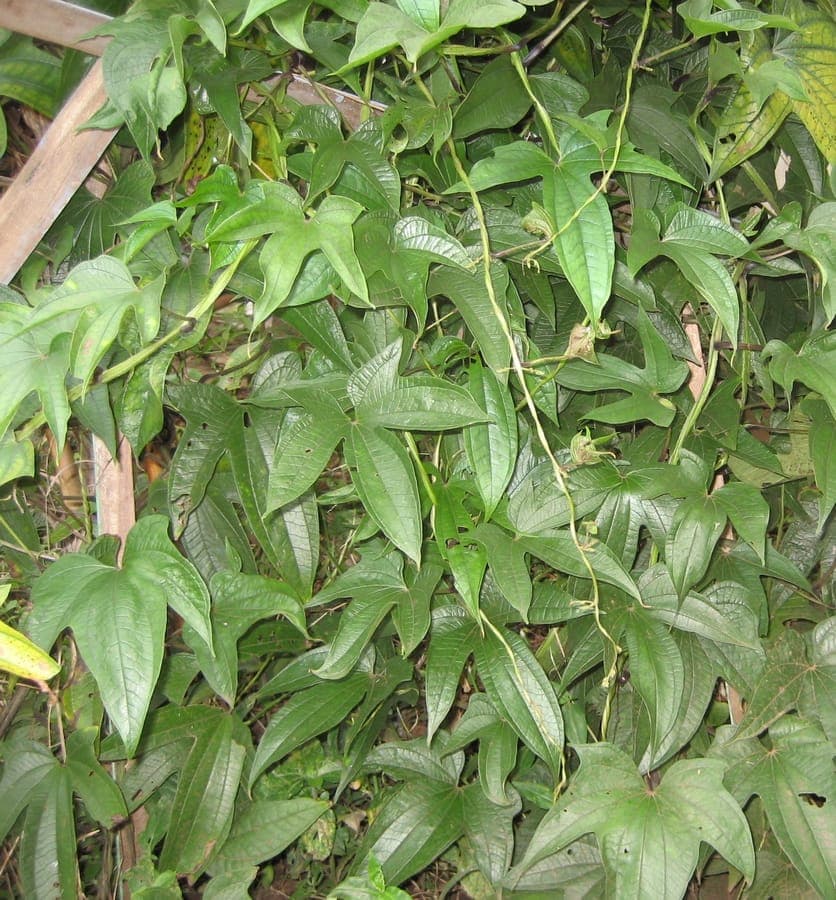
User:Mvh57 / CC BY-SA 3.0, via Wikimedia Commons
Cush-cush yam: complete guide
Dioscorea trifida
Want to see Cush-cush yam: complete guide in your garden?
1 minute, no credit card
Overview
Dioscorea trifida, known in English as cush-cush yam or Indian yam, is a remarkable tropical climbing plant belonging to the family Dioscoreaceae. Native to tropical South and Central America - from Venezuela and Colombia to the Caribbean islands and northern Brazil - it has been cultivated by indigenous peoples for thousands of years as a staple food crop. The tubers are traditionally boiled, roasted, or dried into flour and remain an important part of local cuisines in the Caribbean and northern South America.
With over 600 species in the genus Dioscorea, this is one of the largest genera of monocot plants in the world. The species name 'trifida' directly refers to the three-lobed shape of the leaves, making identification straightforward for the attentive grower. Anyone interested in unusual tuber crops or subtropical climbing plants will find excellent inspiration for garden design at gardenworld.app.
Appearance and bloom cycle
Dioscorea trifida is a perennial herbaceous climber capable of reaching five to eight metres in its natural habitat. The stems are slender but tough and twine in a counter-clockwise direction as they climb - a feature that distinguishes this genus from many other climbers. The leaves are the most striking visual element: deeply three-lobed (occasionally five-lobed), with a heart-shaped base and a glossy dark green upper surface. Individual leaves measure eight to fifteen centimetres across.
The flowers are small and inconspicuous, pale yellow-green in colour, and appear in small clusters along axillary stems. The plant is dioecious, meaning male and female flowers are found on separate plants. In its native range, flowering occurs during the summer months. In temperate regions, the plant rarely flowers when grown outside its natural climate. The underground tubers are oval to elongated, ranging from purple to creamy white depending on the variety, and can weigh between four and eight kilograms in mature tropical specimens.
Ideal location
As a tropical climbing plant, Dioscorea trifida requires warmth and humidity year-round. In northwestern Europe, it can only be grown as a container plant or in a greenhouse. A warm, well-lit conservatory or greenhouse with a minimum temperature of twelve degrees Celsius during the coldest months is essential. During summer, the plant can be moved to a sheltered, sunny spot outdoors - a south-facing wall protected from cold wind works well.
Full sun to light partial shade is ideal. In its native habitat, the plant grows along forest edges and riverbanks where light is filtered through higher vegetation. A sturdy climbing support - a trellis, pergola, or wire frame - is essential, as without support the plant loses much of its ornamental appeal. Position the pot on warm paving during summer so the roots absorb additional ambient heat.
Soil
Dioscorea trifida demands excellent drainage. The tubers rot quickly in waterlogged conditions, so a light, free-draining potting medium is essential. Mix two parts quality potting compost with one part perlite or coarse sand to ensure good aeration. A pH between 5.5 and 6.5 best reflects the plant's natural growing conditions.
In the tropics, this species grows in rich, slightly acidic forest soils. At planting time, incorporate some well-matured compost to supply nutrients, but avoid over-applying nitrogen - this promotes leafy growth at the expense of tuber development. Repot every two to three years into fresh growing medium, as exhausted compost leads to slow growth and increased susceptibility to fungal diseases.
Free design
Want to see Cush-cush yam: complete guide in your garden? Make a free design now.
Watering
During the growing season from April through October, Dioscorea trifida needs regular watering. The growing medium should never dry out completely, but prolonged saturation is equally harmful. A reliable rule of thumb: water when the top two centimetres of the potting mix feel dry to the touch. In a warm summer, this may mean watering two to three times per week.
During the dormancy period - when the aerial stems die back - watering is drastically reduced. Move the pot to a dry, frost-free location (minimum eight degrees Celsius) and water only once a month to prevent the tuber from desiccating. From March onwards, when new shoots begin to emerge, watering can be gradually increased to match the plant's growing needs.
Pruning
The aerial stems of Dioscorea trifida die back naturally at the end of the growing season. Once they have fully died, they can be removed cleanly at the base - though this is not technically pruning. During the growing season, there is little need for active intervention; any vigorous lateral shoots can be trimmed back to keep the plant within bounds. Always cut just above a leaf node to encourage branching from that point.
Remove any yellowing or diseased leaves promptly to prevent fungal issues. A light tidy-up in early spring - before the plant goes back outdoors - helps it enter the new growing season in the best possible condition.
Maintenance calendar
January-February: Tubers rest in dry, frost-free storage. Minimal watering. March: First shoots appear; increase watering gradually; repot if needed. April-May: Move to warm indoor location; install or check climbing support. June-August: Peak growth; water regularly; feed every two weeks with a liquid fertiliser. September-October: Growth slows; stop feeding; reduce watering. November-December: Stems die back; bring plant into winter dormancy in a cool, dry location.
Winter hardiness
Dioscorea trifida is suitable for USDA hardiness zones 10 and warmer - it cannot be overwintered outdoors in Western Europe. The tubers are frost-sensitive and will die at temperatures below zero. In the Netherlands, Belgium, and the UK, the tubers are removed from the pot each autumn or moved, pot and all, to a frost-free storage space. A cellar or heated shed with a minimum temperature of eight degrees Celsius is sufficient.
If storing the tubers loose, wrap them in slightly moist sand or peat fibre to prevent desiccation. Check stored tubers monthly for rot - healthy ones feel firm and will naturally develop new shoots in spring without any intervention.
Companion plants
In a greenhouse or tropical corner, Dioscorea trifida combines beautifully with other warmth-loving plants. Banana plants (Musa), heliconias, and ornamental taro (Colocasia esculenta) create a lush tropical effect. For the base of the climbing support, low-growing ferns (Nephrolepis) or spiderwort (Tradescantia zebrina) work as excellent underplanting, helping to maintain the humid microclimate the yam prefers.
In a mixed container arrangement, the vine-like growth habit of Dioscorea trifida draws the eye upward, while compact pots of tropical herbs such as lemon balm or ginger fill the lower levels. For visual inspiration on tropical garden compositions, explore the design tools and plant pairing ideas at gardenworld.app.
Closing thoughts
Dioscorea trifida is an unusual and underappreciated climbing plant that appeals both to collectors of rare tropicals and to anyone interested in food-producing ornamental plants. The elegant three-lobed leaves, impressive vigour, and edible tubers make it a versatile addition to the conservatory or warm greenhouse. Meeting its basic needs for warmth, light, and good drainage rewards the grower with a lush climber that returns reliably year after year from its tubers. With the right overwintering strategy and a warm summer position, this tropical jewel can be enjoyed far beyond its native range.
Want to see Cush-cush yam: complete guide in your garden? Make a free design now.
Upload a photo, pick a style, and get a photorealistic design with plant list in under a minute.
10,000+ gardens designed already
No credit card required


Similar plants
Dioscorea villosa: complete guide
Dioscorea villosa
Discover Dioscorea villosa (Wild yam), an elegant climbing vine from North America. Growing tips, care, and ornamental applications.
Dioscorea hispida: complete guide
Dioscorea hispida Dennst.
Explore the Asiatic bitter yam, an exotic climbing tuber with dramatic foliage. Perfect for warm-season growing and tropical front yard effects.
Forest yam: complete guide
Dioscorea praehensilis
Discover the forest yam, a vigorous climbing vine with heart-shaped leaves and delicate flowers. Tropical character with twining tendrils from West Africa.