
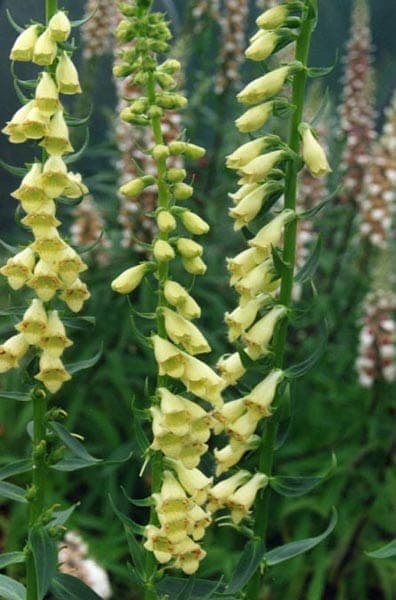
Ghislain118 (AD) http://www.fleurs-des-montagnes.net / CC BY-SA 3.0, via Wikimedia Commons
Digitalis viridiflora: complete guide
Digitalis viridiflora
Want to see Digitalis viridiflora: complete guide in your garden?
1 minute, no credit card
Overview
Digitalis viridiflora is a remarkable greenflowered foxglove from the Plantaginaceae family, representing a less-common alternative to red and purple foxglove varieties. Native to the Balkans (Albania, Bulgaria, Greece, Turkey-in-Europe, and former Yugoslavia), this biennial plant distinguishes itself through subtle, green-yellow flowers and refined elegance. It is a botanical curiosity that rewards patient gardeners with unexpected bloom sophistication.
Appearance and Bloom
Digitalis viridiflora grows as a biennial: first year forms a rosette of large, elliptical, deeply wrinkled leaves (dark green); second year produces slender flower stems 60-120 centimeters (24-48 inches) tall. Flowers are the defining feature: small, greenish-yellow tubular blooms (almost lime-green at opening) with subtle red-spotted markings inside the flower tube. Flowering occurs in June-July. Importantly, this plant is seed-bearing; complete bloom exhaustion leads to ripe seed capsules.
Ideal Location
Partial shade to full sun. Despite Balkan mountain origins, Digitalis viridiflora tolerates more shade than many Digitalis species. In warmer climates (south Netherlands, Belgium), 3-4 hours sun with afternoon shade is ideal. In cooler regions: full sun supports stronger growth. Avoid direct midday heat in southern gardens; morning sun and afternoon shade is superior to full midday sun.
Soil
Digitalis viridiflora requires moderately moist to moist, humus-rich soil. Unlike many alpine plants, drainage is less critical; slight waterlogging is tolerated. A mixture of garden soil with organic matter (40% compost, 60% garden soil) is ideal. Sand additions help in very heavy clay. pH: neutral to slightly acidic (pH 6.0-7.0) is preferred. Autumn leaf-mould amendments improve soil structure.
Watering
Regular moisture without excess. The plant grows best in soil that is consistently moderately moist (not waterlogged, not dry). In drier soils, additional water becomes necessary, especially in July-August as flower stems elongate. Two weeks without adequate water can limit blooming. In regions receiving less than 600mm annual rainfall: water monthly during growth and bloom. Drip irrigation or sub-irrigation prevents leaf-wetting that encourages mildew.
Free design
Want to see Digitalis viridiflora: complete guide in your garden? Make a free design now.
Pruning
Minimal pruning needed for annual growth (first year). In second-year bloom: allow main inflorescence to fully develop. After flowering: if seed is desired, allow seed capsules to mature and ripen. If seed is unwanted and continued plants are desired: cut flower stem after bloom, which sometimes triggers late-season re-bloom. With heavy self-seeding: remove seed capsules before they split open.
Maintenance Calendar
Autumn (Year 1): Sow seed or plant seedlings; hydrate thoroughly. Winter (Year 1): Minimal maintenance; rosettes overwinter outdoors (hardy to -15C). Spring (Year 2): Flower stem elongation begins. Water regularly. May (Year 2): Bloom imminent; ensure adequate moisture. June-July (Year 2): Peak bloom. Watering is critical. August (Year 2): Bloom diminishes. Seed ripening; reduce watering. Autumn (Year 2): Plant dies after seeding; replace with new generation.
Winter Hardiness
Digitalis viridiflora is hardy to approximately -18 degrees Celsius (0 Fahrenheit). First-year rosettes survive UK and northern European winters outdoors without protection. In very wet winters, rosettes can rot, especially on heavy clay. Well-draining raised beds prevent winter damage. In severely winter-wet regions: overwinter first-year rosettes in cold frames or provide deep afternoon shade.
Companion Plants
Pair with fellow shade-lovers: Heuchera, Hosta, Tiarella, Foamflower. For contrasting bloom: red Astilbe or pink Dicentra spectabilis. Let Digitalis viridiflora serve as backdrop in soft-coloured borders. Front layer: low, fast-growing groundcovers like Ajuga reptans or Lamium maculatum. Structural backdrop: Fatsia japonica or Mahonia bealei.
Closing Remarks
Digitalis viridiflora is a special choice for gardeners seeking classic foxglove effect with subtle, understated bloom colour. This is a plant demanding patience and regular attention, but rewarding conscientious gardeners with unexpected bloom sophistication. On GardenWorld.app, use this as an accent plant for semi-shade borders where moist soil and dappled light converge.
Where to Buy
Less commonly available than red foxglove varieties. Specialist seed merchants maintain seed stock; planting timing follows sowing. Some botanical gardens sell young plants in spring. Online European growers offer seed or plant material, though stock is seasonal (April-May for plants, year-round for seed).
Want to see Digitalis viridiflora: complete guide in your garden? Make a free design now.
Upload a photo, pick a style, and get a photorealistic design with plant list in under a minute.
No credit card required


Similar plants
White Beardtongue: complete guide
Penstemon albidus
Discover white beardtongue (Penstemon albidus) - elegant perennial with white to cream flowers. Drought-resistant, perfect for prairie and dry gardens.
Longsepal Beardtongue: complete guide
Penstemon calycosus
Discover longsepal beardtongue (Penstemon calycosus) - beautiful perennial with lilac-blue flowers. For partial shade and moist soil. Ideal for naturalized.
Penstemon cusickii: complete guide
Penstemon cusickii
Discover Cusick's beardtongue, a compact alpine flowering plant with violet-pink blooms. Perfect choice for rock gardens and water-wise landscaping.