
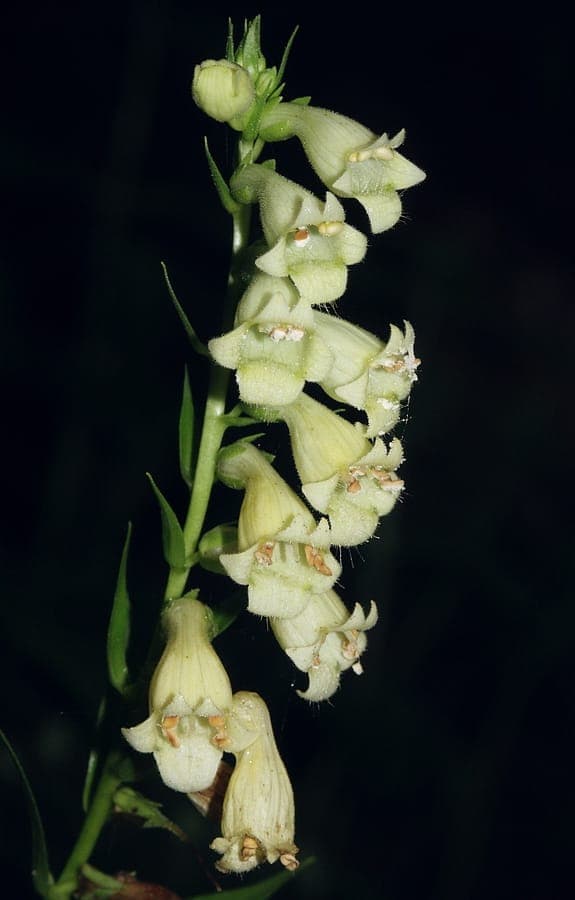
Bernd Haynold / CC BY 2.5, via Wikimedia Commons
Straw foxglove: complete guide
Digitalis lutea
Want to see Straw foxglove: complete guide in your garden?
1 minute, no credit card
Overview
Straw foxglove, or Digitalis lutea, is a quietly striking plant that deserves more attention in UK and North American gardens. Native to woodland edges and hilly regions across central Europe - from eastern France to northern Italy and Switzerland - this member of the Plantaginaceae family brings elegance without drama. Unlike its taller, flashier purple relatives, Digitalis lutea blooms in soft, creamy yellow, forming slender spires that rise 120 to 160 cm above a basal rosette of narrow, downy leaves.
It's a short-lived perennial, often behaving as a biennial, forming foliage in the first year and flowering in the second. Once established, it self-seeds gently, popping up in unexpected corners of the border or beneath shrubs, adding a sense of spontaneity. It's not invasive, but persistent enough to earn a loyal spot in a naturalistic planting scheme.
On gardenworld.app, you can design a border layout that showcases how straw foxglove fits among ferns, hostas, and hellebores for year-round interest.
Appearance & bloom cycle
Flowering runs from late June through August, depending on climate and microsite. The bells are pale yellow, sometimes with a greenish tinge, and measure about 2.5 cm long. They hang in loose, asymmetrical racemes along the upper half of the stem, swaying slightly in the breeze. Up close, you'll notice fine brown veining inside the throat - a subtle detail that draws in bees and hoverflies.
The foliage is lance-shaped, mid-green, and softly hairy. It forms a modest ground-level rosette that persists through the growing season and often into winter in milder zones. While the flower spike dies back after seeding, the basal leaves remain, offering texture and structure even when not in bloom.
Ideal location
Straw foxglove thrives in partial shade - think dappled light under deciduous trees, north-facing borders, or woodland clearings. Full sun is acceptable only if the soil stays reliably moist, but in hot, dry summers, leaves may scorch. Deep shade reduces flowering significantly. The sweet spot is morning sun with afternoon shade, or filtered light all day.
It's a natural fit for cottage gardens, wildflower meadows, or shaded perennial borders. Its height makes it ideal for mid- to back-of-border placement. Use it to add vertical rhythm without overwhelming smaller plants.
On gardenworld.app, you can test different planting combinations and light simulations to see how Digitalis lutea performs in your specific garden conditions.
Free design
Want to see Straw foxglove: complete guide in your garden? Make a free design now.
Soil requirements
This plant prefers moist, humus-rich, well-drained soil with a slightly acidic to neutral pH (5.5–7.0). It tolerates clay if it doesn't stay waterlogged, and sandy soils if amended with compost or leaf mould. Avoid dry, compacted, or chalky soils - they'll stunt growth and reduce flowering.
Mulch annually with well-rotted compost or leaf litter in autumn. This keeps roots cool, conserves moisture, and slowly feeds the plant. A 5–8 cm layer is sufficient.
Watering
Keep the soil consistently moist, especially during the first growing season and in summer droughts. Water deeply once or twice a week rather than frequent shallow sprinklings. Once established, it handles short dry spells, but prolonged drought leads to leaf drop and poor flowering.
Avoid wetting the foliage to prevent powdery mildew. Use soaker hoses or water at soil level.
Pruning
After flowering, cut back the spent spikes to the base if you want to prevent self-seeding. Alternatively, leave a few to scatter seed naturally - just be ready to thin out seedlings in spring. Never cut back the basal rosette; it supports next year's growth.
Dead or damaged leaves can be removed at any time with clean secateurs.
Maintenance calendar
- Jan: Check mulch layer; top up if needed.
- Feb: No action required.
- Mar: Remove any tattered leaves; prepare soil with compost.
- Apr: Watch for seedlings; thin if overcrowded.
- May: Water during dry spells; support emerging spikes if needed.
- Jun: Flowering begins; ensure consistent moisture.
- Jul: Deadhead spent blooms to encourage new growth.
- Aug: Allow some spikes to set seed for next year.
- Sep: Reduce watering unless drought persists.
- Oct: Apply mulch; protect root zone.
- Nov: Leave foliage intact; no pruning.
- Dec: Dormant period; minimal care.
Winter hardiness
Hardy in USDA zones 5–8 (-20°C to -10°C). In colder zones, a light mulch helps protect the crown. The plant may lose some leaves in winter but usually rebounds in spring. Wet, cold winters are riskier than cold alone - ensure good drainage to prevent crown rot.
Companion plants
Pair with hostas, brunnera, astilbe, ferns, or hellebores. The soft yellow flowers contrast beautifully with deep purple or white blooms. Avoid aggressive spreaders like mint or bamboo that could crowd it out.
Excellent for pollinator gardens - bumblebees love the nectar-rich flowers. Keep it away from heavy-footed plants that may shade it out, such as large ornamental grasses.
Closing
Straw foxglove is understated but unforgettable once it finds its place. It brings light, height, and late-spring-to-summer interest to shaded corners where other plants struggle. With minimal care and the right conditions, it becomes a quietly reliable presence. Look for plants at garden centres in spring or autumn, or try OBI and Hornbach in Europe. Avoid collecting from the wild - cultivated stock is readily available and more sustainable.
Want to see Straw foxglove: complete guide in your garden? Make a free design now.
Upload a photo, pick a style, and get a photorealistic design with plant list in under a minute.
No credit card required


Similar plants
White Beardtongue: complete guide
Penstemon albidus
Discover white beardtongue (Penstemon albidus) - elegant perennial with white to cream flowers. Drought-resistant, perfect for prairie and dry gardens.
Longsepal Beardtongue: complete guide
Penstemon calycosus
Discover longsepal beardtongue (Penstemon calycosus) - beautiful perennial with lilac-blue flowers. For partial shade and moist soil. Ideal for naturalized.
Penstemon cusickii: complete guide
Penstemon cusickii
Discover Cusick's beardtongue, a compact alpine flowering plant with violet-pink blooms. Perfect choice for rock gardens and water-wise landscaping.