
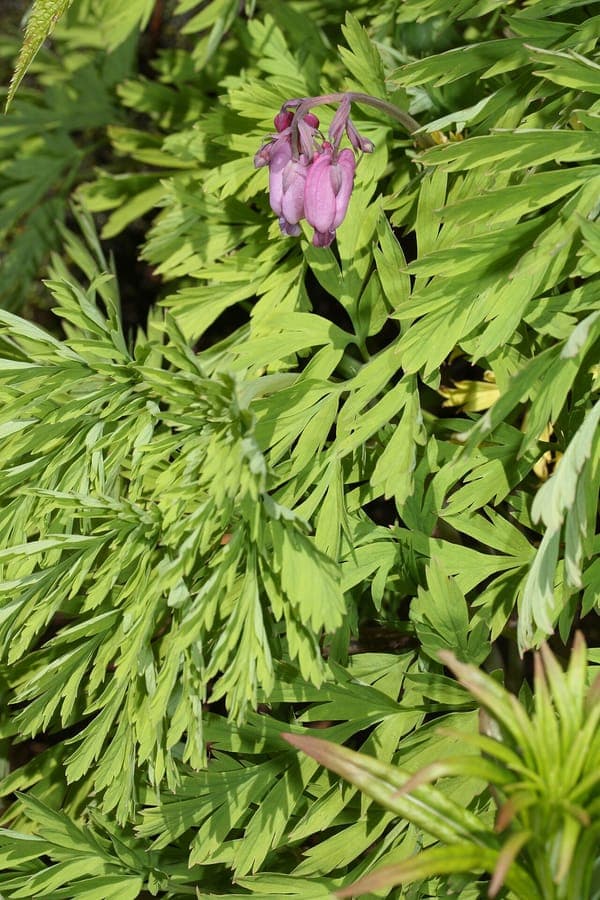
Walter Siegmund (talk) / CC BY-SA 3.0, via Wikimedia Commons
Bleeding-heart: complete guide
Dicentra formosa
Want to see Bleeding-heart: complete guide in your garden?
1 minute, no credit card
Overview
Dicentra formosa, commonly known as bleeding-heart, is a graceful perennial that brings delicate charm to shaded garden spots. Native to the Pacific Northwest - from British Columbia down to California - this herbaceous forb thrives in cool, moist environments with dappled light. It's a favorite among gardeners who appreciate subtle beauty and low-maintenance foliage. Hardy in USDA zones 6 to 9, it reliably returns each spring with fern-like foliage and dangling blooms.
Plant bleeding-heart in early spring, between March and May, when soil temperatures begin to rise but moisture is still abundant. Because it dies back after flowering, it's smart to plant it near companions that will fill the space later in the season. This prevents bare patches once the foliage fades.
On gardenworld.app, you can design a border layout that accounts for dieback timing and pairs Dicentra formosa with supportive plants for year-round appeal.
Appearance & bloom cycle
Bleeding-heart features soft, blue-green, finely divided leaves that resemble those of a fern. The foliage grows in mounds up to 45 cm tall and 30 cm wide, creating a lush, textured base. From late April through June, arching stems produce clusters of heart-shaped flowers in shades of pink to pale mauve, often with white tips. Each bloom is 2 to 2.5 cm long and hangs gracefully, swaying slightly in the breeze.
After blooming, the plant gradually yellows and dies back, especially in hotter, drier conditions. In consistently moist, cool sites, it may linger longer. While you can't extend the bloom period, planting near evergreen ground covers helps maintain visual interest.
Ideal location
Choose a spot with partial to full shade - think north-facing borders, under deciduous trees, or along woodland edges. Avoid hot afternoon sun, which scorches leaves and accelerates dieback. Morning sun with afternoon shade is ideal in cooler climates.
Space plants 30 to 40 cm apart to allow for air circulation and prevent fungal issues. Crowding increases humidity around the foliage, which can lead to mildew in wet summers.
Soil requirements
Bleeding-heart prefers rich, humusy soil that retains moisture but drains well. The pH should be slightly acidic to neutral, between 5.5 and 6.0. Before planting, amend the soil with compost or leaf mold to boost organic content.
Avoid heavy clay without amendment - it holds too much water and can rot the rhizomes. On sandy soil, mix in compost or coconut coir to improve water retention. A well-prepared bed makes all the difference.
Free design
Want to see Bleeding-heart: complete guide in your garden? Make a free design now.
Watering
This plant has moderate to high water needs. Keep the soil consistently moist, especially during spring growth and flowering. In dry spells, water deeply once or twice a week, aiming for the root zone rather than the foliage.
Use rainwater when possible, as Dicentra formosa is sensitive to high calcium levels in tap water. Overhead watering increases the risk of powdery mildew, so use a soaker hose or water at soil level.
Pruning
Pruning is minimal. Remove spent flower stems to tidy the plant, but it won't rebloom. Once the foliage yellows and collapses in mid to late summer, cut it back to the ground. This keeps the garden neat and reduces disease carryover.
Avoid cutting too early - the leaves are still photosynthesizing and feeding the roots for next year's growth.
Maintenance calendar
- January: check mulch layer; protect from freeze-thaw cycles
- February: monitor soil moisture; avoid waterlogging
- March: plant or divide clumps; apply compost
- April: increase watering; watch for slugs
- May: enjoy blooms; deadhead if desired
- June: maintain moisture; provide shade in heatwaves
- July: foliage may decline; cut back if unsightly
- August: clear dead foliage; avoid fertilizing
- September: replant or divide; improve soil
- October: mulch with leaf litter
- November: keep soil slightly moist
- December: leave undisturbed; protect with mulch in cold zones
Winter hardiness
Dicentra formosa is reliably hardy in USDA zones 6–9. In zone 6, apply a light mulch of compost or leaves in autumn to insulate the crown. Avoid piling mulch directly against the base to prevent rot.
In colder microclimates or exposed gardens, a layer of straw can help. The plant goes fully dormant in winter and re-emerges in spring from underground rhizomes.
Companion plants
Pair bleeding-heart with hostas, heucheras, hellebores, and astilbes for a layered, woodland look. These companions thrive in the same conditions and help mask the bare spots left after dieback. Ferns like Athyrium or Dryopteris add texture and longevity.
Avoid aggressive spreaders that might overwhelm its delicate roots. Also, slugs love the tender leaves - plant near slug-repellent herbs like mint or use organic deterrents.
On gardenworld.app, you can explore planting combinations that balance bloom times and foliage textures for a seamless garden flow.
Closing
Dicentra formosa isn't high-maintenance, but it does demand the right conditions: cool, moist soil and protection from hot sun. When happy, it delivers months of soft color and elegant form. Look for healthy plants at garden centres in spring, especially at trusted retailers like those found across the UK and North America. Once established, it becomes a quiet staple in the shade garden - subtle, reliable, and deeply enchanting.
Want to see Bleeding-heart: complete guide in your garden? Make a free design now.
Upload a photo, pick a style, and get a photorealistic design with plant list in under a minute.
No credit card required


Similar plants
Papaver gorodkovii: complete guide
Papaver gorodkovii
Papaver gorodkovii, the arctic poppy, thrives from Alaska to Russia's Far East. Discover how to grow this rare, extremely cold-hardy rock garden treasure.
Papaver setiferum: complete guide
Papaver setiferum
Papaver setiferum is a hardy giant Caucasian poppy with fiery red blooms. Discover siting, soil, deadheading and winter hardiness.
Pale Poppy: complete guide
Papaver alboroseum
Discover pale poppy (Papaver alboroseum) - rare alpine poppy with white-pink flowers. Precious beauty from Kamchatka. Cultivation in alpine and rock gardens.