
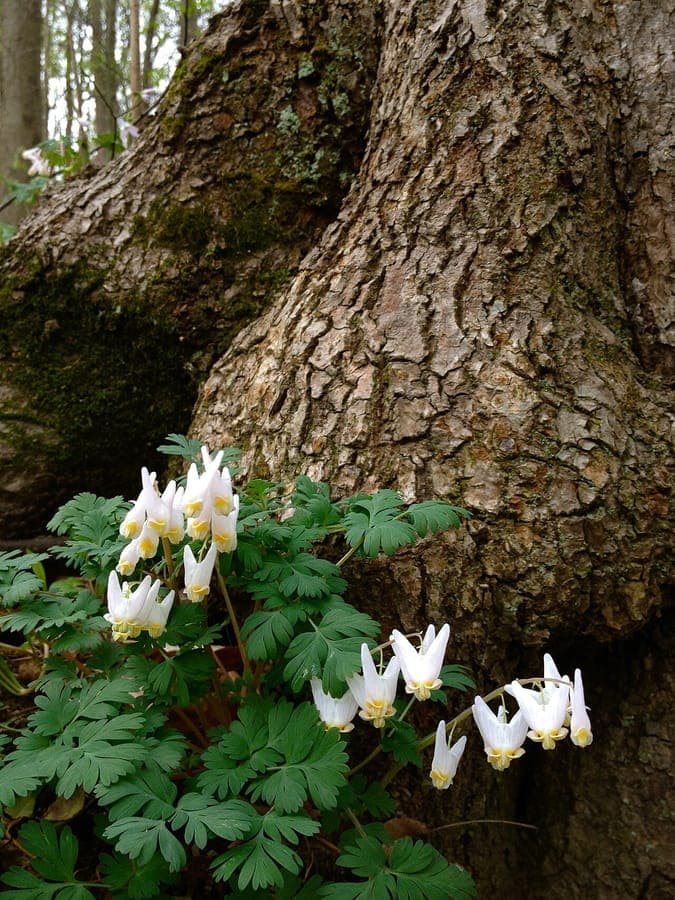
Fritzflohrreynolds / CC BY-SA 3.0, via Wikimedia Commons
Dutchman's-breeches: complete guide
Dicentra cucullaria
Want to see Dutchman's-breeches: complete guide in your garden?
1 minute, no credit card
Overview
Dicentra cucullaria, better known as Dutchman's-breeches or Soldier's cap, is a charming spring bloomer from the forests of North America. This delicate wildflower grows naturally from Canada to Florida, and from the Atlantic to the Great Lakes, especially in hardwood forests on moist soils. The plant owes its humorous English name to the shape of the flowers, which indeed resemble little breeches on a clothesline. This is a true shade-lover and a perfect choice for wooded front garden settings. An established clump can perform well for years with minimal maintenance.
Appearance and Bloom Time
Dutchman's-breeches reaches 20 to 30 centimeters height and has fluffy, finely divided leaves reminiscent of ferns. The flowers appear in April and May in dense clusters and are truly characteristic. Each flower consists of two white to very pale pink lobes that together form like a pair of underwear with yellow points at the ends. The flowers have a subtle, pleasant fragrance. After blooming, the leaves largely disappear, a phenomenon called "summer dormancy." This is completely normal and does not mean your plant is dead.
Ideal Growing Location
Dutchman's-breeches grows best in shady to half-shady locations under deciduous trees. The plant feels most at home in chilled, wooded surroundings. Avoid direct, strong afternoon sun, although some morning sun is welcome. Winter sun when leaves have fallen is no problem. In warm climates, shade is essential to avoid overheating. Ensure moisture but make sure water does not stagnate.
Soil Composition
The soil should be moisture-retentive but well-draining. A mixture of rich woodland soil, processed humus, leafmould, and some sand is ideal. A pH of 5.5 to 7.0 works well. The plant prefers dark, mineral-rich soils like you find in natural forest environment. Add organic matter when planting. In heavier clay soils, you can improve drainage with sand and perlite. Maintaining consistent moisture during the growing season is essential.
Free design
Want to see Dutchman's-breeches: complete guide in your garden? Make a free design now.
Watering
Watering must be consistent during the growing season (spring to early summer). Ensure the soil never completely dries out but also does not become waterlogged. Water about 1 to 2 times per week depending on rainfall. Use lukewarm water, preferably rainwater. Once the plant enters summer dormancy (usually June), watering can be significantly reduced. In fall and winter, little water is needed. However, ensure roots do not completely dry out.
Pruning
Pruning is truly minimal. Only remove dead flowers (deadheading) if you want to stimulate more side-branch growth. At the end of blooming, yellowed, dying leaves can be carefully removed. This helps prevent disease. Underground roots and rhizomes need rest during summer and should not be disturbed. Do not make quick interventions during the dormant period.
Maintenance Calendar
Winter/Early Spring (Jan-March): Monitoring. Ensure soil remains moist as growth begins. Spring (April-May): Peak bloom. Water well. Deadhead if desired. May-June: Leaves fade. Reduce watering gradually. Summer (July-Sept): Summer dormancy. Very low water. Fall (Oct-Nov): Preparation for winter. Light watering. Winter (Dec): Resting period.
Winter Hardiness
Dutchman's-breeches is very hardy in zones 3-9 (minus 35 to plus 30 degrees Celsius). This plant grows outdoors year-round in temperate and cold climates without further protection. In very cold zones (zone 2 and colder), some mulch protection can help but is usually not necessary. In warm zones (9-10), this plant prefers cooler, shaded locations and may have problems with hot summers. Winter frost is no problem.
Companion Plants
Dutchman's-breeches grows wonderfully in mixed woodland settings. Ideal companions are trillium species, other wildflowers, ferns such as Dryopteris and Polystichum, epimedium species, and liliaceae such as Maianthemum. Also combine with large hostas, astilbe, and moisture-loving woodland anemones. This composition creates a natural, unpolished woodland front garden. Ensure all those needing moist, humus-rich soil come together.
Conclusion
Dutchman's-breeches from gardenworld.app brings spring magic to your shaded front garden. With the right wooded environment, moist soil, and patience for the summer dormancy, you will enjoy this charming wildflower for years. Visit gardenworld.app for more inspiration for creating shaded wildflower gardens.
Want to see Dutchman's-breeches: complete guide in your garden? Make a free design now.
Upload a photo, pick a style, and get a photorealistic design with plant list in under a minute.
No credit card required


Similar plants
Papaver gorodkovii: complete guide
Papaver gorodkovii
Papaver gorodkovii, the arctic poppy, thrives from Alaska to Russia's Far East. Discover how to grow this rare, extremely cold-hardy rock garden treasure.
Papaver setiferum: complete guide
Papaver setiferum
Papaver setiferum is a hardy giant Caucasian poppy with fiery red blooms. Discover siting, soil, deadheading and winter hardiness.
Pale Poppy: complete guide
Papaver alboroseum
Discover pale poppy (Papaver alboroseum) - rare alpine poppy with white-pink flowers. Precious beauty from Kamchatka. Cultivation in alpine and rock gardens.