
Bernd Haynold / CC BY-SA 2.5, via Wikimedia Commons
Fringed pink: complete guide
Dianthus superbus
Want to see Fringed pink: complete guide in your garden?
1 minute, no credit card
Overview
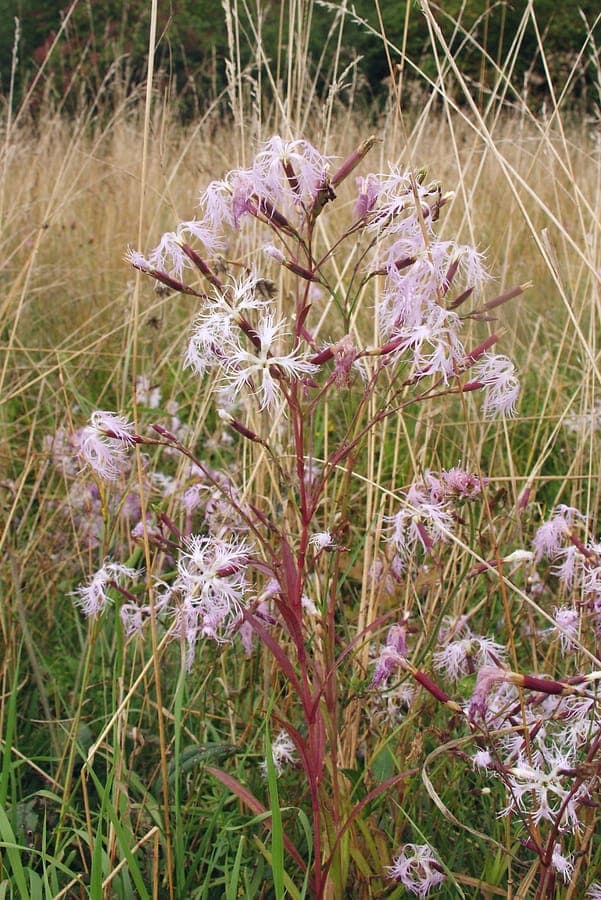
Dianthus superbus, commonly known as fringed pink, is a graceful perennial that brings elegance and scent to the summer garden. A member of the Caryophyllaceae family, it's native to parts of Europe and Asia, including the Baltic States, Central Europe, and northern China. Unlike many cultivated pinks that look stiff and formal, fringed pink has a wild, airy habit that suits cottage gardens, naturalistic plantings, and even damp meadow edges.
The plant grows 30 to 50 cm tall and forms loose clumps with narrow, grey-green leaves. It's herbaceous, dying back in winter and re-emerging in spring. Hardy to USDA zone 4, it thrives in temperate climates and is perfect for UK and North American gardens alike. If you're designing a relaxed border, this is one to consider.
On gardenworld.app, you can create a planting scheme that highlights the soft texture of fringed pink alongside taller grasses and late-summer bloomers.
Appearance & bloom cycle
The flowers are the real showstoppers - deep purple, 4 to 5 cm wide, with intricately fringed petals that give the plant its name. They bloom from June through September, peaking in July and August. Each flower sits atop a single stem, sometimes with a few side shoots. The scent is sweet, slightly spicy, and most noticeable in the evening.
Deadhead regularly to prolong blooming and prevent excessive self-seeding. If you want the plant to spread gently, let a few seed heads mature. The seeds drop in late autumn and may germinate the following spring.
Ideal location
Fringed pink prefers full sun to light shade. Aim for a light level of 7 out of 10, where 10 is full sun. In full sun, flowering is more abundant and stems stay upright. In partial shade, especially under light tree canopies, it still performs well but may need staking.
It's ideal for borders, rock gardens, and damp spots where other pinks might struggle. Avoid deep shade or heavy competition from tree roots. Zone 4 to 8 is ideal for its hardiness range.
Soil requirements
This dianthus likes well-drained but moisture-retentive soil with a pH between 7.5 and 8. It thrives in alkaline, chalky soils. If your soil is acidic, amend it with garden lime. Heavy clay soils need improvement with grit or coarse sand to prevent waterlogging.
Avoid peat-rich mixes - they're too acidic. Instead, mix in some crushed oyster shell or limestone grit to keep pH stable and improve drainage.
Free design
Want to see Fringed pink: complete guide in your garden? Make a free design now.
Watering
Keep the soil consistently moist during the growing season, especially in dry spells. Water when the top inch of soil feels dry. Established plants tolerate short dry periods, but young ones need regular hydration.
Never let the plant sit in soggy soil - root rot is a real risk. In winter, reduce watering, especially in cold, wet climates.
Pruning
After the first flush of flowers, cut back stems by one-third to encourage a second bloom. Remove spent blooms regularly to keep the plant tidy. In autumn, wait until foliage has died back completely, then trim stems to 5 cm above ground level.
This helps prevent fungal issues and gives space for fresh growth in spring.
Maintenance calendar
- Jan: Check for winter damage; remove any wet debris
- Feb: Clear fallen leaves; protect crowns if in wet soil
- Mar: Watch for new shoots; avoid disturbing soil
- Apr: Light feeding with balanced fertilizer; amend soil if needed
- May: Plant or divide established clumps; watch for slugs
- Jun: First blooms appear; water if dry
- Jul: Peak flowering; deadhead weekly
- Aug: Second bloom possible; cut back if leggy
- Sep: Allow seed heads or remove for control
- Oct: Let foliage die down naturally
- Nov: Cut back dead stems; mulch in heavy clay
- Dec: No action needed in zones 5–8
Winter hardiness
Fringed pink is hardy to USDA zone 4 (-34°C). It survives most UK and northern US winters without protection. The plant dies back to the ground and re-sprouts in spring. In areas with heavy winter rain, ensure good drainage to prevent crown rot.
Companion plants
Pair fringed pink with Echinacea, Salvia, or Persicaria for a long-lasting border. Grasses like Molinia or Deschampsia add movement and contrast. In damp areas, combine with Iris sibirica or Astilbe.
It also attracts pollinators - bees and butterflies love the nectar. Avoid overcrowding with aggressive spreaders like mint or goldenrod.
Use gardenworld.app to visualise a planting plan using fringed pink with complementary colours and textures.
Closing
Fringed pink isn't flashy, but it's unforgettable. Its delicate blooms, sweet scent, and natural growth habit make it a gem for informal gardens. Buy it from local garden centres in spring, plant it in alkaline soil, and enjoy its summer-long display. With a little care, it'll return year after year.
Want to see Fringed pink: complete guide in your garden? Make a free design now.
Upload a photo, pick a style, and get a photorealistic design with plant list in under a minute.
No credit card required


Similar plants
Dianthus karami: complete guide
Dianthus karami
Dianthus karami is a rare Lebanese mountain pink with fringed pink blooms on limestone cliffs, ideal for rock gardens and troughs.
Sicilian pink: complete guide
Dianthus siculus
Discover Dianthus siculus, an elegant purple bloomer from Sicily. Cultivation, June-September flowering and garden combinations.
Alpine mouse-ear chickweed: complete guide
Cerastium pedunculatum
Full growing guide for Cerastium pedunculatum: ideal location, soil, watering, winter hardiness, and companion plants for rock gardens.