
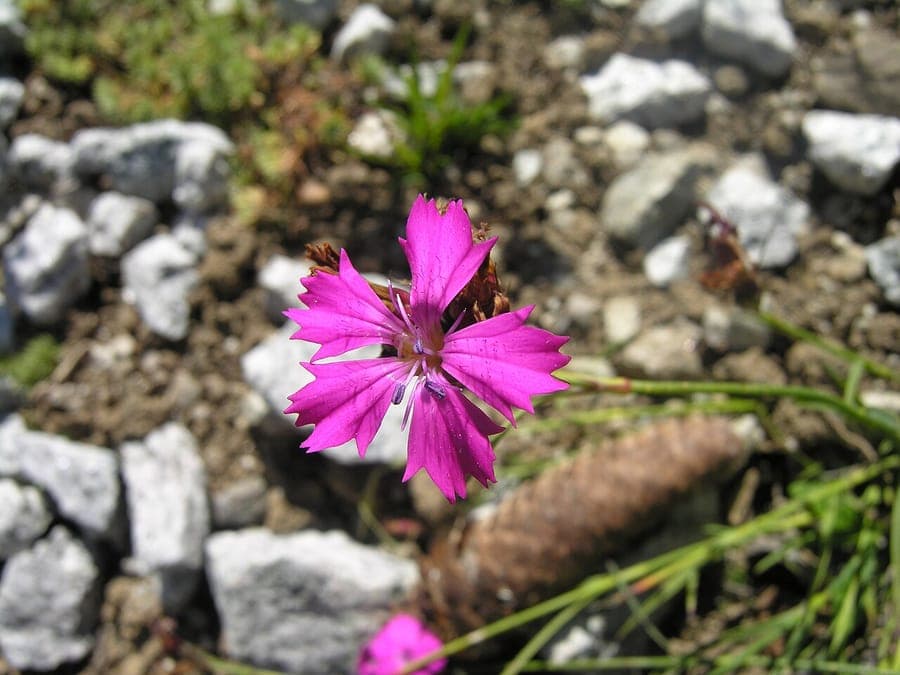
Audrius Meskauskas (Audriusa) / CC BY-SA 3.0, via Wikimedia Commons
Carthusian pink: complete guide
Dianthus carthusianorum
Want to see Carthusian pink: complete guide in your garden?
1 minute, no credit card
Overview
Carthusian pink (Dianthus carthusianorum) is a compact, herbaceous perennial that brings bold colour to dry, sunny spots from early summer through late August. Native to central and southeastern Europe-from Austria to Bulgaria-this member of the Caryophyllaceae family is perfectly adapted to limestone soils and hot, dry conditions. It's not the flashy, double-flowered dianthus you see in cottage gardens; instead, it has a wild, natural charm that suits modern, low-input gardens.
Growing 20–30 cm tall with a spread of about 30 cm, Carthusian pink forms tight clumps of blue-green foliage topped with clusters of deep pink to magenta blooms. It's fully hardy to USDA zone 4 (-34°C), so it handles cold winters without protection. Once established, it needs almost no watering and thrives where other plants struggle.
On gardenworld.app, you can design a drought-resistant planting scheme that highlights Carthusian pink alongside complementary textures and colours.
Appearance & bloom cycle
The flowers are about 2.5 cm across, with five pointed, fringed petals in a rich, saturated pink. Unlike many garden pinks, they're not double, but their open form makes them highly accessible to pollinators. Blooming starts in June and continues through August, with occasional rebloom in September if you deadhead spent flowers.
The narrow, grey-green leaves grow in opposite pairs along upright stems, forming a tidy mound. The plant has a clean, architectural look that works well in structured designs. A light spicy fragrance emerges on warm afternoons, adding another sensory layer to sunny borders.
Ideal location
Carthusian pink demands full sun-aim for 8 hours or more daily. It scores an 8/10 on the light scale and will flop or fail to bloom in partial shade. Best locations include gravel gardens, rock walls, raised beds with sharp drainage, or the front of hot, south-facing borders.
Avoid exposed, windy sites where drying gusts can stress the foliage. If your garden is breezy, tuck it behind low shrubs or grasses like Stipa tenuissima, which provide light windbreaks without shading it.
Soil requirements
This plant thrives in lean, well-drained soil with a pH between 7.0 and 7.5. It prefers alkaline or neutral conditions and grows naturally on limestone scree. Heavy clay or acid soils are problematic-especially if they stay wet in winter.
If your soil is dense, amend the planting hole with sharp sand or fine gravel to improve drainage. Don't add compost or manure-rich soil leads to leggy growth and fewer flowers. A little garden grit mixed into the top 15 cm makes all the difference.
Free design
Want to see Carthusian pink: complete guide in your garden? Make a free design now.
Watering
Once established (after the first growing season), Carthusian pink rarely needs supplemental water. It's exceptionally drought-tolerant. During prolonged dry spells-over three weeks without rain-you can water deeply once a week, but avoid frequent shallow watering.
Always water at the base to keep foliage dry. Wet leaves in humid summers can encourage fungal issues like powdery mildew. Drip irrigation or a watering can aimed at the root zone works best.
Pruning
Deadhead regularly from June to August to encourage a second flush of flowers. Cut spent stems back to a leaf node using clean snips. Don't cut the whole plant back mid-season-just remove faded blooms.
In late winter or early spring (around March), cut all old growth down to 5 cm above ground level. This clears space for fresh shoots and reduces disease risk. Leave the plant intact over winter-its dried stems shelter beneficial insects and add winter texture.
Maintenance calendar
- March: Cut back old stems. Check for pests.
- April: No feeding. Water only if spring is unusually dry.
- May: Watch for new growth. Hand-weed around base.
- June–August: Peak bloom. Deadhead weekly.
- September: Allow late blooms to set seed if desired. Leave stems standing.
- October–February: Leave undisturbed. No water or fertiliser.
Winter hardiness
Carthusian pink is fully winter-hardy in USDA zones 4 to 8. It dies back to a low, evergreen basal rosette in winter. As long as the soil drains well, it tolerates freezing temperatures and snow cover.
The main threat is winter wetness, not cold. Avoid planting in hollows or low spots where water collects. A top dressing of gravel (1–2 cm) around the crown helps shed moisture and prevents rot.
Companion plants
Pair Carthusian pink with other sun-loving, drought-tolerant species:
- Sedum 'Herbstfreude' – for late-season structure
- Nepeta racemosa – for soft blue contrast
- Eryngium planum – for spiky texture
- Thymus vulgaris – as a fragrant ground cover
Avoid moisture-loving plants like Astilbe or ferns-they demand opposite conditions and will outcompete or stress your dianthus.
Use the planting planner on gardenworld.app to visualise combinations that bloom in sequence and share the same cultural needs.
Closing
Carthusian pink is a no-fuss, high-impact perennial that earns its place in any sunny border. It asks for little-full sun, sharp drainage, no rich soil-and gives back months of vibrant colour and pollinator activity.
You'll find it at garden centres across the UK, often labelled by its botanical name. Look for healthy, compact plants in spring. Avoid those with yellowed leaves or mushy stems.
Plant with space to spread, keep the crown dry, and enjoy a resilient, beautiful addition to your garden year after year.
Want to see Carthusian pink: complete guide in your garden? Make a free design now.
Upload a photo, pick a style, and get a photorealistic design with plant list in under a minute.
No credit card required


Similar plants
Dianthus karami: complete guide
Dianthus karami
Dianthus karami is a rare Lebanese mountain pink with fringed pink blooms on limestone cliffs, ideal for rock gardens and troughs.
Sicilian pink: complete guide
Dianthus siculus
Discover Dianthus siculus, an elegant purple bloomer from Sicily. Cultivation, June-September flowering and garden combinations.
Alpine mouse-ear chickweed: complete guide
Cerastium pedunculatum
Full growing guide for Cerastium pedunculatum: ideal location, soil, watering, winter hardiness, and companion plants for rock gardens.